Magna Concursos

Foram encontradas 155 questões.

790265 Ano: 2015
Disciplina: Inglês (Língua Inglesa)
Banca: NUCEPE
Orgão: Pref. Parnaíba-PI
The New Atomic Age We Need
This past summer, the Group of 7 nations promised “urgent and concrete action” to limit climate change. What actions exactly? Activists hope for answers from the coming United Nations climate conference in Paris, which begins Monday. They should look instead to Washington today.
The single most important action we can take is thawing a nuclear energy policy that keeps our technology frozen in time. If we are serious about replacing fossil fuels, we are going to need nuclear power, so the choice is stark: We can keep on merely talking about a carbon-free world, or we can go ahead and create one.
We already know that today’s energy sources cannot sustain a future we want to live in. This is most obvious in poor countries, where billions dream of living like Americans. The easiest way to satisfy this demand for a better life has been to burn more coal: In the past decade alone, China added more coal-burning capacity than America has ever had. But even though average Indians and Chinese use less than 30 percent as much electricity as Americans, the air they breathe is far worse. They deserve a third option besides dire poverty or dirty skies.
In America, the left worries more about our five billion metric tons of annual carbon dioxide emissions and what it might do to Earth’s climate. On the right, even those who discount the environmental effects of fossil fuels can’t deny their contribution to economic volatility. We saw this in 2008 when a historic high oil price coincided with a historic financial crisis.
The need for energy alternatives was already clear to investors a decade ago, which is why they poured funding into clean technology during the early 2000s. But while the money was there, the technology wasn’t: The result was a series of bankruptcies and the scandal of Solyndra, the solar panel manufacturer in California that went bankrupt in 2011 after receiving a federal guarantee of hundreds of millions of dollars. Wind and solar together provide less than 2 percent of the world’s energy, and they aren’t growing anywhere near fast enough to replace fossil fuels.
What’s especially strange about the failed push for renewables is that we already had a practical plan back in the 1960s to become fully carbon-free without any need of wind or solar: nuclear power. But after years of cost overruns, technical challenges and the bizarre coincidence of an accident at Three Mile Island and the 1979 release of the Hollywood horror movie “The ChinaSyndrome,” about a hundred proposed reactors were canceled. If we had kept building, our power grid could have been carbon-free years ago.
Instead, we went in reverse. In 1984, Ohio’s nearly finished William H. Zimmer nuclear plant was abruptly converted into a coal-burning facility: a microcosm of the country’s lurch back toward carbon.
The 2011 Fukushima disaster seemed at first to confirm old fears: Nearly 16,000 people were killed by the Tohoku earthquake and tsunami. But nobody in Japan died from radiation, and in 2013 United Nations researchers predicted that “no discernible increased incidence of radiation-related health effects are expected.”
Critics often point to the Chernobyl accident in the Soviet Union as an even more terrifying warning against nuclear power, but that accident was a direct result of both a faulty design and the operators’ incompetence. Fewer than 50 people were reported to have died at Chernobyl; by contrast, the American Lung Association estimates that smoke from coal-fired power plants kills about 13,000 people every year.
Only recently has climate anxiety challenged nuclear fear. Just as the impact of coal smoke dwarfs the effects of radiation from Fukushima, global warming is predicted to be far worse than mere pollution. The problem is so big that some prominent environmentalists have already declared defeat.
But not everyone has been paralyzed. While politicians prepare a grand bargain on emissions limits that future politicians are unlikely to obey, a new generation of American nuclear scientists has produced designs for better reactors. Crucially, these new designs may finally overcome the most fundamental obstacle to the success of nuclear power: high cost. Designs using molten salt, alternative fuels and small modular reactors have all attracted interest not just from academics but also from entrepreneurs and venture capitalists like me ready to put money behind nuclear power.
However, none of these new designs can benefit the real world without a path to regulatory approval, and today’s regulations are tailored for traditional reactors, making it almost impossible to commercialize new ones.
Fortunately, we have solved this problem before. In 1949 the federal government built a test facility at Idaho National Laboratory to study and evaluate new nuclear reactor designs. We owe our nuclear power industry to the foresight of those New Dealers, and we need their openness to innovation again today.
Earlier this year, the House of Representatives passed a bill calling for reform of our national laboratories; recently, the White House hosted a summit meeting to support nuclear energy. However, now that the speeches are over, we still lack a plan to fund and prototype the new reactors that we badly need.
Both the right’s fear of government and the left’s fear of technology have jointly stunted our nuclear energy policy, but on this issue, liberals hold the balance of power. Speaking about climate change in 2013, President Obama said that our grandchildren will ask whether we did “all that we could when we had the chance to deal with this problem.”
So far, the answer would have to be no — unless he seizes this moment. Supporting nuclear power with more than words is the litmus test for seriousness about climate change. Like Nixon’s going to China, this is something only Mr. Obama can do. If this president clears the path for a new atomic age, American scientists are ready to build it.
Source: Peter Thiel, The New York Times, november 2015

De acordo com as ideias do texto é CORRETO afirmar que:
 

Provas

Questão presente nas seguintes provas
790243 Ano: 2015
Disciplina: Direito Educacional e Tecnológico
Banca: NUCEPE
Orgão: Pref. Parnaíba-PI
Tratando sobre qualidade da educação, as Diretrizes Curriculares Nacionais Gerais para a Educação Básica, citam a Organização das Nações Unidas para a Educação, a Ciência e a Cultura (UNESCO), que expressa o entendimento que a qualidade da educação é também uma questão de direitos humanos. Além da eficácia e da eficiência, a educação de qualidade, deve ser antes de tudo relevante, pertinente e equitativa. A relevância reporta-se à promoção de aprendizagens significativas do ponto de vista das exigências sociais e de desenvolvimento pessoal. A pertinência refere-se à possibilidade de atender às necessidades e às características dos estudantes de diversos contextos sociais e culturais e com diferentes capacidades e interesses. E a equidade, refere-se à
 

Provas

Questão presente nas seguintes provas
790223 Ano: 2015
Disciplina: Geografia
Banca: NUCEPE
Orgão: Pref. Parnaíba-PI
As paisagens expressam um conjunto de elementos naturais e fatores a elas associadas. Sobre as paisagens no mundo é INCORRETO afirmar.
 

Provas

Questão presente nas seguintes provas
790212 Ano: 2015
Disciplina: Matemática
Banca: NUCEPE
Orgão: Pref. Parnaíba-PI
O valor exato !$ 88888^2 - 11112^2 !$ de é
 

Provas

Questão presente nas seguintes provas
790054 Ano: 2015
Disciplina: Biologia
Banca: NUCEPE
Orgão: Pref. Parnaíba-PI
Acidentes por animais peçonhentos são aqueles provocados por picadas ou mordeduras de animais dotados de glândulas secretoras e aparelhos inoculadores de veneno.Vários são os sinais e sintomas percebidos, como dor e inchaço, pulso rápido com respiração difícil, fraqueza, dificuldade visual, náusea e vômitos.
Entre as medidas recomendadas quando uma pessoa é picada por um animal peçonhento, citam-se manter a vítima calma e deitada, localizar a marca da mordedura e limpar o local com água e sabão, cobrir com um pano limpo.
É também correto e imprescindível a seguinte ação:
 

Provas

Questão presente nas seguintes provas
790045 Ano: 2015
Disciplina: Inglês (Língua Inglesa)
Banca: NUCEPE
Orgão: Pref. Parnaíba-PI
The New Atomic Age We Need
This past summer, the Group of 7 nations promised “urgent and concrete action” to limit climate change. What actions exactly? Activists hope for answers from the coming United Nations climate conference in Paris, which begins Monday. They should look instead to Washington today.
The single most important action we can take is thawing a nuclear energy policy that keeps our technology frozen in time. If we are serious about replacing fossil fuels, we are going to need nuclear power, so the choice is stark: We can keep on merely talking about a carbon-free world, or we can go ahead and create one.
We already know that today’s energy sources cannot sustain a future we want to live in. This is most obvious in poor countries, where billions dream of living like Americans. The easiest way to satisfy this demand for a better life has been to burn more coal: In the past decade alone, China added more coal-burning capacity than America has ever had. But even though average Indians and Chinese use less than 30 percent as much electricity as Americans, the air they breathe is far worse. They deserve a third option besides dire poverty or dirty skies.
In America, the left worries more about our five billion metric tons of annual carbon dioxide emissions and what it might do to Earth’s climate. On the right, even those who discount the environmental effects of fossil fuels can’t deny their contribution to economic volatility. We saw this in 2008 when a historic high oil price coincided with a historic financial crisis.
The need for energy alternatives was already clear to investors a decade ago, which is why they poured funding into clean technology during the early 2000s. But while the money was there, the technology wasn’t: The result was a series of bankruptcies and the scandal of Solyndra, the solar panel manufacturer in California that went bankrupt in 2011 after receiving a federal guarantee of hundreds of millions of dollars. Wind and solar together provide less than 2 percent of the world’s energy, and they aren’t growing anywhere near fast enough to replace fossil fuels.
What’s especially strange about the failed push for renewables is that we already had a practical plan back in the 1960s to become fully carbon-free without any need of wind or solar: nuclear power. But after years of cost overruns, technical challenges and the bizarre coincidence of an accident at Three Mile Island and the 1979 release of the Hollywood horror movie “The ChinaSyndrome,” about a hundred proposed reactors were canceled. If we had kept building, our power grid could have been carbon-free years ago.
Instead, we went in reverse. In 1984, Ohio’s nearly finished William H. Zimmer nuclear plant was abruptly converted into a coal-burning facility: a microcosm of the country’s lurch back toward carbon.
The 2011 Fukushima disaster seemed at first to confirm old fears: Nearly 16,000 people were killed by the Tohoku earthquake and tsunami. But nobody in Japan died from radiation, and in 2013 United Nations researchers predicted that “no discernible increased incidence of radiation-related health effects are expected.”
Critics often point to the Chernobyl accident in the Soviet Union as an even more terrifying warning against nuclear power, but that accident was a direct result of both a faulty design and the operators’ incompetence. Fewer than 50 people were reported to have died at Chernobyl; by contrast, the American Lung Association estimates that smoke from coal-fired power plants kills about 13,000 people every year.
Only recently has climate anxiety challenged nuclear fear. Just as the impact of coal smoke dwarfs the effects of radiation from Fukushima, global warming is predicted to be far worse than mere pollution. The problem is so big that some prominent environmentalists have already declared defeat.
But not everyone has been paralyzed. While politicians prepare a grand bargain on emissions limits that future politicians are unlikely to obey, a new generation of American nuclear scientists has produced designs for better reactors. Crucially, these new designs may finally overcome the most fundamental obstacle to the success of nuclear power: high cost. Designs using molten salt, alternative fuels and small modular reactors have all attracted interest not just from academics but also from entrepreneurs and venture capitalists like me ready to put money behind nuclear power.
However, none of these new designs can benefit the real world without a path to regulatory approval, and today’s regulations are tailored for traditional reactors, making it almost impossible to commercialize new ones.
Fortunately, we have solved this problem before. In 1949 the federal government built a test facility at Idaho National Laboratory to study and evaluate new nuclear reactor designs. We owe our nuclear power industry to the foresight of those New Dealers, and we need their openness to innovation again today.
Earlier this year, the House of Representatives passed a bill calling for reform of our national laboratories; recently, the White House hosted a summit meeting to support nuclear energy. However, now that the speeches are over, we still lack a plan to fund and prototype the new reactors that we badly need.
Both the right’s fear of government and the left’s fear of technology have jointly stunted our nuclear energy policy, but on this issue, liberals hold the balance of power. Speaking about climate change in 2013, President Obama said that our grandchildren will ask whether we did “all that we could when we had the chance to deal with this problem.”
So far, the answer would have to be no — unless he seizes this moment. Supporting nuclear power with more than words is the litmus test for seriousness about climate change. Like Nixon’s going to China, this is something only Mr. Obama can do. If this president clears the path for a new atomic age, American scientists are ready to build it.
Source: Peter Thiel, The New York Times, november 2015
De acordo com a leitura, pode-se depreender que esse texto é melhor entendido em termos de construção textual da seguinte forma:
 

Provas

Questão presente nas seguintes provas
790033 Ano: 2015
Disciplina: Pedagogia
Banca: NUCEPE
Orgão: Pref. Parnaíba-PI
Analise as assertivas I e II, que tratam do comportamento operante, na visão de Skinner. Em cada uma, há uma lacuna que deverá ser preenchida com palavras ou termos constantes das alternativas da questão.
I. Trata-se de ___________________quando o aluno passa a estudar mais como forma de evitar a reclamação da mãe pelas notas baixas.
II. Trata-se de ____________________ quando o adolescente começa a preferir ser mais disciplinado em sala de aula porque está percebendo que passou a ser mais aceito entre os colegas.
As lacunas das assertivas acima são CORRETAMENTE preenchidas, na sequência I e II, com o conteúdo da alternativa
 

Provas

Questão presente nas seguintes provas
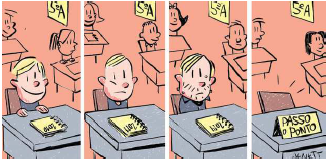
Leia o quadrinho a seguir
Enunciado 789934-1
O quadrinho acima faz referência a uma questão que afeta duramente a qualidade do ensino brasileiro. Fala-se de
 

Provas

Questão presente nas seguintes provas
787231 Ano: 2015
Disciplina: Matemática
Banca: NUCEPE
Orgão: Pref. Parnaíba-PI
Dispõe-se de um fio de !$ 36\,cm !$ de comprimento que deve ser dividido em dois pedaços e os pedaços utilizados para formarem o contorno de um quadrado e o de um triângulo equilátero. Se a divisão do fio deve ser tal que a soma das áreas do triângulo equilátero e do quadrado seja a menor possível, então a medida do lado do quadrado em !$ cm !$ é igual:
 

Provas

Questão presente nas seguintes provas
776290 Ano: 2015
Disciplina: Português
Banca: NUCEPE
Orgão: Pref. Parnaíba-PI

EDUCAÇÃO INFANTIL E LINGUAGEM ESCRITA: DUPLA SEM POLÊMICA

A Educação Infantil vem se legitimando nas últimas décadas como uma importante etapa da Educação Básica. Atualmente, 84,9% das crianças com 4 e 5 anos do País estão na Pré-escola. Em 2016, de acordo com a meta do Plano Nacional de Educação, ela será obrigatória para todas as crianças dessa faixa etária. O avanço, no entanto, só será completo quando, além do acesso à escola, for garantida uma Educação de qualidade a essas crianças, adequada à etapa de desenvolvimento em que estão, conhecida como a idade dos "porquês".

As crianças de 4 e 5 anos pensam e exploram o mundo com a curiosidade e o interesse de quem ainda não sabe a diferença entre aprender, jogar e imaginar. Por isso, é fundamental que o professor designado a trabalhar com essa faixa etária tenha ciência de seu papel e não subestime essa demanda. Ele precisa tornar-se um interlocutor atento e responsável por ampliar o universo cultural das crianças, respeitando a forma própria de ser e de pensar que as caracteriza. Um exemplo desse desafio está no acesso ao universo da escrita, que gera conflitos na identidade da Educação Infantil.

(...)

( Scarpa, R. Anuário Brasileiro de Educação Básica. S.

Paulo: Ed. Moderna. Educação Infantil. Os Números da Educação Básica, 2015 - p. 26.)

As ideias apresentadas no texto sugerem que


Provas

Questão presente nas seguintes provas