Foram encontradas 60 questões.
Em um grande departamento da universidade, 4 servidores
trabalham 6 horas por dia para suprir as demandas desse
setor. Avalia-se a junção de dois departamentos bastante
semelhantes, estimando-se que a quantidade de demandas
deve dobrar. Supondo que isso de fato ocorra e também a
proporcionalidade dessas variáveis, assumindo que todos os
funcionários passem a trabalhar 8 horas por dia, quantos
servidores precisariam ser alocados nesse novo setor com
essa junção?
Provas
Questão presente nas seguintes provas

Um entregador precisa realizar 21 entregas em casas
distribuídas uniformemente numa reta. Sabe-se que:
• a distância do local de abastecimento até a casa mais próxima é de 40m;
• a distância entre cada uma das casas é de 10m;
• ele realiza a entrega em 3 casas consecutivas da mais próxima para a mais distante a cada retorno ao posto de abastecimento.
Partindo do ponto de abastecimento e retornando ao mesmo ponto, qual a distância total percorrida após todas as entregas?
• a distância do local de abastecimento até a casa mais próxima é de 40m;
• a distância entre cada uma das casas é de 10m;
• ele realiza a entrega em 3 casas consecutivas da mais próxima para a mais distante a cada retorno ao posto de abastecimento.
Partindo do ponto de abastecimento e retornando ao mesmo ponto, qual a distância total percorrida após todas as entregas?
Provas
Questão presente nas seguintes provas
Um triângulo isósceles possui o número correspondente ao
seu perímetro igual ao que representa sua área. Com base
nessa informação, pode-se afirmar que o lado desse triângulo
é igual a:
Provas
Questão presente nas seguintes provas
Uma reportagem do jornal da USP de dezembro de 2025
destaca dados do anuário da universidade, dentre os quais
destaca-se, no quadro a seguir, a distribuição por gênero das
categorias de distribuição da população da universidade no
ano de 2023.
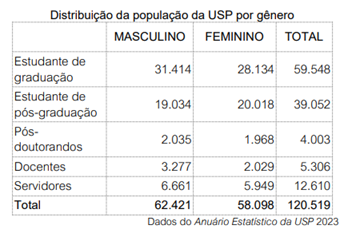
Com base nessas informações, pode-se afirmar que, em 2023,
Com base nessas informações, pode-se afirmar que, em 2023,
Provas
Questão presente nas seguintes provas
Um modelo aproximado mostra que a quantidade de dados
armazenada num sistema interno da universidade dobra a
cada mês. Sabe-se que esse sistema funciona relativamente
bem até atingir pouco mais da metade de sua capacidade que
está prevista para se exaurir em dezembro de 2034. Segundo
esse modelo, o sistema poderá ser utilizado sem maiores
problemas até
Provas
Questão presente nas seguintes provas
Texto para questão
How do we measure attention?
Attention, broadly defined, is the ability to direct the
mind on a specific task, says Gloria Mark, author of Attention
Span: A Groundbreaking Way to Restore Balance, Happiness
and Productivity. There are two main types of attention, Mark
explains. Involuntary attention is automatic—it’s what allows us
to react to a loud noise or a jarringly bright light. Focalized
attention, by contrast, is the ability to concentrate on a specific
task. This latter type is what scientists measure when
researching attention spans.
Since the early 2000s, Mark has tracked focalized
attention by observing how long people remain on a task
before switching to something else—such as checking email
or opening a new browser tab. At first, Mark used in-person
observations— researchers shadowed employees throughout
the office. In recent years, she has tracked attention spans
using software that monitors people’s computers.
“Data from our first study, in 2003, revealed that people
spent an average of 2.5 minutes on something before turning
their attention to a different task,” she says, “Our most recent
study done over the past five years shows that the figure has
gone down to 40 seconds.” The measure doesn’t capture how
long people can focus under ideal conditions, Mark notes,
meaning shorter attention spans don’t reflect a permanent loss
of attention capacity, but changes in how often people break
their focus in daily life.
National Geographic. Jan 21, 2026. Adaptado.
Provas
Questão presente nas seguintes provas
- Vocabulário | Vocabulary
- Gramática - Língua InglesaAdvérbios e conjunções | Adverbs and conjunctions
Texto para questão
How do we measure attention?
Attention, broadly defined, is the ability to direct the
mind on a specific task, says Gloria Mark, author of Attention
Span: A Groundbreaking Way to Restore Balance, Happiness
and Productivity. There are two main types of attention, Mark
explains. Involuntary attention is automatic—it’s what allows us
to react to a loud noise or a jarringly bright light. Focalized
attention, by contrast, is the ability to concentrate on a specific
task. This latter type is what scientists measure when
researching attention spans.
Since the early 2000s, Mark has tracked focalized
attention by observing how long people remain on a task
before switching to something else—such as checking email
or opening a new browser tab. At first, Mark used in-person
observations— researchers shadowed employees throughout
the office. In recent years, she has tracked attention spans
using software that monitors people’s computers.
“Data from our first study, in 2003, revealed that people
spent an average of 2.5 minutes on something before turning
their attention to a different task,” she says, “Our most recent
study done over the past five years shows that the figure has
gone down to 40 seconds.” The measure doesn’t capture how
long people can focus under ideal conditions, Mark notes,
meaning shorter attention spans don’t reflect a permanent loss
of attention capacity, but changes in how often people break
their focus in daily life.
National Geographic. Jan 21, 2026. Adaptado.
Provas
Questão presente nas seguintes provas
Texto para questão
How do we measure attention?
Attention, broadly defined, is the ability to direct the
mind on a specific task, says Gloria Mark, author of Attention
Span: A Groundbreaking Way to Restore Balance, Happiness
and Productivity. There are two main types of attention, Mark
explains. Involuntary attention is automatic—it’s what allows us
to react to a loud noise or a jarringly bright light. Focalized
attention, by contrast, is the ability to concentrate on a specific
task. This latter type is what scientists measure when
researching attention spans.
Since the early 2000s, Mark has tracked focalized
attention by observing how long people remain on a task
before switching to something else—such as checking email
or opening a new browser tab. At first, Mark used in-person
observations— researchers shadowed employees throughout
the office. In recent years, she has tracked attention spans
using software that monitors people’s computers.
“Data from our first study, in 2003, revealed that people
spent an average of 2.5 minutes on something before turning
their attention to a different task,” she says, “Our most recent
study done over the past five years shows that the figure has
gone down to 40 seconds.” The measure doesn’t capture how
long people can focus under ideal conditions, Mark notes,
meaning shorter attention spans don’t reflect a permanent loss
of attention capacity, but changes in how often people break
their focus in daily life.
National Geographic. Jan 21, 2026. Adaptado.
Provas
Questão presente nas seguintes provas
Texto para questão
How do we measure attention?
Attention, broadly defined, is the ability to direct the
mind on a specific task, says Gloria Mark, author of Attention
Span: A Groundbreaking Way to Restore Balance, Happiness
and Productivity. There are two main types of attention, Mark
explains. Involuntary attention is automatic—it’s what allows us
to react to a loud noise or a jarringly bright light. Focalized
attention, by contrast, is the ability to concentrate on a specific
task. This latter type is what scientists measure when
researching attention spans.
Since the early 2000s, Mark has tracked focalized
attention by observing how long people remain on a task
before switching to something else—such as checking email
or opening a new browser tab. At first, Mark used in-person
observations— researchers shadowed employees throughout
the office. In recent years, she has tracked attention spans
using software that monitors people’s computers.
“Data from our first study, in 2003, revealed that people
spent an average of 2.5 minutes on something before turning
their attention to a different task,” she says, “Our most recent
study done over the past five years shows that the figure has
gone down to 40 seconds.” The measure doesn’t capture how
long people can focus under ideal conditions, Mark notes,
meaning shorter attention spans don’t reflect a permanent loss
of attention capacity, but changes in how often people break
their focus in daily life.
National Geographic. Jan 21, 2026. Adaptado.
Provas
Questão presente nas seguintes provas
Texto para questão
How do we measure attention?
Attention, broadly defined, is the ability to direct the
mind on a specific task, says Gloria Mark, author of Attention
Span: A Groundbreaking Way to Restore Balance, Happiness
and Productivity. There are two main types of attention, Mark
explains. Involuntary attention is automatic—it’s what allows us
to react to a loud noise or a jarringly bright light. Focalized
attention, by contrast, is the ability to concentrate on a specific
task. This latter type is what scientists measure when
researching attention spans.
Since the early 2000s, Mark has tracked focalized
attention by observing how long people remain on a task
before switching to something else—such as checking email
or opening a new browser tab. At first, Mark used in-person
observations— researchers shadowed employees throughout
the office. In recent years, she has tracked attention spans
using software that monitors people’s computers.
“Data from our first study, in 2003, revealed that people
spent an average of 2.5 minutes on something before turning
their attention to a different task,” she says, “Our most recent
study done over the past five years shows that the figure has
gone down to 40 seconds.” The measure doesn’t capture how
long people can focus under ideal conditions, Mark notes,
meaning shorter attention spans don’t reflect a permanent loss
of attention capacity, but changes in how often people break
their focus in daily life.
National Geographic. Jan 21, 2026. Adaptado.
Provas
Questão presente nas seguintes provas
Cadernos
Caderno Container