Foram encontradas 50 questões.
Examine a figura abaixo.
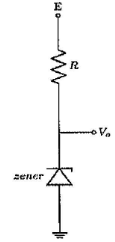
Uma importante aplicação do diodo encontra-se nos reguladores de tensão, onde é explorada a operação na zona de ruptura inversa de diodos especiais, os chamados diodos Zener. Para o regulador sem carga representado na figura acima, considere que o diodo Zener é modelado por uma fonte de tensão fixa \( V_{z0} \) em série com a sua resistência interna \( r_2 \). Considerando também a tensão de alimentação E e o resistor R, conforme mostrados na figura acima, assinale a opção que apresenta o valor \( V_o \)
Provas

Observe o circuito com transistor bipolar de junção abaixo.
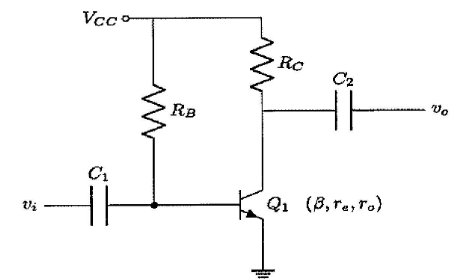
Com base nessas informações, assinale a opção correta.
Provas
Considere o circuito abaixo.
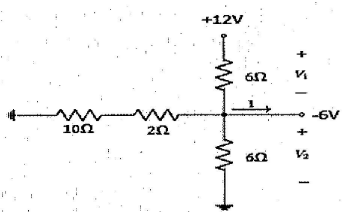
Com base nessas informações, assinale a opção que apresenta os valores corretos das tensões \( V_1 \), \( V_2 \) e da corrente I, respectivamente.
Provas
O tempo (em minutos) que um cliente aguarda para ser atendido em um banco segue uma distribuição exponencial \( (f(x)=λ e^{- λ x}) \) com média de 30 minutos. Sendo assim, qual é a probabilidade de um cliente selecionado aleatoriamente aguardar mais 10 minutos para ser atendido, dado que ele já aguardou 30 minutos?
Provas
Um sistema linear invariante no tempo apresenta resposta ao impulso dada por \( h[n]=2^{-\left\vert n \right\vert} \). O valor de sua resposta em frequência \( H(e^{jw}) \) em \( w=0 \) é dado por:
Provas
Uma fábrica produz componentes eletrônicos e uma inspeção é conduzida periodicamente para verificar se há defeitos de fabricação. Historicamente, 10% dos componentes apresentam defeitos. Quando o produto é defeituoso, o teste detecta corretamente a presença de defeito em 20% das vezes. Quando ele não é defeituoso, ele ainda pode ser identificado incorretamente como defeituoso em 5% das vezes. Um produto foi testado e o resultado foi positivo. Com base nessas informações, a probabilidade de o produto ser realmente defeituoso é de:
Provas
Converta o número decimal 29310 para o sistema de numeração hexadecimal e assinale a opção que apresenta o número convertido no sistema de numeração binário com 16 bits.
Provas
Tomando as condições iniciais \( y(0)=3 \) e \( y'(0)=2 \), resolva a equação diferencial \( y"+2y'+3y=0 \) e assinale a opção correta.
Provas
Read the text below and answer question.
TEXT II
TITLE: Asteroid probe snaps rare images of Martian Moon
March 13,2025 3:29 PM
By Agence France-Press
Paris -
On the way to investigate the scene of a historic asteroid collision, a European spacecraft swung by Mars and captured rare images of the red planet's mysterious small moon Deimos, the European Space Agency said Thursday.
Europe's HERA mission is aiming to find out how much of an impact a NASA spacecraft made when it deliberately smashed into an asteroid in 2022 in the first test of our planetary defenses.
But HERA will not reach the asteroid - which is 11 million kilometers from Earth in the asteroid belt between Mars and Jupiter - until late 2026.
On the long voyage there, the spacecraft swung around Mars on Wednesday.
The spacecraft used the planet's gravity to get a “kick” that also changed its direction and saved fuel, mission analyst Pablo Munoz told a press conference.
For an hour, HERA flew as close as 5,600 kilometers from the Martian surface, at a speed of 33,480 kilometers an hour.
It used the opportunity to test some of its scientific instruments, snapping around 600 pictures, including rare ones of Deimos.
The lumpy, 12.5-kilometer-wide moon is the smaller and less well-known of the two moons of Mars.
Exactly how Deimos and the bigger Phobos were formed remains a matter of debate.
Some scientists believe they were once asteroids that were captured in the gravity of Mars, while others think they could have been shot from a massive impact on the surface.
The new images add “another piece of the puzzle” to efforts to determine their origin, Marcel Popescu of the Astronomical Institute of the Romanian Academy said.
There are hopes that data from HERA's "HyperScout" and thermal infrared imagers - which observe colors beyond the limits of the human eye - will shed light on this mystery by discovering more about the moon's composition.
Those infrared imagers are why the red planet appears blue in some of the photos.
Next, HERA will turn its focus back to asteroid Dimorphos. When NASA's DART mission smashed into Dimorphos in 2022, it shortened the 160-meter-wide asteroid's orbit around its big brother Didymos by 33 minutes.
Although Dimorphos itself posed no threat to Earth, HERA intends to discover whether this technique could be an effective way for Earth to defend itself against possibly existence-threatening asteroids in the future.
Space agencies have been working to ramp up Earth's planetary defences, monitoring for potential threats so they can be dealt with as soon as possible.
Earlier this year, a newly discovered asteroid capable of destroying a city was briefly given a more than 3% chance of hitting Earth in 2032.
However further observations sent the chances of a direct hit back down to nearly zero.
Richard Moissl, head of the ESA's planetary defense office, said that asteroid, 2024 YR, followed a pattern that will become more common.
As we get better at scanning the skies, “we will discover asteroids at a higher rate," he said.
The ESA is developing a secondary planetary defense mission to observe the 350-meter-wide asteroid Apophis, which will fly just 32,000 kilometers from Earth on April 13, 2029.
If approved by the ESA's ministerial council, the Ramses mission will launch in 2028, reaching the asteroid two months before it approaches Earth.
According to the text, HERA's main objective was:
Provas
Read the text below and answer question.
TEXT II
TITLE: Asteroid probe snaps rare images of Martian Moon
March 13,2025 3:29 PM
By Agence France-Press
Paris -
On the way to investigate the scene of a historic asteroid collision, a European spacecraft swung by Mars and captured rare images of the red planet's mysterious small moon Deimos, the European Space Agency said Thursday.
Europe's HERA mission is aiming to find out how much of an impact a NASA spacecraft made when it deliberately smashed into an asteroid in 2022 in the first test of our planetary defenses.
But HERA will not reach the asteroid - which is 11 million kilometers from Earth in the asteroid belt between Mars and Jupiter - until late 2026.
On the long voyage there, the spacecraft swung around Mars on Wednesday.
The spacecraft used the planet's gravity to get a “kick” that also changed its direction and saved fuel, mission analyst Pablo Munoz told a press conference.
For an hour, HERA flew as close as 5,600 kilometers from the Martian surface, at a speed of 33,480 kilometers an hour.
It used the opportunity to test some of its scientific instruments, snapping around 600 pictures, including rare ones of Deimos.
The lumpy, 12.5-kilometer-wide moon is the smaller and less well-known of the two moons of Mars.
Exactly how Deimos and the bigger Phobos were formed remains a matter of debate.
Some scientists believe they were once asteroids that were captured in the gravity of Mars, while others think they could have been shot from a massive impact on the surface.
The new images add “another piece of the puzzle” to efforts to determine their origin, Marcel Popescu of the Astronomical Institute of the Romanian Academy said.
There are hopes that data from HERA's "HyperScout" and thermal infrared imagers - which observe colors beyond the limits of the human eye - will shed light on this mystery by discovering more about the moon's composition.
Those infrared imagers are why the red planet appears blue in some of the photos.
Next, HERA will turn its focus back to asteroid Dimorphos. When NASA's DART mission smashed into Dimorphos in 2022, it shortened the 160-meter-wide asteroid's orbit around its big brother Didymos by 33 minutes.
Although Dimorphos itself posed no threat to Earth, HERA intends to discover whether this technique could be an effective way for Earth to defend itself against possibly existence-threatening asteroids in the future.
Space agencies have been working to ramp up Earth's planetary defences, monitoring for potential threats so they can be dealt with as soon as possible.
Earlier this year, a newly discovered asteroid capable of destroying a city was briefly given a more than 3% chance of hitting Earth in 2032.
However further observations sent the chances of a direct hit back down to nearly zero.
Richard Moissl, head of the ESA's planetary defense office, said that asteroid, 2024 YR, followed a pattern that will become more common.
As we get better at scanning the skies, “we will discover asteroids at a higher rate," he said.
The ESA is developing a secondary planetary defense mission to observe the 350-meter-wide asteroid Apophis, which will fly just 32,000 kilometers from Earth on April 13, 2029.
If approved by the ESA's ministerial council, the Ramses mission will launch in 2028, reaching the asteroid two months before it approaches Earth.
Mark the correct option that presents a paraphrase to the following extract: “The spacecraft used the planet's gravity to get a kick.”
Provas
Caderno Container