Foram encontradas 5.226 questões.
Disciplina: Literatura Brasileira e Estrangeira
Banca: FLEM
Orgão: Pref. Riachão Jacuípe-BA

Motivation as a Dynamic Process in Language Learning
Motivation has long been recognised as an
important element in second-language learning.
Nevertheless, researchers have increasingly
questioned the idea that learners are either motivated
or unmotivated as if motivation were a permanent
personal trait. Studies conducted in different
educational contexts have shown that motivation may
change across lessons, tasks, stages of education,
and experiences of success or failure.
Self-determination theory distinguishes between
controlled and more autonomous forms of motivation. A
learner may initially study English because of external
pressure, an examination, or the expectation of
future employment. Such motives are not necessarily
ineffective. They may gradually become more
internalised if learners understand the value of the
activity, perceive that they are making progress, and
connect language learning with personally meaningful
goals.
Autonomous motivation is supported when
learners experience a sense of competence, a degree
of meaningful choice, and constructive relationships
with teachers and classmates. Choice, however,
should not be confused with the absence of guidance.
Asking learners to choose among purposeful tasks,
texts, or modes of participation can strengthen agency,
whereas offering options without clear goals may
produce uncertainty rather than engagement.
Teachers also influence motivation through the
way they respond to difficulty. A teacher may say,
“I have noticed that some of you give up when you
cannot understand every word in these recordings.” If
learners interpret temporary difficulty as evidence that
they lack ability, they may withdraw from participation.
If, instead, they are taught how to listen selectively, use
context, notice stressed words, recognise changes in
intonation, and become familiar with different accents,
difficulty can become evidence of what still needs to
be learned.
Support should help learners persist with
demanding tasks without taking over the decisions
that belong to them. Excessive control may produce
short-term compliance while weakening long-term
engagement. By contrast, structured guidance,
achievable challenge, informative feedback, and
opportunities to revise work can help learners develop
both competence and ownership of their learning.
Motivationally responsive teaching may also
involve literature. Short stories, poems, dramatic
scenes, and spoken-word performances can connect
language with imagination, identity, history, and
social experience. Allowing learners some choice
among texts may increase personal relevance, but
meaningful literary learning still requires attention to
language, genre, authorship, historical context, and
interpretation. Motivation is therefore not created by
entertainment alone; it develops when learners can
see value in demanding work and believe that they
are capable of progressing through it.
Adaptado de: NOELS, Kimberly A.; VARGAS LASCANO, Dayuma I.; SAUMURE, Kristie. The development of self-determination across the language course: trajectories of motivational change and the dynamic interplay of psychological needs, orientations, and engagement. Studies in Second Language Acquisition, v. 41, n. 4, p. 821-851, 20
Considerando a concepção de motivação desenvolvida no texto, os princípios de autonomia com suporte pedagógico, a organização didática mais consistente deve
Provas

Disciplina: Literatura Brasileira e Estrangeira
Banca: FLEM
Orgão: Pref. Riachão Jacuípe-BA
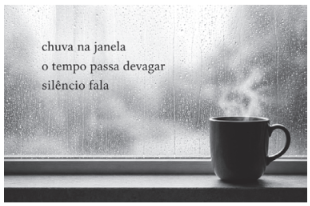
O haicai é uma forma poética breve, caracterizada pela concisão e pela sugestão de imagens.
Na articulação entre o haicai e a imagem, o verso “o tempo passa devagar” contribui para representar
Provas
Disciplina: Literatura Brasileira e Estrangeira
Banca: AMEOSC
Orgão: Pref. Mondaí-SC
Considerando as principais manifestações da literatura brasileira, assinale a alternativa correta.
Provas
Disciplina: Literatura Brasileira e Estrangeira
Banca: AMEOSC
Orgão: Pref. Mondaí-SC
Considerando a versificação e as relações entre métrica, ritmo e rima, analise as afirmativas a seguir.
I.A métrica corresponde à medida do verso estabelecida pela contagem das sílabas poéticas, cuja delimitação considera critérios sonoros próprios da escansão e se encerra na última sílaba tônica.
II. O ritmo de um verso decorre da correspondência entre sua extensão silábica e a recorrência de um mesmo padrão métrico, sendo a regularidade da medida responsável pela organização rítmica da composição.
III.A coincidência entre a divisão das sílabas gramaticais e a das sílabas poéticas constitui condição para a manutenção do metro, pois os processos de ligação sonora entre palavras não interferem na escansão.
IV. A rima estabelece correspondências sonoras entre segmentos dos versos a partir da recorrência de fonemas, podendo reunir palavras que apresentam configurações gráficas distintas.
V. O verso livre organiza seu ritmo por recursos como distribuição de acentos, pausas e recorrências sonoras, embora apresente variação na extensão silábica dos versos.
Assinale a alternativa correta.
Provas
Disciplina: Literatura Brasileira e Estrangeira
Banca: ISET
Orgão: Pref. Lajedinho-BA
I. Foi elaborado em forma de versos a fim de realçar uma expressividade rítmica.
II. Fundamenta-se na variedade dialetal a fim de realçar o falar próprio de uma região.
III. Na sua composição, prescinde de vocabulário sociocultural representativo de um povo específico.
IV. Restringe sua expressividade linguística a uma modalidade escorreita conforme o contexto em que se encontra.
Pode-se dizer que está correto o que se afirma
Provas
Disciplina: Literatura Brasileira e Estrangeira
Banca: ISET
Orgão: Pref. Lajedinho-BA
Provas
Disciplina: Literatura Brasileira e Estrangeira
Banca: ISET
Orgão: Pref. Lajedinho-BA
Provas
Disciplina: Literatura Brasileira e Estrangeira
Banca: Unesc
Orgão: InoversaSul
Which procedure is pedagogically CORRECT?
Provas
Disciplina: Literatura Brasileira e Estrangeira
Banca: Itame
Orgão: Pref. Caldazinha-GO
(...) Melhor, se arrepare: pois num chão, e com igual formato de ramos e folhas, não dá mandioca mansa, que se come comum, e a mandioca-brava, que mata? Agora, o senhor já viu uma estranhez? A mandioca doce pode de repente virar azangada - motivos não sei; às vezes se diz que é por replantada no terreno sempre, com mudas seguidas, de manaíbas - vai em amargando, de tanto em tanto, de si mesma toma peçonhas. E, ora veja: a outra, a mandioca-brava, também é que às vezes pode ficar mansa, a esmo, de se comer sem nenhum mal. (...) Arre, ele (o demo) está misturado em tudo
(Rosa, João Guimarães. Grande sertão: veredas. Rio de Janeiro: Nova Fronteira, 2001, p. 27).
Provas
Disciplina: Literatura Brasileira e Estrangeira
Banca: AGATA
Orgão: Pref. Xinguara-PA
Provas
Caderno Container