Foram encontradas 900 questões.
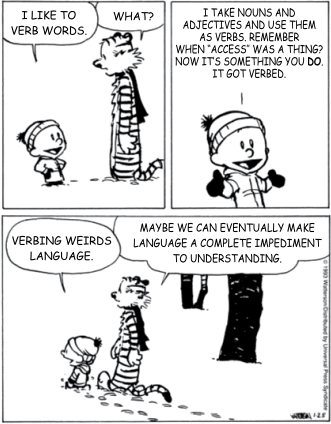
(https://www.gocomics.com/calvinandhobbes/1993/01/25)
The words of the tiger in the last frame are an example of
Provas

Leia a tira.
(https://www.gocomics.com/calvinandhobbes/1993/01/25)
No diálogo entre os personagens, o primeiro uso de um substantivo como verbo é:
Provas
Read the text to answer question.
The last century of language teaching history, operating within this theory-practice, researcher teacher dichotomy, has not been completely devoid of dialogue between the two sides. We moved in and out of paradigms (Kuhn, 1970) as inadequacies of the old ways of doing things were replaced by better ways. These trends in language teaching were partly the result of teachers and researchers communicating with each other.
The custom of leaving theory to researchers and practice to teachers has become, in Clarke’s (1994) words, “dysfunctional”. What is becoming clearer in this profession now is the importance of viewing the process of language instruction as a cooperative dialog among many technicians, each endowed with special skills, such as program developing, textbook writing, measuring variables of acquisition, designing experiments, and the list goes on.
We are all practitioners and we are all theorists. Whenever that understanding calls for putting together diverse bits and pieces of knowledge, you are doing some theory building. Or, if you have observed some learners in classrooms and you discern common threads of process among them, you have created a theory. And whenever you, in the role of a teacher, ask pertinent questions about Second Language Acquisition (SLA), you are beginning the process of research that can lead to a theoretical statement.
(Brown, H.D. 2006. Adaptado)
Provas
Read the text to answer question.
The last century of language teaching history, operating within this theory-practice, researcher teacher dichotomy, has not been completely devoid of dialogue between the two sides. We moved in and out of paradigms (Kuhn, 1970) as inadequacies of the old ways of doing things were replaced by better ways. These trends in language teaching were partly the result of teachers and researchers communicating with each other.
The custom of leaving theory to researchers and practice to teachers has become, in Clarke’s (1994) words, “dysfunctional”. What is becoming clearer in this profession now is the importance of viewing the process of language instruction as a cooperative dialog among many technicians, each endowed with special skills, such as program developing, textbook writing, measuring variables of acquisition, designing experiments, and the list goes on.
We are all practitioners and we are all theorists. Whenever that understanding calls for putting together diverse bits and pieces of knowledge, you are doing some theory building. Or, if you have observed some learners in classrooms and you discern common threads of process among them, you have created a theory. And whenever you, in the role of a teacher, ask pertinent questions about Second Language Acquisition (SLA), you are beginning the process of research that can lead to a theoretical statement.
(Brown, H.D. 2006. Adaptado)
Provas
Read the text to answer question.
The last century of language teaching history, operating within this theory-practice, researcher teacher dichotomy, has not been completely devoid of dialogue between the two sides. We moved in and out of paradigms (Kuhn, 1970) as inadequacies of the old ways of doing things were replaced by better ways. These trends in language teaching were partly the result of teachers and researchers communicating with each other.
The custom of leaving theory to researchers and practice to teachers has become, in Clarke’s (1994) words, “dysfunctional”. What is becoming clearer in this profession now is the importance of viewing the process of language instruction as a cooperative dialog among many technicians, each endowed with special skills, such as program developing, textbook writing, measuring variables of acquisition, designing experiments, and the list goes on.
We are all practitioners and we are all theorists. Whenever that understanding calls for putting together diverse bits and pieces of knowledge, you are doing some theory building. Or, if you have observed some learners in classrooms and you discern common threads of process among them, you have created a theory. And whenever you, in the role of a teacher, ask pertinent questions about Second Language Acquisition (SLA), you are beginning the process of research that can lead to a theoretical statement.
(Brown, H.D. 2006. Adaptado)
Provas
Provas
Provas
Provas
Read the text to answer question.
Robots are writing more of what we read on the internet. And artificial intelligence (AI) writing tools are becoming freely available for anyone, including students, to use.
In a period of rapid change, there are enormous ethical implications for post-human authorship — in which humans and machines collaborate. The study of AI ethics needs to be central to education as we increasingly use machinegenerated content to communicate with others.
AI robot writers, such as GPT-3 (Generative Pre-trained Transformer) take seconds to create text that seems like it was written by humans. In September, 2020 GPT-3 wrote an entire essay in The Guardian to convince people not to fear artificial intelligence. As recently as 2019, this kind of technology seemed a long way off. But today, it is readily available.
Of course, there’s the issue of cheating on essays and other assignments. School and university leaders need to have difficult conversations about what constitutes “authorship” and “editorship” in the post-human age. We are all (already) writing with technological devices, even just via spelling and grammar checkers.
(https://theconversation.com. Adaptado)
Provas
Read the text to answer question.
Robots are writing more of what we read on the internet. And artificial intelligence (AI) writing tools are becoming freely available for anyone, including students, to use.
In a period of rapid change, there are enormous ethical implications for post-human authorship — in which humans and machines collaborate. The study of AI ethics needs to be central to education as we increasingly use machinegenerated content to communicate with others.
AI robot writers, such as GPT-3 (Generative Pre-trained Transformer) take seconds to create text that seems like it was written by humans. In September, 2020 GPT-3 wrote an entire essay in The Guardian to convince people not to fear artificial intelligence. As recently as 2019, this kind of technology seemed a long way off. But today, it is readily available.
Of course, there’s the issue of cheating on essays and other assignments. School and university leaders need to have difficult conversations about what constitutes “authorship” and “editorship” in the post-human age. We are all (already) writing with technological devices, even just via spelling and grammar checkers.
(https://theconversation.com. Adaptado)
Provas
Caderno Container