Foram encontradas 50 questões.
A Lei n. 9.394 de 1996, a Lei de Diretrizes e Base da Educação Nacional (LDB), estabelece que o sistema educacional brasileiro deve se organizar nas três esferas administrativas: federal, estadual/distrital e municipal. Os sistemas municipais de ensino
Provas

De acordo com as Diretrizes Curriculares Nacionais para a Educação Infantil, fixadas pela Resolução n. 05 de 2009 da Câmara de Educação Básica (CEB) do Conselho Nacional de Educação (CNE), as propostas pedagógicas da educação infantil deverão considerar que as crianças, centro do planejamento curricular,
Provas
Em relação à educação infantil, a Lei n. 9.394 de 1996, a Lei de Diretrizes e Base da Educação Nacional (LDB) estabelece que
Provas
Leia o texto a seguir:
As ações e orientações do Estado interferem no cotidiano de cada instituição educativa e dos sujeitos que a constroem. Desde a quantidade de dias letivos, o conteúdo e a metodologia trabalhada no interior de cada sala de aula sofrem as determinações das políticas públicas para a educação.
ARAÚJO, Denise Silva; ALMEIDA Maria Zeneide C. M. Políticas Educacionais: refletindo sobre seus significados. In: Revista Educativa. Goiânia, v. 13, n. 1, p. 97 jan./jun. 2010.
Compreender as determinações apresentadas no texto e como elas se constroem é fundamental para que o professor possa se posicionar criticamente perante elas e participar efetivamente na construção de políticas educacionais. As Políticas Educacionais, portanto, são entendidas como
Provas
Um professor de Estatística divulgou as notas de cinco estudantes da seguinte forma: tanto a média aritmética das notas quanto a mediana são iguais a 6,0, a moda das notas é 3,0 e apenas um estudante tirou nota 10,0. Qual foi a segunda maior nota nesse grupo de alunos?
Provas
Considere a proposição:
P: Ao final de um curso o aluno é aprovado.
Sabendo que P é equivalente à proposição composta obtida pela conjunção das duas proposições seguintes:
Q: o aluno atingiu a frequência de no mínimo 75%;
R: a média final do aluno foi superior ou igual a 6,0.
Qual proposição é equivalente à ~P?
Provas
A teoria que entende o Estado como sendo um ente neutro, acima dos interesses das classes sociais, que objetiva a realização do bem comum, é considerada com enfoque
Provas
Disciplina: Inglês (Língua Inglesa)
Banca: Verbena
Orgão: Pref. Itiquira-MT
Leia o poema a seguir.
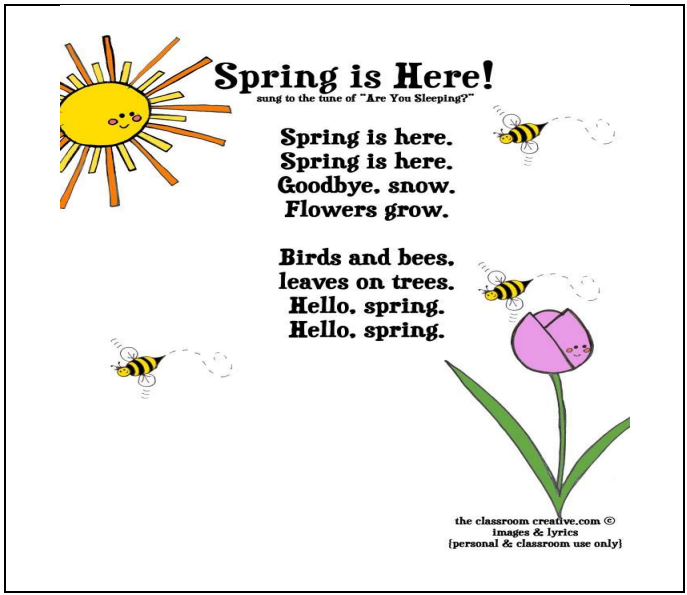
Disponível em: <https://theclassroomcreative.com/2013/04/freebie-spring-song-printable-for-kids/>. Acesso em: 29 ago. 2022.
The poem describes the beginning of spring, a season celebrated for its warm weather, flowers and beauty. However, one element in the poem is hardly ever seen in Brazil. Which one is it?
Provas
Disciplina: Inglês (Língua Inglesa)
Banca: Verbena
Orgão: Pref. Itiquira-MT
Leia o texto 4 para responder as questões 44 a 46.
Texto 4
Is there still a place in teaching for magazines, pictures, scissors, correction fluid, flipcharts and all those traditional pen-and-paper resources that have suddenly started to look a bit old-fashioned? In the modern, digitally connected world, young people are constantly online and using screens, both in their studies and in social interaction. Won’t they roll their eyes at being asked to look at a torn-out picture, make a hand-written poster or collect ideas in a flipchart?
I’d argue that such traditional resources still have an important place in language classroom, and, interestingly, they are starting to feel increasingly engaging, perhaps because they are simple and different - a hands-on contrast to the staring at screens that makes up so much of our 21st century days, In being different from much of the separated, individual computer work students do, pen-and-paper resources often bring people together, working with tangible, shared materials, in a way that feels surprisingly alive and engaging.
Fonte: SCRIVENER, J. Classroom Management Techniques. Cambridge: Cambridge University Press, Cambridge Handbooks for Language Teachers, 2012. p. 270. (Adaptado).
In the text, the adjective old-fashioned means
Provas
Disciplina: Inglês (Língua Inglesa)
Banca: Verbena
Orgão: Pref. Itiquira-MT
Leia o texto 4 para responder as questões 44 a 46.
Texto 4
Is there still a place in teaching for magazines, pictures, scissors, correction fluid, flipcharts and all those traditional pen-and-paper resources that have suddenly started to look a bit old-fashioned? In the modern, digitally connected world, young people are constantly online and using screens, both in their studies and in social interaction. Won’t they roll their eyes at being asked to look at a torn-out picture, make a hand-written poster or collect ideas in a flipchart?
I’d argue that such traditional resources still have an important place in language classroom, and, interestingly, they are starting to feel increasingly engaging, perhaps because they are simple and different - a hands-on contrast to the staring at screens that makes up so much of our 21st century days, In being different from much of the separated, individual computer work students do, pen-and-paper resources often bring people together, working with tangible, shared materials, in a way that feels surprisingly alive and engaging.
Fonte: SCRIVENER, J. Classroom Management Techniques. Cambridge: Cambridge University Press, Cambridge Handbooks for Language Teachers, 2012. p. 270. (Adaptado).
Qual dos títulos a seguir reflete a temática abordada no texto?
Provas
Caderno Container