Foram encontradas 1.169 questões.
1372465
Ano: 2009
Disciplina: Odontologia
Banca: FUMARC
Orgão: Pref. Governador Valadares-MG
Disciplina: Odontologia
Banca: FUMARC
Orgão: Pref. Governador Valadares-MG
Provas:
Percebe-se que vários dentes posteriores restaurados com resina composta apresentam sensibilidade no pós-operatório. Esta sensibilidade se desenvolve à medida que o paciente mastiga durante até um ou dois anos após a confecção da restauração.
Avalie as afirmações quanto as prováveis razões desta sensibilidade:
I. Condicionamento ácido da dentina.
II. Deflexão da resina sob estresses oclusais, transmitindo pressão hidráulica aos odontoblastos.
III. Toxidade da resina composta.
IV. Contração de polimerização da resina, seguida por infiltração marginal.
Assinale a alternativa que contenha as afirmações verdadeiras:
Provas
Questão presente nas seguintes provas

1372461
Ano: 2009
Disciplina: Engenharia Civil
Banca: FUMARC
Orgão: Pref. Governador Valadares-MG
Disciplina: Engenharia Civil
Banca: FUMARC
Orgão: Pref. Governador Valadares-MG
Provas:
Malária, leishmaniose, febre amarela, dengue e filariose são doenças relacionadas com o lixo e nas habitações exigem o controle de:
Provas
Questão presente nas seguintes provas
1372411
Ano: 2009
Disciplina: Contabilidade Geral
Banca: FUMARC
Orgão: Pref. Governador Valadares-MG
Disciplina: Contabilidade Geral
Banca: FUMARC
Orgão: Pref. Governador Valadares-MG
Provas:
Dentre as alternativas a seguir, assinale aquela que é considerada formalidade intrínseca do livro Diário:
Provas
Questão presente nas seguintes provas
1372217
Ano: 2009
Disciplina: Inglês (Língua Inglesa)
Banca: FUMARC
Orgão: Pref. Governador Valadares-MG
Disciplina: Inglês (Língua Inglesa)
Banca: FUMARC
Orgão: Pref. Governador Valadares-MG
Provas:
READ THE FOLLOWING TEXTS AND CHOOSE THE OPTION WHICH BEST COMPLETES EACH QUESTION ACCORDING TO THE TEXTS:
TEXT 01
Does good teaching equal good learning?
Submitted by Alan Maley on 13 December, 2009 - 12:11
Once we start to consider what good teachers need to do, we come up with enormously long lists, and come to realize just how complex the job of teaching is. They need to plan, to control, to present, to monitor, to react to feedback, to offer a model, to motivate, and so on. And these labels are also over-simplifications. For example, the teacher needs to simultaneously control what happens while empowering learners, leaving space for them to learn. Teachers need to provide input yet also to promote learner discovery. They need to motivate in the short term ('keeping them awake') while keeping them interested in the long term ('keeping them alive'). They need to plan but not to become the slaves of their plans but to remain receptive to what is happening 'in the moment'.
Above all, they need to offer engaging, varied, non-trivial input in the form of content and activities. This implies finding things that learners will find both interesting and relevant.
But what teachers do is contingent on how learners respond to it. There are some obvious but nonetheless important differences between teaching and learning. Whereas teaching is a public, observable act, learning is private and largely unobservable. Teaching is intentional - the teacher has in mind what he/she wants to teach, but learning is largely unconscious. Teaching is an intermittent activity (so many minutes per lesson, so many lessons per week, etc.) but learning is a process which goes on outside these time frames. The teacher must assume that there is a degree of predictability in the teaching whereas unpredictability is the only certainty.
This reminds me of Norman Whitney's wise observation: that any classroom event is unpredictable, unrepeatable, unobservable (in every detail) and has unforeseen, long-term consequences.
So teaching is very much a process of seeing 'through a glass darkly'. Perhaps the best teachers are those who, while well-informed and well-trained, are also those best able to live with the unexpected.
(Adapted from: http://www.teachingenglish.org.uk/blogs)
The modal verb must in: “. The teacher must assume …” (paragraph 3), conveys an idea of
Provas
Questão presente nas seguintes provas
Assinale a alternativa CORRETA que apresenta os 06 processos básicos da Gestão de Pessoas:
Provas
Questão presente nas seguintes provas
1372186
Ano: 2009
Disciplina: Comunicação Social
Banca: FUMARC
Orgão: Pref. Governador Valadares-MG
Disciplina: Comunicação Social
Banca: FUMARC
Orgão: Pref. Governador Valadares-MG
Provas:
Na redação jornalística, os lides são classificados em diversos tipos. Assinale a alternativa em que o tipo de lead apresenta a definição INCORRETA:
Provas
Questão presente nas seguintes provas
1372133
Ano: 2009
Disciplina: Inglês (Língua Inglesa)
Banca: FUMARC
Orgão: Pref. Governador Valadares-MG
Disciplina: Inglês (Língua Inglesa)
Banca: FUMARC
Orgão: Pref. Governador Valadares-MG
Provas:
READ THE FOLLOWING TEXTS AND CHOOSE THE OPTION WHICH BEST COMPLETES EACH QUESTION ACCORDING TO THE TEXTS:
TEXT 01
Does good teaching equal good learning?
Submitted by Alan Maley on 13 December, 2009 - 12:11
Once we start to consider what good teachers need to do, we come up with enormously long lists, and come to realize just how complex the job of teaching is. They need to plan, to control, to present, to monitor, to react to feedback, to offer a model, to motivate, and so on. And these labels are also over-simplifications. For example, the teacher needs to simultaneously control what happens while empowering learners, leaving space for them to learn. Teachers need to provide input yet also to promote learner discovery. They need to motivate in the short term ('keeping them awake') while keeping them interested in the long term ('keeping them alive'). They need to plan but not to become the slaves of their plans but to remain receptive to what is happening 'in the moment'.
Above all, they need to offer engaging, varied, non-trivial input in the form of content and activities. This implies finding things that learners will find both interesting and relevant.
But what teachers do is contingent on how learners respond to it. There are some obvious but nonetheless important differences between teaching and learning. Whereas teaching is a public, observable act, learning is private and largely unobservable. Teaching is intentional - the teacher has in mind what he/she wants to teach, but learning is largely unconscious. Teaching is an intermittent activity (so many minutes per lesson, so many lessons per week, etc.) but learning is a process which goes on outside these time frames. The teacher must assume that there is a degree of predictability in the teaching whereas unpredictability is the only certainty.
This reminds me of Norman Whitney's wise observation: that any classroom event is unpredictable, unrepeatable, unobservable (in every detail) and has unforeseen, long-term consequences.
So teaching is very much a process of seeing 'through a glass darkly'. Perhaps the best teachers are those who, while well-informed and well-trained, are also those best able to live with the unexpected.
(Adapted from: http://www.teachingenglish.org.uk/blogs)
Besides being well-informed and well-trained teachers should have the
ability to deal with:
Provas
Questão presente nas seguintes provas
1372073
Ano: 2009
Disciplina: Comunicação Social
Banca: FUMARC
Orgão: Pref. Governador Valadares-MG
Disciplina: Comunicação Social
Banca: FUMARC
Orgão: Pref. Governador Valadares-MG
Provas:
Considerando jornalismo público como aquele em que as empresas são comprometidas com o interesse da sociedade em geral e do receptor como cidadão e ator social, e não apenas com o consumidor de notícias como um produto quase que de natureza mercadológica, é CORRETO afirmar:
Provas
Questão presente nas seguintes provas
O gráfico abaixo representa a relação da osmolalidade urinária com ADH plasmático durante o teste de restrição hídrica em pacientes com diabetes insipidus de diversas etiologias.
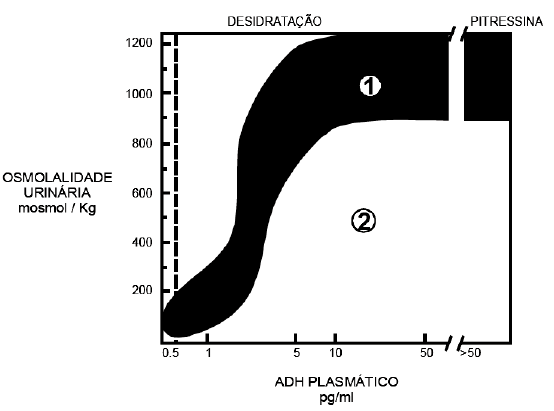
A interpretação correta das áreas 1 e 2 é, respectivamente:
Provas
Questão presente nas seguintes provas
1372016
Ano: 2009
Disciplina: Biblioteconomia
Banca: FUMARC
Orgão: Pref. Governador Valadares-MG
Disciplina: Biblioteconomia
Banca: FUMARC
Orgão: Pref. Governador Valadares-MG
Provas:
Assinale a alternativa que apresenta CORRETAMENTE a legenda bibliográfica de um artigo de periódico, elaborada de acordo com a NBR 6026 (ABNT, 1994):
Provas
Questão presente nas seguintes provas
Cadernos
Caderno Container