Foram encontradas 30 questões.
791069
Ano: 2015
Disciplina: Inglês (Língua Inglesa)
Banca: INAZ do Pará
Orgão: Pref. Curuçá-PA
Disciplina: Inglês (Língua Inglesa)
Banca: INAZ do Pará
Orgão: Pref. Curuçá-PA
Provas:
English for Specific Purposes: Negotiating Needs, Possibilities, and Promises
We live and work in Charlotte, North Carolina; Lima, Peru; Ouagadougou, Burkina Faso; and Los Angeles, California. In all these locations English language teaching (ELT) professionals and institutions are increasingly in demand to design and deliver English for Specific Purposes (ESP) courses tailored to specific professional and/or academic activities. Our wide-ranging projects have included (1) equipping Spanish-dominant migrant farm workers in rural North Carolina with language skills to meet critical safety requirements; (2) strengthening the academic English capacities of Peruvian public school teachers; (3) enhancing Ouagadougou International Airport passport control officials’ ability to interface with international visitors; and (4) providing international legal professionals with pre-academic orientation for graduate study in law. Despite our diverse contexts, the four of us shared the experience of transitioning from highly structured, leveled, intensive English classes mostly directed toward adolescent and adult learners to the development of strategic and purposeful curricula to engage professionals and emerging professionals in English for professional purposes. Along the way, questions emerged about what ESP was, what it could be, and how it could be better realized.
Indeed, in the last four decades, ESP has evolved from a somewhat obscure subset of ELT to a mainstream, standalone focal point of international, interdisciplinary scholarship and practice attuned to the multiple and complex needs of a “flat world” (see Basturkmen 2010; Hyland 2007; Johns and Dudley-Evans 1991; Louhiala-Salminen, Charles, and Kankaanranta 2005; Nickerson 2005; Warschauer 2000). Not without controversy, contemporary scholarship for ESP has critically examined, among other things, the complex contextual issues surrounding the conceptualization and delivery of ESP instruction (Allison 1996; Hyland and Hamp-Lyons 2002; Watson Todd 2003), “authenticity” in the development of materials and curricula (Widdowson 1998), and complex ethical issues about who decides what learners need (Belcher 2004; Edge 2003; Lee 2008; Widdowson 1994). As these and other debates continue to play out, English language professionals such as ourselves are increasingly in demand to provide ESP for a variety of local, regional, national, and international contexts.
It is beyond the scope of this article to trace the history of ESP as a professional discipline or to provide our readers with a detailed description of the processes that collectively comprise ESP. Instead, our intent in writing this article is to share some of the lessons we have learned from our collective experiences in designing and delivering ESP programs as a starting point for further study, discussion, and reflection. In too many communities, ESP is often advertised as a sort of “snake oil” that will have professionals mastering English in 30 days or less. We have yet to see such promises realized in practice, and such promises, we argue, threaten to undermine the work of the larger ELT community. The central message we hope to convey is, therefore, an ethical one that we believe needs more consistent articulation in the professional literature. Namely, in designing and delivering an ESP program, ESP professionals need to commit to an ethic of transparency grounded in dialogue. What ESP programming is and how it works is a process of negotiation—especially when a program is being offered for the first time. These negotiation processes must include not only consideration of the learners’ needs, but also of the structural limitations that surround the design and delivery of ESP programming and a candid assessment of the individual and combined capacities of those charged to design and deliver an ESP program.
(…)
At the conclusion of a seminar in 2010 with veteran English teaching professionals in Ouagadougou, one participant recounted how she had taken on an ESP Business English project with great enthusiasm. Initially her students, who were working professionals, were excited about the course—which, she explained, she taught as she had taught any other, with a balance of grammar and communicative activities. Little by little, the busy professionals stopped attending, and she asked some of them why. Their response was that they did not find the course relevant to their needs. Her story was one that we too had experienced in our transition from English for Basic Communicative Purposes to ESP—and we suspect that our readers here will recognize or even have experienced the same sort of disappointment she felt. It does not have to be that way.
In surveying ESP curricula, we found some stark variations in the extent and depth to which ESP programming actually reflects the language in use of a community of practice— for a variety of reasons. Often, ESP is introduced at the tertiary level as a degree requirement for large numbers of students—some with no knowledge of English whatsoever, others at various levels. In our own practice, we have found it useful to think of ESP as a continuum of possibilities, and, we encourage readers to do the same. On one end of that continuum, ESP is tailor-made to address the short- and long-term professional communicative development of individuals—with clearly defined and authentic objectives and ways of reaching those objectives that mirror the sorts of targeted professional language interactions that the same participants are striving to achieve. On the other end of the spectrum, an ESP course might be identical to, for example, any other communicative language course except for a few thematic readings and targeted vocabulary. Regardless of where in the spectrum of possibilities an ESP experience falls, it is critical that ESP professionals articulate that position with clarity—without pretending it is something more or less than what it is.
Finally, we believe that ESP needs analyses should be participatory—honoring and involving the perspectives of those on the receiving end of coursework. Yet we recognize that stakeholders are not always on the same page in terms of what they hope to get out of an ESP course. The owner of a mid-sized North Carolina farm might request an ESP course for migrant workers with the goal of ensuring their safety. However, the same migrant workers might see an ESP course as a means of developing their conversational proficiency in English. For this very reason, contradictory expectations need to be renegotiated in advance of course design and delivery.
To reiterate, as individuals and colleagues working in ESP, we have learned a number of important lessons in the field: not all ESP is created equal; ESP methods are strategic, purposeful, and context specific; and ESP takes time and sufficient needs analysis to make sense. In contrast to much of the practice and scholarly literature, perhaps one of the most important lessons we have learned is that ESP is not simply about learners’ needs. ESP also depends on the possibilities of ESP professionals who need to be honest about their own limitations—especially in terms of the time and effort they are able to commit to the needs analysis, syllabus design, and course delivery and what they can and cannot deliver. Constraints of time, budget, space, English proficiency levels, and other factors complicate what ESP can be. Potential ESP practitioners must decide how and to what extent they will meet the challenges that ESP demands and communicate those possibilities to stakeholders. A positive ESP experience largely depends, we argue, on ESP professionals’ ability and willingness to recognize and negotiate needs, possibilities, and their own promises with a commitment to an ethic of transparency. With honesty and thoughtfulness, ESP will continue to be a tool for local, regional, and national development in a global era.
Spencer Salas, Leonardo A. Mercado, Lynn Hanson
Ouedraogo, and Bernadette Musetti. In: English Teaching Forum 2013, Volume 51, Number 4.
The true intention of the authors of this article is:
Provas
Questão presente nas seguintes provas

“BERRO AMAZÔNICO”
Falar, já falamos. E não nos ouviram...! Gritar, já gritamos. E não nos ouviram...! Já falamos. Não ouviram...! Já gritamos. Não ouviram...! Então, berramos! Que o nosso berro amazônico possa ser ouvido em todo o Brasil e tenha ressonância pelo mundo para que venhamos a ter o respeito que merecemos e exigimos. Berramos para que a Amazônia conheça, se reconheça e se ame! Berramos para afirmar a nossa luta em defesa dos direitos dos povos e das culturas amazônidas. Berramos para afirmar os valores e as tradições de nossas manifestações artísticas e culturais, que fundam o processo de construção de nossas diversidades e identidades e que constituem o nosso espírito amazônico. Berramos porque somos nós, os amazônidas, os maiores guardiões das nossas riquezas naturais que, historicamente, vem sendo usurpadas por um sistema que tem como meta a destruição do homem e da floresta. Berramos contra a discriminação que nos marginaliza das grandes prioridades nacionais, condenando-nos a receber migalhas orçamentárias ou favores institucionais, notadamente no que se refere às artes e culturas nativas e à preservação de nosso patrimônio histórico e cultural. Berramos contra os meios de comunicação social vinculados às grandes redes que abrem espaço e repercutem informações negativas sobre a Amazônia, ignorando as nossas criação e produção artística e cultural e a nossa capacidade de refletir e propor alternativas eficazes para a Região. Berramos contra todas as formas de discriminação que sofrem as culturas indígenas e negras, bases fundamentais de nossa civilização amazônica, exigindo para elas o mesmo tratamento que queremos para as manifestações de outras etnias. Berramos porque nossa alma transborda a arte, a ciência e a cultura desta região que anseia ser conhecida mundo afora com a expressividade de nossos talentos. Berramos, finalmente, para que o Brasil tome a consciência de que a Amazônia, mais do que sua extensão territorial, possui privilegiada situação na balança comercial brasileira; se não nos querem irmanados, com o devido respeito e igualdade de tratamento, haveremos de construir a nossa própria história.
in O Liberal 16/3/2004
De qual das figuras de linguagem a seguir se valeu o autor desse texto em: " Falar, já falamos. E não nos ouviram...! Gritar, já gritamos. E não nos ouviram...! Já falamos. Não ouviram...! Já gritamos. Não ouviram...! Então, berramos!"?
Provas
Questão presente nas seguintes provas
758290
Ano: 2015
Disciplina: Inglês (Língua Inglesa)
Banca: INAZ do Pará
Orgão: Pref. Curuçá-PA
Disciplina: Inglês (Língua Inglesa)
Banca: INAZ do Pará
Orgão: Pref. Curuçá-PA
Provas:
English for Specific Purposes: Negotiating Needs, Possibilities, and Promises
We live and work in Charlotte, North Carolina; Lima, Peru; Ouagadougou, Burkina Faso; and Los Angeles, California. In all these locations English language teaching (ELT) professionals and institutions are increasingly in demand to design and deliver English for Specific Purposes (ESP) courses tailored to specific professional and/or academic activities. Our wide-ranging projects have included (1) equipping Spanish-dominant migrant farm workers in rural North Carolina with language skills to meet critical safety requirements; (2) strengthening the academic English capacities of Peruvian public school teachers; (3) enhancing Ouagadougou International Airport passport control officials’ ability to interface with international visitors; and (4) providing international legal professionals with pre-academic orientation for graduate study in law. Despite our diverse contexts, the four of us shared the experience of transitioning from highly structured, leveled, intensive English classes mostly directed toward adolescent and adult learners to the development of strategic and purposeful curricula to engage professionals and emerging professionals in English for professional purposes. Along the way, questions emerged about what ESP was, what it could be, and how it could be better realized.
Indeed, in the last four decades, ESP has evolved from a somewhat obscure subset of ELT to a mainstream, standalone focal point of international, interdisciplinary scholarship and practice attuned to the multiple and complex needs of a “flat world” (see Basturkmen 2010; Hyland 2007; Johns and Dudley-Evans 1991; Louhiala-Salminen, Charles, and Kankaanranta 2005; Nickerson 2005; Warschauer 2000). Not without controversy, contemporary scholarship for ESP has critically examined, among other things, the complex contextual issues surrounding the conceptualization and delivery of ESP instruction (Allison 1996; Hyland and Hamp-Lyons 2002; Watson Todd 2003), “authenticity” in the development of materials and curricula (Widdowson 1998), and complex ethical issues about who decides what learners need (Belcher 2004; Edge 2003; Lee 2008; Widdowson 1994). As these and other debates continue to play out, English language professionals such as ourselves are increasingly in demand to provide ESP for a variety of local, regional, national, and international contexts.
It is beyond the scope of this article to trace the history of ESP as a professional discipline or to provide our readers with a detailed description of the processes that collectively comprise ESP. Instead, our intent in writing this article is to share some of the lessons we have learned from our collective experiences in designing and delivering ESP programs as a starting point for further study, discussion, and reflection. In too many communities, ESP is often advertised as a sort of “snake oil” that will have professionals mastering English in 30 days or less. We have yet to see such promises realized in practice, and such promises, we argue, threaten to undermine the work of the larger ELT community. The central message we hope to convey is, therefore, an ethical one that we believe needs more consistent articulation in the professional literature. Namely, in designing and delivering an ESP program, ESP professionals need to commit to an ethic of transparency grounded in dialogue. What ESP programming is and how it works is a process of negotiation—especially when a program is being offered for the first time. These negotiation processes must include not only consideration of the learners’ needs, but also of the structural limitations that surround the design and delivery of ESP programming and a candid assessment of the individual and combined capacities of those charged to design and deliver an ESP program.
(…)
At the conclusion of a seminar in 2010 with veteran English teaching professionals in Ouagadougou, one participant recounted how she had taken on an ESP Business English project with great enthusiasm. Initially her students, who were working professionals, were excited about the course—which, she explained, she taught as she had taught any other, with a balance of grammar and communicative activities. Little by little, the busy professionals stopped attending, and she asked some of them why. Their response was that they did not find the course relevant to their needs. Her story was one that we too had experienced in our transition from English for Basic Communicative Purposes to ESP—and we suspect that our readers here will recognize or even have experienced the same sort of disappointment she felt. It does not have to be that way.
In surveying ESP curricula, we found some stark variations in the extent and depth to which ESP programming actually reflects the language in use of a community of practice— for a variety of reasons. Often, ESP is introduced at the tertiary level as a degree requirement for large numbers of students—some with no knowledge of English whatsoever, others at various levels. In our own practice, we have found it useful to think of ESP as a continuum of possibilities, and, we encourage readers to do the same. On one end of that continuum, ESP is tailor-made to address the short- and long-term professional communicative development of individuals—with clearly defined and authentic objectives and ways of reaching those objectives that mirror the sorts of targeted professional language interactions that the same participants are striving to achieve. On the other end of the spectrum, an ESP course might be identical to, for example, any other communicative language course except for a few thematic readings and targeted vocabulary. Regardless of where in the spectrum of possibilities an ESP experience falls, it is critical that ESP professionals articulate that position with clarity—without pretending it is something more or less than what it is.
Finally, we believe that ESP needs analyses should be participatory—honoring and involving the perspectives of those on the receiving end of coursework. Yet we recognize that stakeholders are not always on the same page in terms of what they hope to get out of an ESP course. The owner of a mid-sized North Carolina farm might request an ESP course for migrant workers with the goal of ensuring their safety. However, the same migrant workers might see an ESP course as a means of developing their conversational proficiency in English. For this very reason, contradictory expectations need to be renegotiated in advance of course design and delivery.
To reiterate, as individuals and colleagues working in ESP, we have learned a number of important lessons in the field: not all ESP is created equal; ESP methods are strategic, purposeful, and context specific; and ESP takes time and sufficient needs analysis to make sense. In contrast to much of the practice and scholarly literature, perhaps one of the most important lessons we have learned is that ESP is not simply about learners’ needs. ESP also depends on the possibilities of ESP professionals who need to be honest about their own limitations—especially in terms of the time and effort they are able to commit to the needs analysis, syllabus design, and course delivery and what they can and cannot deliver. Constraints of time, budget, space, English proficiency levels, and other factors complicate what ESP can be. Potential ESP practitioners must decide how and to what extent they will meet the challenges that ESP demands and communicate those possibilities to stakeholders. A positive ESP experience largely depends, we argue, on ESP professionals’ ability and willingness to recognize and negotiate needs, possibilities, and their own promises with a commitment to an ethic of transparency. With honesty and thoughtfulness, ESP will continue to be a tool for local, regional, and national development in a global era.
Spencer Salas, Leonardo A. Mercado, Lynn Hanson
Ouedraogo, and Bernadette Musetti. In: English Teaching Forum 2013, Volume 51, Number 4.
The word willingness (in the last lines) is close in meaning to
Provas
Questão presente nas seguintes provas
“BERRO AMAZÔNICO”
Falar, já falamos. E não nos ouviram...! Gritar, já gritamos. E não nos ouviram...! Já falamos. Não ouviram...! Já gritamos. Não ouviram...! Então, berramos! Que o nosso berro amazônico possa ser ouvido em todo o Brasil e tenha ressonância pelo mundo para que venhamos a ter o respeito que merecemos e exigimos. Berramos para que a Amazônia conheça, se reconheça e se ame! Berramos para afirmar a nossa luta em defesa dos direitos dos povos e das culturas amazônidas. Berramos para afirmar os valores e as tradições de nossas manifestações artísticas e culturais, que fundam o processo de construção de nossas diversidades e identidades e que constituem o nosso espírito amazônico. Berramos porque somos nós, os amazônidas, os maiores guardiões das nossas riquezas naturais que, historicamente, vem sendo usurpadas por um sistema que tem como meta a destruição do homem e da floresta. Berramos contra a discriminação que nos marginaliza das grandes prioridades nacionais, condenando-nos a receber migalhas orçamentárias ou favores institucionais, notadamente no que se refere às artes e culturas nativas e à preservação de nosso patrimônio histórico e cultural. Berramos contra os meios de comunicação social vinculados às grandes redes que abrem espaço e repercutem informações negativas sobre a Amazônia, ignorando as nossas criação e produção artística e cultural e a nossa capacidade de refletir e propor alternativas eficazes para a Região. Berramos contra todas as formas de discriminação que sofrem as culturas indígenas e negras, bases fundamentais de nossa civilização amazônica, exigindo para elas o mesmo tratamento que queremos para as manifestações de outras etnias. Berramos porque nossa alma transborda a arte, a ciência e a cultura desta região que anseia ser conhecida mundo afora com a expressividade de nossos talentos. Berramos, finalmente, para que o Brasil tome a consciência de que a Amazônia, mais do que sua extensão territorial, possui privilegiada situação na balança comercial brasileira; se não nos querem irmanados, com o devido respeito e igualdade de tratamento, haveremos de construir a nossa própria história.
in O Liberal 16/3/2004
Em termos de funções de linguagem, a reiteração da palavra berramos ao longo do texto indica o uso da função:
Provas
Questão presente nas seguintes provas
744056
Ano: 2015
Disciplina: Direito Educacional e Tecnológico
Banca: INAZ do Pará
Orgão: Pref. Curuçá-PA
Disciplina: Direito Educacional e Tecnológico
Banca: INAZ do Pará
Orgão: Pref. Curuçá-PA
Provas:
Segundo a Lei 9394/96, A Educação Básica compreende a Educação Infantil – creches (de 0 a 3 anos) e pré-escolas (de 4 a 5 anos); é gratuita mas não obrigatória. Marque a alternativa que indique de quem é a competência deste nível de ensino:
Provas
Questão presente nas seguintes provas
João está com algumas dívidas na praça e para quitá-las, resolveu solicitar um empréstimo bancário no valor de R$ 100.000,00 por 360 dias, a uma taxa de 2,5% a.m. Marque a alternativa correta que contemple a fórmula para que o resultado do valor financeiro (Célula B4) seja o valor de R$ 134.488,88.
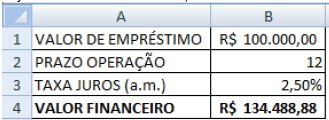
Fonte: Autor Próprio
Provas
Questão presente nas seguintes provas
- Estatística DescritivaMedidas de Tendência CentralMédiasMédia AritméticaMédia Simples (Não Agrupados)
Em Curuçá, foi feito uma enquete com 1.788 pessoas com a seguinte pergunta: Qual a preferência de tipos de mulheres nesse município?
A tabela abaixo, mostra o número desta enquete:
| COR DOS CABELOS | COR DOS OLHOS | |||
| AZUL | CASTANHO | VERDE | PRETO | |
| LOIRO | 120 | 250 | 189 | 25 |
| CASTANHO | 180 | 120 | 100 | 289 |
| RUIVO | 100 | 85 | 330 | --------- |
Qual a média aritmética da preferência por mulheres loiras?
Provas
Questão presente nas seguintes provas
“BERRO AMAZÔNICO”
Falar, já falamos. E não nos ouviram...! Gritar, já gritamos. E não nos ouviram...! Já falamos. Não ouviram...! Já gritamos. Não ouviram...! Então, berramos! Que o nosso berro amazônico possa ser ouvido em todo o Brasil e tenha ressonância pelo mundo para que venhamos a ter o respeito que merecemos e exigimos. Berramos para que a Amazônia conheça, se reconheça e se ame! Berramos para afirmar a nossa luta em defesa dos direitos dos povos e das culturas amazônidas. Berramos para afirmar os valores e as tradições de nossas manifestações artísticas e culturais, que fundam o processo de construção de nossas diversidades e identidades e que constituem o nosso espírito amazônico. Berramos porque somos nós, os amazônidas, os maiores guardiões das nossas riquezas naturais que, historicamente, vem sendo usurpadas por um sistema que tem como meta a destruição do homem e da floresta. Berramos contra a discriminação que nos marginaliza das grandes prioridades nacionais, condenando-nos a receber migalhas orçamentárias ou favores institucionais, notadamente no que se refere às artes e culturas nativas e à preservação de nosso patrimônio histórico e cultural. Berramos contra os meios de comunicação social vinculados às grandes redes que abrem espaço e repercutem informações negativas sobre a Amazônia, ignorando as nossas criação e produção artística e cultural e a nossa capacidade de refletir e propor alternativas eficazes para a Região. Berramos contra todas as formas de discriminação que sofrem as culturas indígenas e negras, bases fundamentais de nossa civilização amazônica, exigindo para elas o mesmo tratamento que queremos para as manifestações de outras etnias. Berramos porque nossa alma transborda a arte, a ciência e a cultura desta região que anseia ser conhecida mundo afora com a expressividade de nossos talentos. Berramos, finalmente, para que o Brasil tome a consciência de que a Amazônia, mais do que sua extensão territorial, possui privilegiada situação na balança comercial brasileira; se não nos querem irmanados, com o devido respeito e igualdade de tratamento, haveremos de construir a nossa própria história.
in O Liberal 16/3/2004
No trecho: " Berramos contra os meios de comunicação social vinculados às grandes redes que abrem espaço e repercutem informações negativas sobre a Amazônia, ignorando as nossas criação e produção artística e cultural e a nossa capacidade de refletir e propor alternativas eficazes para a Região", não podemos confirmar que:
Provas
Questão presente nas seguintes provas
Em uma emergência de um hospital público em Curuçá, oito enfermeiros atenderam trinta e cinco pacientes em duas horas. No outro dia, cinco enfermeiros atenderam um quinto dos pacientes do dia anterior. Em quanto tempo os enfermeiros atenderam esses pacientes?
Provas
Questão presente nas seguintes provas
A figura abaixo mostra a trajetória de um salto de esqui, um esporte praticado para deslizar na neve descrito em
!$ y = {\large - 20x^2 + 400 x \over 5} !$
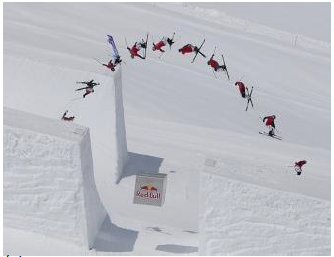
Disponível em: http://2.bp.blogspot.com/KQnMAiyeMqI/TeqhL1
VNDgI/AAAAAAAABiA/4ZaKhGPnDUg/s 1600/Simon+Dumont+Red+Bull+Cubed+Pipe.jpg. Acesso em 01/12/2015. (ADAPTADO)
A altura máxima atingida pelo esportista é de:
Provas
Questão presente nas seguintes provas
Cadernos
Caderno Container