Foram encontradas 46.411 questões.
“Wore/carried a badge (ordinarily).”
Provas

Provas
Provas
Disciplina: Inglês (Língua Inglesa)
Banca: FUNDATEC
Orgão: Pref. Pontão-RS
Publisher cancels horror novel's release over AI claims
By Paul Glynn
- Shy Girl was originally self-published in February 2025, then got a full UK release in
- November.
- The US release of a horror novel has been cancelled by its publisher over concerns that AI
- was used to help write it.
- Shy Girl by US author Mia Ballard had been scheduled for publication in the US next month,
- but that will no longer go ahead, publisher Hachette said. The UK version, which was released in
- November, will also be discontinued.
- A spokesperson for Hachette told BBC News the company “remains committed to protecting
- original creative expression and storytelling”.
- Ballard, who sold almost 2,000 copies of the book in the UK, has denied using AI to write
- the book—telling the New York Times an acquaintance she hired to edit the original self-published
- version of the novel had used AI.
- “This controversy has changed my life in many ways and my mental health is at an all time
- low and my name is ruined for something I didn't even personally do,” she said, noting she was
- pursuing legal action.
- The New York Times, which first reported the story, said it “appears to be the first
- commercial novel from a major publishing house to be pulled over evidence of AI use”.
- The publisher said: “Hachette remains committed to protecting original creative expression
- and storytelling”.
- “Orbit (in the US) will not publish Shy Girl, and Wildfire (in the UK) have decided to no
- longer continue publishing their edition,” it added, referring to its imprints.
- Originally self-published last February, Shy Girl was described in its promotional material
- as a “buzzy¹ BookTok sensation” and “a harrowing tale of survival and revenge” and well as
- being “bloody and unapologetic”.
- However, one reviewer on the GoodReads website claimed the book appeared to be “written
- by ChatGPT”, while another noted the “bizarre formatting, typos and repetitive turns of phrase”.
- BBC News has approached Ballard for further comment.
¹Buzzy (adj.): Something that is buzzy is getting a lot of attention and excitement, especially online. People are talking about it a lot, and it is popular right now.
(Available at: https://www.bbc.com/news/articles/c5y9d44jj24o – text specially adapted for this test).
In the sentence “Shy Girl by US author Mia Ballard had been scheduled for publication in the US next month, but that will no longer go ahead”, the use of “had been scheduled” serves to:
Provas
Disciplina: Inglês (Língua Inglesa)
Banca: FUNDATEC
Orgão: Pref. Pontão-RS
Publisher cancels horror novel's release over AI claims
By Paul Glynn
- Shy Girl was originally self-published in February 2025, then got a full UK release in
- November.
- The US release of a horror novel has been cancelled by its publisher over concerns that AI
- was used to help write it.
- Shy Girl by US author Mia Ballard had been scheduled for publication in the US next month,
- but that will no longer go ahead, publisher Hachette said. The UK version, which was released in
- November, will also be discontinued.
- A spokesperson for Hachette told BBC News the company “remains committed to protecting
- original creative expression and storytelling”.
- Ballard, who sold almost 2,000 copies of the book in the UK, has denied using AI to write
- the book—telling the New York Times an acquaintance she hired to edit the original self-published
- version of the novel had used AI.
- “This controversy has changed my life in many ways and my mental health is at an all time
- low and my name is ruined for something I didn't even personally do,” she said, noting she was
- pursuing legal action.
- The New York Times, which first reported the story, said it “appears to be the first
- commercial novel from a major publishing house to be pulled over evidence of AI use”.
- The publisher said: “Hachette remains committed to protecting original creative expression
- and storytelling”.
- “Orbit (in the US) will not publish Shy Girl, and Wildfire (in the UK) have decided to no
- longer continue publishing their edition,” it added, referring to its imprints.
- Originally self-published last February, Shy Girl was described in its promotional material
- as a “buzzy¹ BookTok sensation” and “a harrowing tale of survival and revenge” and well as
- being “bloody and unapologetic”.
- However, one reviewer on the GoodReads website claimed the book appeared to be “written
- by ChatGPT”, while another noted the “bizarre formatting, typos and repetitive turns of phrase”.
- BBC News has approached Ballard for further comment.
¹Buzzy (adj.): Something that is buzzy is getting a lot of attention and excitement, especially online. People are talking about it a lot, and it is popular right now.
(Available at: https://www.bbc.com/news/articles/c5y9d44jj24o – text specially adapted for this test).
In the promotional material, the novel is described as a “harrowing tale of survival and revenge” (l. 23). Based on the context of the story and its genre, the underlined word “harrowing” is closest in meaning to:
Provas
Disciplina: Inglês (Língua Inglesa)
Banca: FUNDATEC
Orgão: Pref. Pontão-RS
Publisher cancels horror novel's release over AI claims
By Paul Glynn
- Shy Girl was originally self-published in February 2025, then got a full UK release in
- November.
- The US release of a horror novel has been cancelled by its publisher over concerns that AI
- was used to help write it.
- Shy Girl by US author Mia Ballard had been scheduled for publication in the US next month,
- but that will no longer go ahead, publisher Hachette said. The UK version, which was released in
- November, will also be discontinued.
- A spokesperson for Hachette told BBC News the company “remains committed to protecting
- original creative expression and storytelling”.
- Ballard, who sold almost 2,000 copies of the book in the UK, has denied using AI to write
- the book—telling the New York Times an acquaintance she hired to edit the original self-published
- version of the novel had used AI.
- “This controversy has changed my life in many ways and my mental health is at an all time
- low and my name is ruined for something I didn't even personally do,” she said, noting she was
- pursuing legal action.
- The New York Times, which first reported the story, said it “appears to be the first
- commercial novel from a major publishing house to be pulled over evidence of AI use”.
- The publisher said: “Hachette remains committed to protecting original creative expression
- and storytelling”.
- “Orbit (in the US) will not publish Shy Girl, and Wildfire (in the UK) have decided to no
- longer continue publishing their edition,” it added, referring to its imprints.
- Originally self-published last February, Shy Girl was described in its promotional material
- as a “buzzy¹ BookTok sensation” and “a harrowing tale of survival and revenge” and well as
- being “bloody and unapologetic”.
- However, one reviewer on the GoodReads website claimed the book appeared to be “written
- by ChatGPT”, while another noted the “bizarre formatting, typos and repetitive turns of phrase”.
- BBC News has approached Ballard for further comment.
¹Buzzy (adj.): Something that is buzzy is getting a lot of attention and excitement, especially online. People are talking about it a lot, and it is popular right now.
(Available at: https://www.bbc.com/news/articles/c5y9d44jj24o – text specially adapted for this test).
Analyze the use of the relative pronoun in the third paragraph. The underlined word “which” (l. 06) refers to:
Provas
Disciplina: Inglês (Língua Inglesa)
Banca: FUNDATEC
Orgão: Pref. Pontão-RS
Publisher cancels horror novel's release over AI claims
By Paul Glynn
- Shy Girl was originally self-published in February 2025, then got a full UK release in
- November.
- The US release of a horror novel has been cancelled by its publisher over concerns that AI
- was used to help write it.
- Shy Girl by US author Mia Ballard had been scheduled for publication in the US next month,
- but that will no longer go ahead, publisher Hachette said. The UK version, which was released in
- November, will also be discontinued.
- A spokesperson for Hachette told BBC News the company “remains committed to protecting
- original creative expression and storytelling”.
- Ballard, who sold almost 2,000 copies of the book in the UK, has denied using AI to write
- the book—telling the New York Times an acquaintance she hired to edit the original self-published
- version of the novel had used AI.
- “This controversy has changed my life in many ways and my mental health is at an all time
- low and my name is ruined for something I didn't even personally do,” she said, noting she was
- pursuing legal action.
- The New York Times, which first reported the story, said it “appears to be the first
- commercial novel from a major publishing house to be pulled over evidence of AI use”.
- The publisher said: “Hachette remains committed to protecting original creative expression
- and storytelling”.
- “Orbit (in the US) will not publish Shy Girl, and Wildfire (in the UK) have decided to no
- longer continue publishing their edition,” it added, referring to its imprints.
- Originally self-published last February, Shy Girl was described in its promotional material
- as a “buzzy¹ BookTok sensation” and “a harrowing tale of survival and revenge” and well as
- being “bloody and unapologetic”.
- However, one reviewer on the GoodReads website claimed the book appeared to be “written
- by ChatGPT”, while another noted the “bizarre formatting, typos and repetitive turns of phrase”.
- BBC News has approached Ballard for further comment.
¹Buzzy (adj.): Something that is buzzy is getting a lot of attention and excitement, especially online. People are talking about it a lot, and it is popular right now.
(Available at: https://www.bbc.com/news/articles/c5y9d44jj24o – text specially adapted for this test).
Who does Mia Ballard claim is actually responsible for the use of Artificial Intelligence in the novel?
Provas
Disciplina: Inglês (Língua Inglesa)
Banca: FUNDATEC
Orgão: Pref. Pontão-RS
Publisher cancels horror novel's release over AI claims
By Paul Glynn
- Shy Girl was originally self-published in February 2025, then got a full UK release in
- November.
- The US release of a horror novel has been cancelled by its publisher over concerns that AI
- was used to help write it.
- Shy Girl by US author Mia Ballard had been scheduled for publication in the US next month,
- but that will no longer go ahead, publisher Hachette said. The UK version, which was released in
- November, will also be discontinued.
- A spokesperson for Hachette told BBC News the company “remains committed to protecting
- original creative expression and storytelling”.
- Ballard, who sold almost 2,000 copies of the book in the UK, has denied using AI to write
- the book—telling the New York Times an acquaintance she hired to edit the original self-published
- version of the novel had used AI.
- “This controversy has changed my life in many ways and my mental health is at an all time
- low and my name is ruined for something I didn't even personally do,” she said, noting she was
- pursuing legal action.
- The New York Times, which first reported the story, said it “appears to be the first
- commercial novel from a major publishing house to be pulled over evidence of AI use”.
- The publisher said: “Hachette remains committed to protecting original creative expression
- and storytelling”.
- “Orbit (in the US) will not publish Shy Girl, and Wildfire (in the UK) have decided to no
- longer continue publishing their edition,” it added, referring to its imprints.
- Originally self-published last February, Shy Girl was described in its promotional material
- as a “buzzy¹ BookTok sensation” and “a harrowing tale of survival and revenge” and well as
- being “bloody and unapologetic”.
- However, one reviewer on the GoodReads website claimed the book appeared to be “written
- by ChatGPT”, while another noted the “bizarre formatting, typos and repetitive turns of phrase”.
- BBC News has approached Ballard for further comment.
¹Buzzy (adj.): Something that is buzzy is getting a lot of attention and excitement, especially online. People are talking about it a lot, and it is popular right now.
(Available at: https://www.bbc.com/news/articles/c5y9d44jj24o – text specially adapted for this test).
According to the text, what is the main reason why the publisher Hachette cancelled the US release of the novel “Shy Girl”?
Provas

In the last panel of the comic strip, the barber says: “Well, I guess this guy knows which side his bread is buttered on!”. Grammatically, the word “his” is a:
Provas
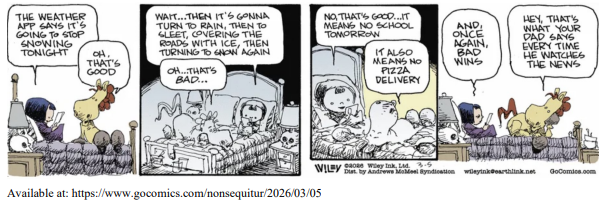
Consider the statement “Once again, bad wins.”. Choose the alternative containing an antonym for bad.
Provas
Caderno Container