Foram encontradas 120 questões.
Text II
Peak Oil for Dummies
by Tom Rogue - August 09, 2009
Over the past decade, a fierce debate has emerged amongst energy experts about whether global oil production was about to reach a peak, followed by an irreversible decline. This event, commonly known as “Peak Oil” far outreaches the sole discipline of geology. From transportation to modern agriculture, petrochemicals and even the pharmaceutical industry all of them rely on one commodity: cheap and abundant oil. In order to sustain the needs of an ever globalized world, oil demand should double by 2050.
Nonetheless, geological limitations will disrupt this improbable scenario. In fact, a growing proportion of energy experts argue that Peak Oil is impending and warn about the extraordinary scale of the crisis.
According to the 2009 BP Statistical Review, the world has precisely 42 years of oil left. Those numbers come from a very simple formula, the R/P ratio, which consists of dividing the official number of global oil reserves by the level of today’s production.
Nevertheless, this methodology is dangerously defective on several key points as it ignores geological realities. Oil production does not consist of a plan level of production that brutally ends one day; it follows a bell-shaped curve.
Indeed, the important day occurs when production starts to decline, not when it ends. As it is a non-flexible commodity, even a small deficit in oil production can lead to a major price surge.
Finally, the R/P ratio does not acknowledge that production costs increase over the time; the first oil fields to be developed were logically the easy ones and so the most profitable. It is well recognized that remaining oil fields consist of poor quality oil or remotely located fields which need high technologies and expensive investments. Therefore, relying on the R/P ratio gives a false impression of security while the actual situation is critical.
Oil is a strategic resource; therefore having oil is a key political and economical advantage for a state. This is why politics interfere in the evaluation of oil reserves, especially in countries with poor accountability records; that is, the majority of OPEC countries. In fact, OPEC oil reserves have dramatically increased during the 1980s and 1990s. However, they have not discovered major oil fields after the 1970s. At this conjuncture, the question of what lays behind these fluctuations needs to be asked.
The geologist Dr. Colin Campbell, founder of the Association for the Study of Peak Oil and Gas (ASPO), explains the hidden reasons that led to these changes: “In 1985, Kuwait, added 50% to its reserve. At that time, the OPEC quota was based on the reported reserves; the more you reported, the more you could produce.”
Fellow OPEC members who were unwilling to see the influence of Kuwait growing, simply raised their reserves soon after. Moreover, OPEC countries continue to present their reserves as flat despite having extracted huge amounts of oil during the past twenty years.
At this point, we should not forget that oil reserves reported by these countries are not audited by independent experts. In 2006, the notorious Petroleum Intelligence Weekly said it had access to confidential Kuwaiti reports which stated that reserves were half the official numbers.
The question of oil reserves is most relevant. As oil exporting countries have less oil in their ground, Peak Oil will arrive faster. Oil optimists who argue Peak Oil is still decades away rely on these same erroneous data.
In addition, if importing countries assume oil reserves are abundant as they do, the crisis will be unexpected, unprepared and misunderstood; in one word: overwhelming. Similarly, once oil shortages occur, oil importing countries may assume that exporting countries are deliberately reducing their oil exports to harm their national interests.
Such a flawed assumption from oil importing countries is likely to have serious repercussions, and eventually lead to new oil wars.
http://seekingalpha.com/article/154901-peak-oil-for-dummies, access on March 14, 2010.
The fragment “oil demand should double by 2050.” expresses a(n)
Provas
Questão presente nas seguintes provas

Text I
The age of speed: how to reduce global fuel consumption by 75 percent
September 11, 2008
Low-tech Magazine
Breaking speed records was an almost daily occurrence throughout the 20th century. Cars, ships, planes and trains became faster and faster, year after year. Because the power needed to push an object through air increases with the cube of velocity, this race to ever higher speeds raises energy consumption exponentially.
Engineers treat velocity as a non-variable, while in fact it is the most powerful factor to save a really huge amount of energy - with just one stroke, at minimal cost, and without the need for new technology. Lower speeds combined with more energy efficient engines, better aerodynamics and lighter materials could make fuel savings even larger.
Air resistance increases with the square of speed, and therefore the power needed to push an object through air increases with the cube of the velocity. If a car cruising on the highway at 80 km/h requires 30 kilowatts to overcome air drag, that same car will require 240 kilowatts at a speed of 160 km/h. Thus, a vehicle needs 8 times the engine power to reach twice the speed. In principle, this means that fuel consumption will increase fourfold (not eightfold, because the faster vehicle exerts the power only over half the time).
Over a distance of 1,000 kilometres, the slow car would consume 375 kilowatt-hours (12.5 hours multiplied by 30 kilowatts) and the fast car would consume 1,500 kilowatt-hours (6.25 hours multiplied by 240 kilowatts).
However, this extra fuel consumption can be diminished or even negated by, most importantly, more fuel efficient engines, lighter materials and better aerodynamics. Even though today’s cars are faster than those from decades ago, they consume a similar amount of fuel. This is the reason why almost everybody is talking about energy efficiency and aerodynamics, and not about speed.
But if you lower the speed, fuel consumption is decreased by the full 75 percent. More efficient technology cannot change that – unless in a positive way. If you combine a lower speed with more fuel efficient engines and better aerodynamics, fuel savings can become much larger than 75 percent.
A decrease of 75 percent in fuel consumption is not peanuts. More than 60 percent of world oil production is used for transportation, which means that total oil production would be almost halved (-45%). In combination with more efficient engines, better aerodynamics and lighter materials a 75 percent reduction of oil production is not unrealistic.
Yet, when the International Energy Agency argues that the average car sold in 2030 would need to consume 60 percent less fuel than the average car sold in 2005, it claims: “With current technologies, only plug-in hybrids are capable of this”.
This statement is wrong. We could lower the fuel consumption of cars (and other vehicles) by at least 75 percent, we could do it today, and we can do it with present technology.
© Kris De Decker (edited by Vincent Grosjean) http://www.lowtechmagazine.com/2008/09/speed-energy.html, access on April 6, 2010.
‘It’ in “... while in fact it is the most powerful factor...” refers to
Provas
Questão presente nas seguintes provas
Text II
Peak Oil for Dummies
by Tom Rogue - August 09, 2009
Over the past decade, a fierce debate has emerged amongst energy experts about whether global oil production was about to reach a peak, followed by an irreversible decline. This event, commonly known as “Peak Oil” far outreaches the sole discipline of geology. From transportation to modern agriculture, petrochemicals and even the pharmaceutical industry all of them rely on one commodity: cheap and abundant oil. In order to sustain the needs of an ever globalized world, oil demand should double by 2050.
Nonetheless, geological limitations will disrupt this improbable scenario. In fact, a growing proportion of energy experts argue that Peak Oil is impending and warn about the extraordinary scale of the crisis.
According to the 2009 BP Statistical Review, the world has precisely 42 years of oil left. Those numbers come from a very simple formula, the R/P ratio, which consists of dividing the official number of global oil reserves by the level of today’s production.
Nevertheless, this methodology is dangerously defective on several key points as it ignores geological realities. Oil production does not consist of a plan level of production that brutally ends one day; it follows a bell-shaped curve.
Indeed, the important day occurs when production starts to decline, not when it ends. As it is a non-flexible commodity, even a small deficit in oil production can lead to a major price surge.
Finally, the R/P ratio does not acknowledge that production costs increase over the time; the first oil fields to be developed were logically the easy ones and so the most profitable. It is well recognized that remaining oil fields consist of poor quality oil or remotely located fields which need high technologies and expensive investments. Therefore, relying on the R/P ratio gives a false impression of security while the actual situation is critical.
Oil is a strategic resource; therefore having oil is a key political and economical advantage for a state. This is why politics interfere in the evaluation of oil reserves, especially in countries with poor accountability records; that is, the majority of OPEC countries. In fact, OPEC oil reserves have dramatically increased during the 1980s and 1990s. However, they have not discovered major oil fields after the 1970s. At this conjuncture, the question of what lays behind these fluctuations needs to be asked.
The geologist Dr. Colin Campbell, founder of the Association for the Study of Peak Oil and Gas (ASPO), explains the hidden reasons that led to these changes: “In 1985, Kuwait, added 50% to its reserve. At that time, the OPEC quota was based on the reported reserves; the more you reported, the more you could produce.”
Fellow OPEC members who were unwilling to see the influence of Kuwait growing, simply raised their reserves soon after. Moreover, OPEC countries continue to present their reserves as flat despite having extracted huge amounts of oil during the past twenty years.
At this point, we should not forget that oil reserves reported by these countries are not audited by independent experts. In 2006, the notorious Petroleum Intelligence Weekly said it had access to confidential Kuwaiti reports which stated that reserves were half the official numbers.
The question of oil reserves is most relevant. As oil exporting countries have less oil in their ground, Peak Oil will arrive faster. Oil optimists who argue Peak Oil is still decades away rely on these same erroneous data.
In addition, if importing countries assume oil reserves are abundant as they do, the crisis will be unexpected, unprepared and misunderstood; in one word: overwhelming. Similarly, once oil shortages occur, oil importing countries may assume that exporting countries are deliberately reducing their oil exports to harm their national interests.
Such a flawed assumption from oil importing countries is likely to have serious repercussions, and eventually lead to new oil wars.
http://seekingalpha.com/article/154901-peak-oil-for-dummies, access on March 14, 2010.
The aim of Text II is to
Provas
Questão presente nas seguintes provas
Considere o texto abaixo para responder a questão.
Para realizar a calibração de um termômetro de mercúrio, um laboratorista utilizou gelo fundente e água em ebulição, sob pressão atmosférica. Foi verificado que, para a fusão do gelo, a altura da coluna de mercúrio foi de 5 cm, ao passo que, para a água em ebulição, a altura foi igual a 30 cm, sendo a altura total da cânula do termômetro igual a 40 cm. O laboratorista teve o cuidado de realizar todas essas medidas a partir do centro do bulbo. Por questões operacionais, estabeleceu que, para utilizar o termômetro, as leituras deveriam ser realizadas a partir de uma altura de coluna igual a 3 cm, onde foi feita uma marcação com tinta indelével.
Ao finalizar a calibração, o laboratorista concluiu que o termômetro descrito no texto pode ser empregado para medir a temperatura de reações que ocorram entre
Provas
Questão presente nas seguintes provas
Considere o texto abaixo para responder a questão.
Para realizar a calibração de um termômetro de mercúrio, um laboratorista utilizou gelo fundente e água em ebulição, sob pressão atmosférica. Foi verificado que, para a fusão do gelo, a altura da coluna de mercúrio foi de 5 cm, ao passo que, para a água em ebulição, a altura foi igual a 30 cm, sendo a altura total da cânula do termômetro igual a 40 cm. O laboratorista teve o cuidado de realizar todas essas medidas a partir do centro do bulbo. Por questões operacionais, estabeleceu que, para utilizar o termômetro, as leituras deveriam ser realizadas a partir de uma altura de coluna igual a 3 cm, onde foi feita uma marcação com tinta indelével.
Para o termômetro descrito no texto, a temperatura T, expressa em graus Celsius, e o valor da altura da coluna de mercúrio L, medida em centímetros, atendem à função termométrica
Provas
Questão presente nas seguintes provas
Um reservatório de água aberto é localizado no pátio de uma fábrica. O fundo do reservatório tem contato direto com o chão, pavimentado com asfalto. Ao longo do dia, é verificada uma variação na temperatura da água, conforme o gráfico esquemático apresentado abaixo.
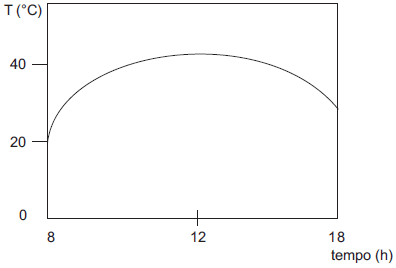
Figura: Variação da temperatura da água no tanque.
A variação da temperatura ao longo do dia pode ser atribuída à transferência de calor por radiação,
Provas
Questão presente nas seguintes provas
Um experimento foi conduzido para a determinação do calor específico de um fluido miscível com a água. Para tal, foram adicionados 50 g desse fluido, cuja temperatura era 20 ºC, a um recipiente termicamente isolado contendo 200 g de água, a uma temperatura de 80 ºC. No equilíbrio, a temperatura foi igual a 70 ºC. Sabendo-se que o calor específico da água é igual a 1 cal/g ºC, o valor do calor específico do fluido, expresso na mesma unidade, é
Provas
Questão presente nas seguintes provas
Considere o texto a seguir para responder a questão.
A temperatura ótima para uma reação química em um dado processo é 145 ºC. Antes de dar início à reação, o reator contendo o meio reacional que, no instante t = 0 se encontra a 25 ºC, deve ser aquecido para, então, ser adicionado o catalisador. O sistema de aquecimento foi programado para aquecer o reator a uma taxa média de 2 ºC/minuto. No entanto, com 15 minutos de aquecimento, o sistema apresentou um problema e passou a operar com uma taxa média de aquecimento igual a 1,5 ºC/minuto.
A diferença de temperatura expressa em ºF, do início do aquecimento até o instante em que ocorreu o problema no sistema, chegou a
Provas
Questão presente nas seguintes provas
Considere o texto a seguir para responder a questão.
A temperatura ótima para uma reação química em um dado processo é 145 ºC. Antes de dar início à reação, o reator contendo o meio reacional que, no instante t = 0 se encontra a 25 ºC, deve ser aquecido para, então, ser adicionado o catalisador. O sistema de aquecimento foi programado para aquecer o reator a uma taxa média de 2 ºC/minuto. No entanto, com 15 minutos de aquecimento, o sistema apresentou um problema e passou a operar com uma taxa média de aquecimento igual a 1,5 ºC/minuto.
Considerando-se que não houve perda de calor do reator para o ambiente, e devido ao maior tempo de aquecimento em relação ao previsto inicialmente, o problema ocorrido no sistema de aquecimento acarretou uma
Provas
Questão presente nas seguintes provas
Os termômetros de uso doméstico ou de uso em laboratório são dispositivos cilíndricos, fechados, dotados de um bulbo na parte inferior contendo mercúrio. Na parte interna, o bulbo tem comunicação com uma cânula e, na parte externa do termômetro, há uma escala, dita termométrica, onde é feita a leitura da temperatura. O princípio de funcionamento do termômetro está relacionado a que propriedade do mercúrio?
Provas
Questão presente nas seguintes provas
Cadernos
Caderno Container