Foram encontradas 863 questões.
Dois blocos estão conectados por um cabo inextensível e com massa desprezível, como mostrado na figura. Se o sistema é liberado do repouso, determine a velocidade do bloco A depois que ele se desloca 3 m. Admita que o coeficiente de atrito cinético entre o bloco A e o plano seja de μk=0,2, e que a roldana tenha massa desprezível e peso e atrito desconsideráveis.
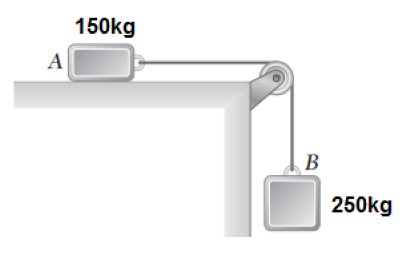
Assinale a alternativa CORRETA:
Provas

Considere o estado plano de tensões abaixo.
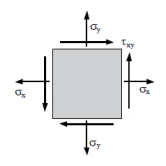
I. e σy , σx então a tensão principal máxima é dada por σmáx = σx + τxy .
II. Se σy = σx , então a tensão principal mínima é dada por σmín = - σx + τxy .
III. Se σx = 80 MPa, σy = 20 MPa, τxy =40MPa, então a tensão principal máxima é dada por σmáx = 100 MPa .
IV. Se σx = 80 MPa, σy = 20 MPa, τxy = 40MPa, então a tensão de cisalhamento máxima é dada por τmáx = 50 MPa.
V. Se σx = 80 MPa, σy = 20 MPa, τxy = 40MPa, então a tensão de cisalhamento máxima é dada por τmáx = -50 MPa .
Assinale a alternativa em que todas a(s) afirmativa(s) está(ão) CORRETA(S):
Provas
Analise as afirmativas a seguir.
I. A deflexão lateral que ocorre em elementos estruturais compridos e esbeltos sujeitos à compressão axial é denominada flambagem.
II. A carga crítica é a carga máxima axial que uma coluna pode suportar quando está na iminência de sofrer a flambagem.
III. A tensão crítica na flambagem é definida por .
IV. A carga crítica independe da resistência do material, ou seja, depende somente das dimensões da coluna e da rigidez (módulo de elasticidade).
Assinale a alternativa em que todas as afirmativas estão CORRETAS:
Provas
Sobre parafusos, julgue as afirmativas a seguir, com “V” para VERDADEIRAS ou “F” para FALSAS.
( ) Existem diversos maneiras de unir peças, como por exemplo, rebites, soldas, parafusos e etc. Os parafusos são os mais utilizados por serem um tipo de união fixa.
( ) A área resistente nas roscas métricas é a área calculada em função do diâmetro dos flancos.
( ) Os tipos mais usados de roscas são: a rosca métrica, a rosca Whitworth e as unificadas.
( ) Existem somente roscas finas métricas. Roscas Whitworth e roscas unificadas só possuem roscas grossas.
Assinale a alternativa que contém a sequência CORRETA de preenchimento dos parênteses, de cima para baixo.
Provas
A figura (a) abaixo mostra um trem de engrenagem de dentes retos. A figura (b) mostra o diagrama de corpo livre da engrenagem 3. O pinhão 2 roda a 167,55 rad/s e transmite 3 KW à engrenagem intermediária sem torque. O número de dentes da engrenagem 3 e da engrenagem 2 são respectivamente 56 e 24 e o módulo m das engrenagens é 2 mm.
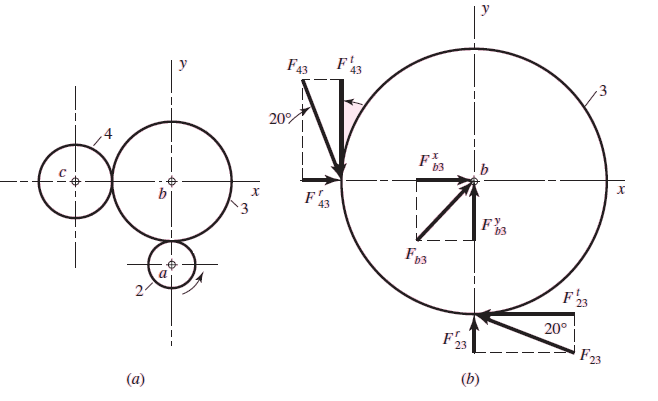
O valor da força tangencial em KN da engrenagem 2 sobre a engrenagem 3 é igual a:
Provas
Analise as figuras abaixo.
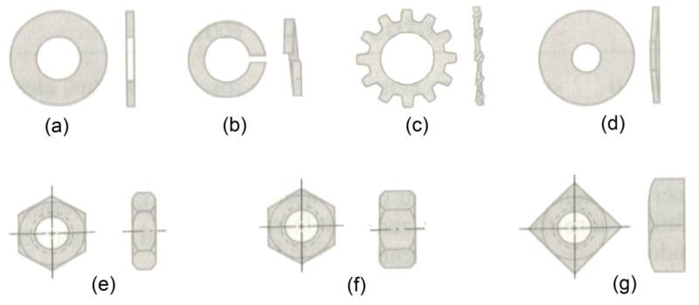
Com base nas figuras, as arruelas (a), (b), (c) e (d) e as porcas (e), (f) e (g). Assinale a alternativa CORRETA, na sequência da esquerda para a direita:
Provas
Sobre correias, julgue as afirmativas a seguir com “V” para VERDADEIRO ou “F” para FALSO.
( ) A transmissão por correia aberta é utilizada em eixos paralelos com mesma direção de rotação.
( ) A transmissão por correia cruzada é utilizada em eixos paralelos com direção de rotação oposta.
( ) A transmissão por correia meio cruzada e angular é sempre utilizada em eixos paralelos.
( ) Algumas correias podem ser fabricadas em couro e borracha. Porém, existem outros tipos de materiais para fabricação de correias.
Assinale a alternativa que contém a sequência CORRETA de preenchimento dos parênteses, de cima para baixo.
Provas
Considere um par de polias realizando uma transmissão. A polia (1) está fixa no eixo (1), que é o eixo motor, e possui um diâmetro de 150 mm. A polia (2) está fixa no eixo (2) e possui diâmetro de 240 mm. Considere as afirmativas a seguir.
I. Desconsiderando o escorregamento da correia sobre as polias, a velocidade periférica da polia (1) é igual à velocidade periférica da polia (2).
II. A relação de transmissão é igual a 1,6.
III. A relação de transmissão é igual a 0,625.
IV. Se a polia (1) possuir uma rotação de 900 rpm, a rotação da polia (2) é igual a 450 rpm.
V. A distância mínima entre os centros das polias é igual a 195 mm.
Assinale a alternativa em que todas as afirmativas estão CORRETAS.
Provas
Os rebites são utilizados em inúmeras operações. Sobre junções rebitadas, julgue as afirmativas a seguir.
I. Rebites proporcionam junções de elevadas resistência para estruturas de aço, como por exemplo, estruturas de edifícios, pontes e guindastes.
II. Junções rebitadas não possuem elevada resistência e, por isso, não podem ser utilizadas em estruturas de aço.
III. Com a utilização de rebites podem ser obtidas junções estanques de elevada resistência, como por exemplo, em caldeiras.
IV. Rebites proporcionam junções de responsabilidade de chapas de revestimento, como por exemplo, em construções de aviões.
Assinale a alternativa em que todas a(s) afirmativa(s) está(ão) CORRETA(S):
Provas
Read the excerpt below and answer the questions 34 to 40.
- The transfer of Alaska from Russia to the United States formed one of those unbelievable incidents of
- history because by 1867, Russia was nervously eager to get rid of it, while the United States still
- recovering from the Civil War and immersed in the impending impeachment of President Johnson,
- refused to accept it on any terms.
- At this impasse an extraordinary man monopolized center stage. He was not a Russian, a fact which
- would become important more than a century later, but a soi-disant baron of dubious background; half
- Austrian, half Italian, and a charmer who was picked up in 1841 for temporary duty representing Russia in
- the United States and who lingered there till 1868. In that time, Edouard de Stoeckl, parading himself as a
- nobleman, although no one could say for sure how or when or even if he had earned his title, became
- such an ardent friend of America that he married an American heiress and took upon himself the task of
- acting as marriage broker between Russia, which he called homeland, and the United States, his adopted
- residence.
- He faced a most difficult task, for when the United States showed hesitancy about accepting Alaska,
- support for the sale withered in Russia, and later when Russia wanted to sell, half a dozen of the most
- influential American politicians led by Secretary of State William Seward of New York looked far into the
- future and saw the desirability of acquiring Alaska to serve as America's artic bastion, yet the hard-
- headed businessmen in the Senate, the House and the general public opposed the purchase with all the
- scorn they could summon. 'Seward's Icebox' and 'Seward's Folly' were two of the gentler jibes. Some
- critics accused Seward of being in the pay of the Russians; others accused De Stoeckl of buying votes in
- the House. One sharp satirist claimed that Alaska contained nothing but polar bears and Eskimos, and
- many protested that America should not accept this useless, frozen domain even if Russia wanted to give
- it away.
- Many pointed out that Alaska had no wealth of any kind, not even reindeer, which proliferated in other
- northern areas, and experts affirmed that an arctic area like this could not possibly have any minerals or
- other deposits of value. On and on went the abuse of this unknown and somewhat terrifying land, and the
- castigations would have been comical had they not influenced American thinking and behavior and
- condemned Alaska to decades of neglect.
- But an ingenious man like Baron de Stoeckl was not easily diverted from his main target, and with
- Seward's unflinching support and admirable statesmanship, the sale squeaked by with a favorable margin
- of one vote. By such a narrow margin did the United States come close to losing one of her potentially
- valuable acquisitions, but of course, had one viewed Alaska from the vantage point of frozen Fort Nulato
- in 1867, with the thermometer at minus-fifty-seven and about to be attacked by hostile Athapascans, the
- purchase at more than $7,000,000 would have seemed a poor bargain.
- Now the comedy intensified, became burlesque, for although the U.S Senate had bought the place,
- the U.S. House refused to appropriate the money to pay for it, and for many tense months the sale hung
- in the balance. When a favorable vote was finally taken, it was almost negated by the discovery that
- Baron de Stoeckl had disposed of $125,000 in cash for which he refused to give an accounting. Widely
- suspected of having bribed congressmen to vote for land that was obviously worthless, the baron waited
- until the sale was completed, then quietly slipped out of the country, his life's ambition having been
- achieved.
- One congressman with a keen sense of history, economics and geopolitics said of the whole affair:
- 'If we were so eager to show Russia our appreciation of the help she gave us during the Civil War, why
- didn't we give her the seven million and tell her to keep her damned colony? It'll never be of any use to
- us.'
-
Excerpt from: MICHENER, James A. Alaska. Fawcett Books: New York, 1988, p. 369 - 370.
Consider the statements below:
I. The verbs 'claimed' (line 20), 'pointed out' (line 23), and 'affirmed' (line 24) are verbs of saying;
II. The sentence 'Alaska contained nothing' (line 20) can be rewritten as 'Alaska did not contain anything';
III. The sentence 'Baron de Stoeckl had disposed of $125,000 in cash' (lines 37) means that the Baron won that sum of money only after the negotiations were finished.
Provas
Caderno Container