Foram encontradas 40 questões.
Read the text and answer the question.
Motivation
Motivation is the force that inspires us to do something: pass an examination, get a better job, or climb the highest mountain in the world. Psychology offers us many theoretical approaches for explaining what motivates us. At the most basic level is the “drive-reduction approach”. We usually try to reduce these needs by finding ways to fulfill them. If you're hungry before dinnertime, you might eat a snack to relieve that feeling of hunger. However, this approach does not sufficiently explain the motivation behind more complex behaviors.
“Cognitive approaches” propose that we do things because of the way we think about the world, the goals we wish to achieve, and our expectations. There are two separate types of behavior related to the cognitive approaches: intrinsic motivation and extrinsic motivation. The former motivation means that we do something just because we like doing it, not because we think it will lead to some kind of future reward, praise, or honor. For example, an intrinsically motivated student might read extra materials not to get better grades, but just because the topic is interesting. This can be seen in the case of an extrinsically motivated employee who agrees to relocate for higher wages even though it means living in a new city that he doesn't particularly like.
Interestingly, psychological studies suggest that we are more likely to push ourselves harder and do our best work when we do it for our own enjoyment or simply because it is interesting or personally challenging to us. That is, when we are intrinsically motivated. However, it is believed that if we become more extrinsically motivated by external rewards, we may find that our intrinsic motivation is significantly lowered. This is especially true when a person thinks that the extrinsic motivators - better job conditions or more vacation time – are controlled by other people. For instance, when an employee discovers that to get an important promotion, his boss insists that he work very long hours, he may begin to lose motivation.
(GILBERT, T. L. & ZEMACK, D. E. Express to the TOEFL iBT test. New York: Pearson, 2013.)
Which of the following is NOT stated in the text?
Provas
Questão presente nas seguintes provas

Read the text and answer the question.
Motivation
Motivation is the force that inspires us to do something: pass an examination, get a better job, or climb the highest mountain in the world. Psychology offers us many theoretical approaches for explaining what motivates us. At the most basic level is the “drive-reduction approach”. We usually try to reduce these needs by finding ways to fulfill them. If you're hungry before dinnertime, you might eat a snack to relieve that feeling of hunger. However, this approach does not sufficiently explain the motivation behind more complex behaviors.
“Cognitive approaches” propose that we do things because of the way we think about the world, the goals we wish to achieve, and our expectations. There are two separate types of behavior related to the cognitive approaches: intrinsic motivation and extrinsic motivation. The former motivation means that we do something just because we like doing it, not because we think it will lead to some kind of future reward, praise, or honor. For example, an intrinsically motivated student might read extra materials not to get better grades, but just because the topic is interesting. This can be seen in the case of an extrinsically motivated employee who agrees to relocate for higher wages even though it means living in a new city that he doesn't particularly like.
Interestingly, psychological studies suggest that we are more likely to push ourselves harder and do our best work when we do it for our own enjoyment or simply because it is interesting or personally challenging to us. That is, when we are intrinsically motivated. However, it is believed that if we become more extrinsically motivated by external rewards, we may find that our intrinsic motivation is significantly lowered. This is especially true when a person thinks that the extrinsic motivators - better job conditions or more vacation time – are controlled by other people. For instance, when an employee discovers that to get an important promotion, his boss insists that he work very long hours, he may begin to lose motivation.
(GILBERT, T. L. & ZEMACK, D. E. Express to the TOEFL iBT test. New York: Pearson, 2013.)
Considering the information in the text, mark T for the true statements and F for the false ones.
( ) highest , most basic, best work are in the superlative form.
( ) better grades, higher wages , more extrinsically motivated are in the comparative of inferiority form.
( ) us and our are possessive pronouns.
( ) motivated and theoretical are adjectives.
Mark the correct sequence.
Provas
Questão presente nas seguintes provas
Read the text and answer the question.
Teachers assessing students
Assessment of performance can be explicit when we say That was really good, or implicit when, during a language drill for example, we pass on to the next student without making any comment or correction (there is always the danger, however, that the student may misconstrue our silence as something else).
Because the assessment we give is either largely positive or somewhat negative students are likely to receive it in terms of praise or criticism. Indeed, one of our roles is to encourage students by praising them for work that is well done, just as it is one of our duties to say when things have not been successful. Yet the value of this praise and blame is not quite as clear-cut as such a bald statement might imply.
(HARMER, J. The practice of Language Learning Teaching. 7Th ed. London: Longman, 2005.)
Regarding the assessment of student's performance, the text encourages teachers to
Provas
Questão presente nas seguintes provas
Sobre a educação profissional e tecnológica na Lei N.º 9.394/1996, é INCORRETO afirmar:
Provas
Questão presente nas seguintes provas
De acordo com as Orientações Curriculares do Estado de Mato Grosso (MATO GROSSO, 2010, p. 100/101), “a leitura e interpretação de textos de diferentes gêneros discursivos que circulam socialmente exigem do aluno, inicialmente, reconhecer-se como interlocutor. [...] Na produção de textos o estudante precisa ser ensinado a assumir-se como autor de seus textos”.
A partir dessa afirmação, analise as assertivas abaixo.
I - Somente uma concepção de leitura e escrita que leve em consideração aspectos sociais e discursivos poderá orientar o desenvolvimento da interlocução.
II - A interlocução é característica da oralidade, posto que, na escrita, deve-se observar a norma culta.
III - Para que o aluno se reconheça como interlocutor, ele precisa assumir o papel de locutor em práticas discursivas efetivas.
IV - O desenvolvimento do papel de locutor e do de autor é favorecido com o trabalho das três dimensões constitutivas do gênero: tema, estrutura composicional e estilo.
Estão corretas as assertivas
Provas
Questão presente nas seguintes provas
Read the text and answer the question.
Teachers assessing students
Assessment of performance can be explicit when we say That was really good, or implicit when, during a language drill for example, we pass on to the next student without making any comment or correction (there is always the danger, however, that the student may misconstrue our silence as something else).
Because the assessment we give is either largely positive or somewhat negative students are likely to receive it in terms of praise or criticism. Indeed, one of our roles is to encourage students by praising them for work that is well done, just as it is one of our duties to say when things have not been successful. Yet the value of this praise and blame is not quite as clear-cut as such a bald statement might imply.
(HARMER, J. The practice of Language Learning Teaching. 7Th ed. London: Longman, 2005.)
In the text, the words Indeed, encourage , duties , likely can be replaced respectively by
Provas
Questão presente nas seguintes provas
Read the text and answer the question.
Standard English developed not only at the expense of Latin and French, but also at the expense of other, 'non-standard' social dialects (and of the other languages of Britain – Welsh and Gaelic, and especially since the Second World War many others, including a number of Asian languages). Standard English was regarded as correct English, and other social dialects were stigmatized not only in terms of correctness but also in terms which indirectly reflected on the lifestyles, morality and so forth of their speakers, the emergent working class of capitalist society: they were vulgar, slovenly, low, barbarous, and so forth. The establishment of the dominance of standard English and the subordination of other social dialects was part and parcel of the establishment of the dominance of the capitalist class and the subordination of the working class.
(FAIRCLOUGH, N. Language and Power. New York: Longman, 1989.)
The expression part and parcel in the text means
Provas
Questão presente nas seguintes provas
Read the text and answer question.
At a tertiary institution in Hong Kong, a foreign teacher is lecturing to a class of students, who listen attentively, occasionally commenting to each other in Cantonese on what the teacher has said. The teacher, disturbed by the talking, stops and waits for the students to stop. The students, sensing the teacher's discomfort, become silent, and the teacher resumes lecturing. Gradually, the students learn that the teacher expects them to be silent when she is lecturing. At the end of the lecture, the teacher asks whether there are questions. One student asks a question, and, as the teacher responds, the other students start talking among themselves. Soon it becomes noisy enough that the teacher either has to move toward the student in order to continue the discourse or ask the other students to be quiet. In either case, it is not long before students begin to ask whether they are permitted to leave. The teacher must then decide whether the class is over and if so, either give nonverbal permission and continue talking, or cut off her conversation at least momentarily to announce that the class is dismissed. If not, she may hurriedly give instructions regarding the assignment for the next class. She cannot help feeling that the students are being rude or showing lack of interest in the class. She may feel that she is wasting her breath if one student has raised an important question and the others are not listening to her response.
(SCOLLON, S. Not to waste words or students. In Culture in Second Teaching and Learning. 6ed. Cambridge: C.U.P., Applied Linguistics Series, 2006.)
It can be implied from the text that
Provas
Questão presente nas seguintes provas
Observe as charges a seguir.
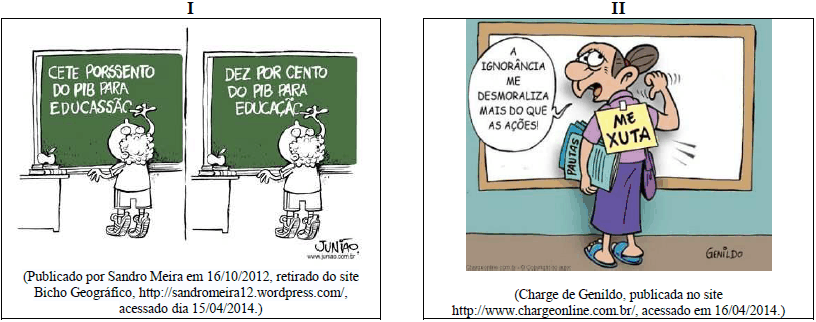
Sobre as charges, marque V para as afirmativas verdadeiras e F para as falsas.
( ) As charges tratam do mesmo assunto, ou seja, o respeito à variedade linguística do aluno.
( ) Na charge I, o foco é o investimento do governo na educação e na II, o foco é o fracasso do processo de escolarização.
( ) A grafia das palavras cete, porssento, educassão e xuta revela uma relação não biunívoca entre fonema e grafema própria da língua portuguesa.
( ) Lendo as charges conjuntamente, pode-se depreender que a ortografia é colocada como indicador do domínio da língua portuguesa, fruto de uma educação com altos investimentos públicos.
Assinale a sequência correta.
Provas
Questão presente nas seguintes provas
Read the text and answer question.
At a tertiary institution in Hong Kong, a foreign teacher is lecturing to a class of students, who listen attentively, occasionally commenting to each other in Cantonese on what the teacher has said. The teacher, disturbed by the talking, stops and waits for the students to stop. The students, sensing the teacher's discomfort, become silent, and the teacher resumes lecturing. Gradually, the students learn that the teacher expects them to be silent when she is lecturing. At the end of the lecture, the teacher asks whether there are questions. One student asks a question, and, as the teacher responds, the other students start talking among themselves. Soon it becomes noisy enough that the teacher either has to move toward the student in order to continue the discourse or ask the other students to be quiet. In either case, it is not long before students begin to ask whether they are permitted to leave. The teacher must then decide whether the class is over and if so, either give nonverbal permission and continue talking, or cut off her conversation at least momentarily to announce that the class is dismissed. If not, she may hurriedly give instructions regarding the assignment for the next class. She cannot help feeling that the students are being rude or showing lack of interest in the class. She may feel that she is wasting her breath if one student has raised an important question and the others are not listening to her response.
(SCOLLON, S. Not to waste words or students. In Culture in Second Teaching and Learning. 6ed. Cambridge: C.U.P., Applied Linguistics Series, 2006.)
According to genre classification, this text is
Provas
Questão presente nas seguintes provas
Cadernos
Caderno Container