Foram encontradas 48 questões.
Para participar de um concurso no qual serão escolhidos mosaicos para a calçada de uma igreja, um artista construiu seu mosaico usando pentágonos regulares e losangos dispostos conforme figura a seguir:
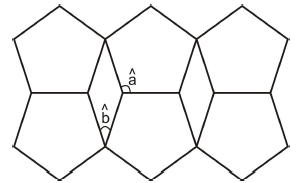
Sabe-se que !$ \hat{a} !$ e !$ \hat{b} !$ são ângulos do pentágono regular e do losango, respectivamente.
Se a soma !$ \hat{a}+\hat{b} !$ equivale a x graus, então, quanto ao valor de x pode-se afirmar que é um número
Provas

Disciplina: Inglês (Língua Inglesa)
Banca: DIRENS Aeronáutica
Orgão: EPCAR
TEXT
Your digital footprint
Every time you go online you leave a trail. This is just like a real footprint. It reveals where you’ve been, how long you stayed and what you’ve been doing there. Every time you register for an online service, send an email, download a video or upload a photo, the information can be accessed and your digital footprint can be revealed. This shouldn’t necessarily be worrying but it is advisable to be aware of your digital footprint and to be cautious and sensible when you are online. Six top tips for taking care of your digital footprint
Don’t forget to log off when you leave a website, especially if you are using a shared computer. If you don’t, someone can easily pretend to be you!
Don’t tell anyone your passwords and don’t write them down in an obvious place. Make them more complex by using a combination of letters, numbers and punctuation marks.
Tell an adult if you come across anything online that makes you upset, anxious or concerned. There are ways to report inappropriate or abusive content and in most cases web managers respond rapidly.
Remember your favourite websites by using the history button and the bookmark function on your computer or mobile device. This is a way that your digital footprint can work in your favour, but remember to clear your browser history regularly.
If you want to post comments online, you don’t have to use your own name. Invent a nickname to use instead. You can also use a picture instead of a real photo.
Protect your identity online. Be careful about who you share personal information with and always think twice before sharing details like your email, home address, school or phone number with someone. Think about the future
All kinds of people are interested in your digital footprint. It's now quite common for colleges, universities and employers to check out the online profiles of possible candidates as part of their application process. There are cases of people having missed out on jobs and places in college because their digital footprint didn’t impress the recruiters. So, remember: keep safe, don’t put too much personal information online and always think carefully before you post something. Ask yourself, ‘Would I be happy for absolutely everyone to see this?’
(Taken from http://learnenglishteens.britishcouncil.org/skills/ reading/upper-intermediate-b2-reading/your-digital-footprint Access on 28/08/20)
In “six top tips”, the author advises people
Provas
TEXTO II
O QUE É INTOLERÂNCIA
A palavra “intolerância” vem do latim intolerantia, que significa impaciência, incapacidade de suportar, falta de condescendência e de compreensão. Também compreende o sentido de inflexível, rígido e que não admite opinião ou posição divergente. No sentido oposto, “tolerância” foi definida pela Organização das Nações Unidas para a Educação, a Ciência e a Cultura (Unesco) como “o respeito, a aceitação e o apreço da riqueza e da diversidade das culturas de nosso mundo, de nossos modos de expressão e de nossas maneiras de exprimir nossa qualidade de seres humanos”.
(...)
Um interessante entendimento das razões da intolerância é o da antropóloga francesa Françoise Héritier (1933-2017). Segundo ela, a intolerância está associada à dificuldade de reconhecer a expressão da condição humana no que nos é absolutamente diverso. Ser intolerante seria "restringir a definição de humano aos membros do grupo; os outros, sendo não humanos, podem ser tratados como tais". Está aí uma das chaves para a compreensão das causas do aumento da intolerância nos últimos tempos.
(...)
(Disponível em: http://conhecimentocerebral1.blogspot.com/2018/06/ atualidades-vestibular-e-enem-dossie.html - Acesso em 28/08/2020)
De acordo com o texto II, na compreensão da antropóloga francesa Françoise Héritier, a intolerância caracteriza-se pela
Provas
Disciplina: Inglês (Língua Inglesa)
Banca: DIRENS Aeronáutica
Orgão: EPCAR
TEXT
Your digital footprint
Every time you go online you leave a trail. This is just like a real footprint. It reveals where you’ve been, how long you stayed and what you’ve been doing there. Every time you register for an online service, send an email, download a video or upload a photo, the information can be accessed and your digital footprint can be revealed. This shouldn’t necessarily be worrying but it is advisable to be aware of your digital footprint and to be cautious and sensible when you are online. Six top tips for taking care of your digital footprint
Don’t forget to log off when you leave a website, especially if you are using a shared computer. If you don’t, someone can easily pretend to be you!
Don’t tell anyone your passwords and don’t write them down in an obvious place. Make them more complex by using a combination of letters, numbers and punctuation marks.
Tell an adult if you come across anything online that makes you upset, anxious or concerned. There are ways to report inappropriate or abusive content and in most cases web managers respond rapidly!$ ^{(C)} !$.
Remember your favourite websites by using the history button and the bookmark function on your computer or mobile device. This is a way that your digital footprint can work in your favour, but remember to clear your browser history regularly.
If you want to post comments online, you don’t have to use your own name. Invent a nickname to use instead. You can also use a picture instead of a real photo!$ ^{(B)} !$.
Protect your identity online. Be careful about who you share personal information with and always think twice before sharing details like your email, home address, school or phone number with someone. Think about the future
All kinds of people are interested in your digital footprint!$ ^{(A)} !$. It's now quite common for colleges, universities and employers to check out the online profiles of possible candidates as part of their application process. There are cases of people having missed out on jobs and places in college because their digital footprint didn’t impress the recruiters!$ ^{(D)} !$. So, remember: keep safe, don’t put too much personal information online and always think carefully before you post something. Ask yourself, ‘Would I be happy for absolutely everyone to see this?’
(Taken from http://learnenglishteens.britishcouncil.org/skills/ reading/upper-intermediate-b2-reading/your-digital-footprint Access on 28/08/20)
In one of the alternatives, the underlined word has a negative meaning. Mark it.
Provas
Na reforma que está sendo feita nas dependências da EPCAR, há uma via, por onde os alunos transitam, cujo piso é retangular, com dimensões 4,40 m por 2,75 m .
Essa via será pavimentada, e deve-se usar o menor número possível de bloquetes quadrados, todos inteiros e de mesmo tamanho. Há que se considerar que os bloquetes da borda externa desse pavimento serão na cor vermelha e os internos a essa borda, na cor cinza, como mostra a figura.
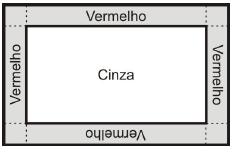
Serão usados !$ x !$ bloquetes na cor vermelha e !$ y !$ na cor cinza.
Sobre os valores de !$ x !$ e !$ y !$ é correto afirmar que
Provas
TEXTO II
O QUE É INTOLERÂNCIA
A palavra “intolerância” vem do latim intolerantia, que significa impaciência, incapacidade de suportar, falta de condescendência e de compreensão. Também compreende o sentido de inflexível, rígido e que não admite opinião ou posição divergente. No sentido oposto, “tolerância” foi definida pela Organização das Nações Unidas para a Educação, a Ciência e a Cultura (Unesco) como “o respeito, a aceitação e o apreço da riqueza e da diversidade das culturas de nosso mundo, de nossos modos de expressão e de nossas maneiras de exprimir nossa qualidade de seres humanos”.
(...)
Um interessante entendimento das razões da intolerância é o da antropóloga francesa Françoise Héritier (1933-2017). Segundo ela, a intolerância está associada à dificuldade de reconhecer a expressão da condição humana no que nos é absolutamente diverso. Ser intolerante seria "restringir a definição de humano aos membros do grupo; os outros, sendo não humanos, podem ser tratados como tais". Está aí uma das chaves para a compreensão das causas do aumento da intolerância nos últimos tempos.
(...)
(Disponível em: http://conhecimentocerebral1.blogspot.com/2018/06/ atualidades-vestibular-e-enem-dossie.html - Acesso em 28/08/2020)
Assinale a opção cujo “sujeito da oração” pode ser classificado como o da sentença abaixo:
“A única coisa que não pode ser comprada é o saber”
Provas
Observe a figura a seguir:

Nessa figura, tem-se que ABC é um triângulo equilátero, CDEF é um quadrado, e FGHA é um retângulo em que !$ \overline{GH}=2\overline{HA} !$
!$ \overline{AC} !$, !$ \overline{CF} !$ e !$ \overline{AF} !$ têm medidas, numa mesma unidade, respectivamente, iguais a !$ (3x+1)(2x+1) !$, !$ (3x+1)(x+1) !$ e !$ (3x+1)(3x \, 2) !$
Se P é o polinômio, em função da variável real x, para o perímetro do polígono ABCDEFGH, e m e n são as raízes de P, tal que !$ m > n !$, com !$ \{m,n\} ⊂ \mathbb{R} !$, então !$ m-n !$ é um número
Provas
Disciplina: Inglês (Língua Inglesa)
Banca: DIRENS Aeronáutica
Orgão: EPCAR
TEXT
Your digital footprint
Every time you go online you leave a trail. This is just like a real footprint. It reveals where you’ve been, how long you stayed and what you’ve been doing there. Every time you register for an online service, send an email, download a video or upload a photo, the information can be accessed and your digital footprint can be revealed. This shouldn’t necessarily be worrying but it is advisable to be aware of your digital footprint and to be cautious and sensible when you are online. Six top tips for taking care of your digital footprint
Don’t forget to log off when you leave a website, especially if you are using a shared computer. If you don’t, someone can easily pretend to be you!
Don’t tell anyone your passwords and don’t write them down in an obvious place. Make them more complex by using a combination of letters, numbers and punctuation marks.
Tell an adult if you come across anything online that makes you upset, anxious or concerned. There are ways to report inappropriate or abusive content and in most cases web managers respond rapidly.
Remember your favourite websites by using the history button and the bookmark function on your computer or mobile device. This is a way that your digital footprint can work in your favour, but remember to clear your browser history regularly.
If you want to post comments online, you don’t have to use your own name. Invent a nickname to use instead. You can also use a picture instead of a real photo.
Protect your identity online. Be careful about who you share personal information with and always think twice before sharing details like your email, home address, school or phone number with someone. Think about the future
All kinds of people are interested in your digital footprint. It's now quite common for colleges, universities and employers to check out the online profiles of possible candidates as part of their application process. There are cases of people having missed out on jobs and places in college because their digital footprint didn’t impress the recruiters. So, remember: keep safe, don’t put too much personal information online and always think carefully before you post something. Ask yourself, ‘Would I be happy for absolutely everyone to see this?’
(Taken from http://learnenglishteens.britishcouncil.org/skills/ reading/upper-intermediate-b2-reading/your-digital-footprint Access on 28/08/20)
In the sentence “it reveals where you’ve been”, the underlined word refers to
Provas
Caderno Container