Foram encontradas 46.768 questões.
In the book titled Literacies by Mary Kalantzis and Bill Cope, the authors mention the roles of teachers and students facing the challenges of reading in a technological environment. According to the authors, “Communication is rapidly changing. With the rise of new technologies and media, the way we make and transmit meaning is shifting significantly”. For this reason the profile of students have changed considerably from passive actors in the reading and interpreting information to more active meaning-makers, considering the various forms of access to information. New media environment “focuses not only on reading and writing, but also on other modes of communication, including oral, visual, audio, gestural and spatial”.
Below you will find a list of actions related to reading and interpreting texts both in the new and old environments. Read the actions and decide which action relates to which kind of environment. Then choose the correct alternative that corresponds to the right choice.
1. Appreciating texts of prestige ‘literary’ value must be the rule for right interpretation.
2. Innovations, risk-taking and diversity in meaning-making are aspects to be regarded by teachers.
3. It must be considered that a wide and diverse range of texts exists and should be valued.
4. Reading means decoding messages transmitted by written texts.
5. Teaching students to read means dealing solely with canonic British and American production.
6. The fundamentals of literacy should be understanding messages beyond messages.
7. The many social languages and variations in communication must be considered.
8. There are multiple forms of reading a word in multimodal communication.
9. Understanding and using correct spelling and grammar is good communication.
10. We should read only standard, educated English used in homogeneous situations.
KALANTZIS, Mary; COPE, Bill. Literacies. Melbourne: CUP, 2012, p.19. (Adapted).
Provas

Even if a foreign language student is an able decoder in English, the level of effort required to read for meaning in real time academic situations can be a monumental task. Look how author Richard Rodriguez (1982) describes his own reading in English as a new language: “Most books, of course, I barely understood. While reading Plato’s Republic, I needed to keep looking at the book jacket to remind myself what the text was about”. One might ask how Rodriguez could be reading a book at such an advanced level in English but still not reading with comprehension. How could he read and yet not read? And what is it that makes reading in a new language so overwhelming? Perhaps part of the answer can be found in the less extensive listening vocabulary upon which foreign language students can draw when reading written words, they have never seen before. Part of it may result from incomplete knowledge of the syntax and grammar patterns of English. When we struggle with sentences in a new language, reading takes a great deal of cognitive energy. As a result, retaining the gist of the previous sentences in a paragraph or of previous paragraphs in working memory is hard to do as we move through a text. Even when decoding is no longer very effortful, it is still much harder to move along through a text and construct meaning from it as we read in a new language. We might describe this as a real-time “delay”, which has to do with discursive practices. When the rate of processing discursive meaning from text can’t “catch up” with the rate of our decoding, the result may be the strange phenomenon of decoding but not comprehending, as lamented by Richard Rodriguez above.
LEMS, Kristin; MILLER, Leah D.; SORO, Tenema M. Teaching Reading to English Language Learners. Insights from Linguistics. New York and London: 2010, pp. 171-2. (Adapted).
The excerpt discusses what the author calls ‘real-time delay’ in English as a foreign language students’ reading ability. After reading this passage, choose the best alternative that may define this real-time delay.
Provas
1._______________ familiar with diverse research methods in social sciences.
2._______________ speech acts associated with racist ideologies in different sociolinguistic situations and samples, including films, news, music, daily interactions and textbooks.
3._______________ through some samples of cultural and sociolinguistic contexts such as academia to identify stigmatized markers of racist cultural linguistic materiality.
4._______________ that antiracist fight is possible through reflecting, relating, comparing and contrasting different perspectives.
5._______________ on their own linguistic awareness development and agency throughout the course.
MAGRO, José L. Language and Antiracism. An Antiracist Approach to Teaching Language in the USA. Jackson: Multilingual Matters, 2023. (Adapted).
The items mentioned have to do with the outcomes of a foreign language class of which objective is to teach L2 language viewing antiracist practices. The verbs “become”; “identify”; “go”; “demonstrate”; “reflect”, have been extracted from the items. After reading the topics, choose the alternative that presents the verbs that fit the items, respectively.
Provas
CHAPTER 2
Adult Literacy and Popular Libraries
To speak of adult literacy and popular libraries is to speak of the problems of reading and writing: not reading and writing words in and of themselves, as if the reading and writing of words did not imply another reading, anterior to and simultaneous with the first, the reading itself. The critical comprehension of literacy, which involves the equally critical comprehension of reading, demands the critical comprehension of reading, demands the critical comprehension of the library. However, upon speaking of a critical vision, authenticated in a practice of the same critical form of literacy, I not only recognize but also emphasize the existence of a contrary practice, an understanding that, in an essay published a long time ago, I called naive.
It would be tiresome to insist on points referred to on other occasions when I discussed the problems of literacy. Nevertheless, at the risk of repeating myself, I will try to clarify or reclarify what I call the critical practice and understanding of literacy, as opposed to the naive and so-called “astute” practice and understanding. The naive and astute, while identical from the objective point of view, differentiate themselves with respect to the subjectivity of their agents.
The myth of the neutrality of education — which leads to the negation of the political nature of the educational process, regarding it only as a task we do in the service of humanity in the abstract sense — is the point of departure for our understanding of the fundamental differences between a naive practice, an astute practice, and a truly critical practice.
From the critical point of view, it is as impossible to deny the political nature of the educational process as it is to deny the educational character of the political act. This does not mean, however, that the political nature of the educational process and the educational character of the political act drain the understanding of that process and this act. Just as a neutral education that claims to be at the service of humanity, of human beings in general, is impossible, so is a political practice devoid of educational meaning.
FREIRE, Paulo; MACEDO, Maldonado. Literacy: Reading the Word and the World. London: Routledge, 2005, p. 46. (Adapted).
After reading this excerpt from chapter 2 of the book titled Literacy: Reading the Word and the World, select the correct alternative that completes the sentence: Reading is
Provas
Provas
- Gramática - Língua InglesaAdvérbios e conjunções | Adverbs and conjunctions
- Gramática - Língua InglesaPalavras conectivas | Connective words
Target meaning: The theory is widely accepted; however, it still fails to explain several anomalies in the data.
Provas
- Gramática - Língua InglesaDiscurso direto e indireto | Reported speech
- Gramática - Língua InglesaVerbos | Verbs
“Had I known you were coming,” she exclaimed, “I could have arranged something far more suitable!”
Provas
Provas
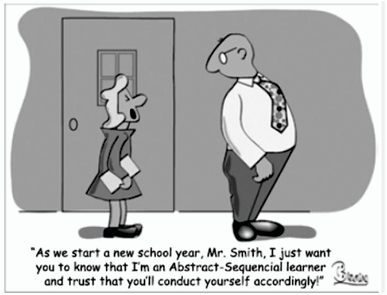
Source: GLASBERGEN, Randy. Education Cartoons. Glasbergen Cartoon Service, [s.d.]. Disponível em: https://www.glasbergen.com/education-cartoons/. Acesso em: 10 mar. 2026.
In the cartoon, the student tells Mr. Smith that she is an “Abstract-Sequential learner.” What is the primary source of humor in this interaction?
Provas
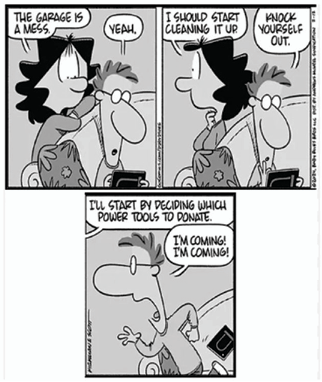
Source: KIRKMAN, Rick; SCOTT, Jerry. Baby Blues. GoComics, 12 fev. 2024. Disponível em: www.gocomics.com. Acesso em: 10 mar. 2026.
Provas
Caderno Container