Foram encontradas 46.768 questões.
96-year-old secretary secretly grew a $9M fortune
By Sarah Jackson
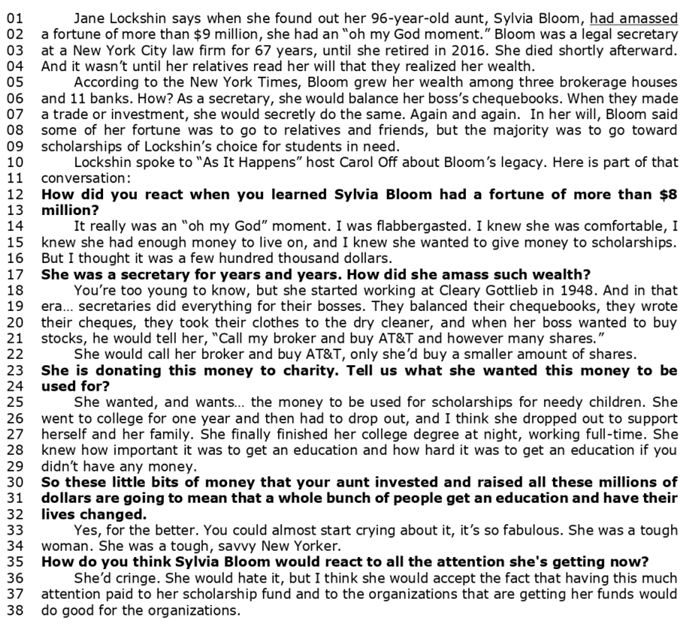
(Available at: https://www.cbc.ca/radio/asithappens/as-it-happens-monday-full-episode-1.4651457/96-yearold-secretary-secretly-grew-9m-fortune-then-donates-to-students-1.4651864 - text specially adapted for this test).
Provas
Questão presente nas seguintes provas

Para responder a questão,
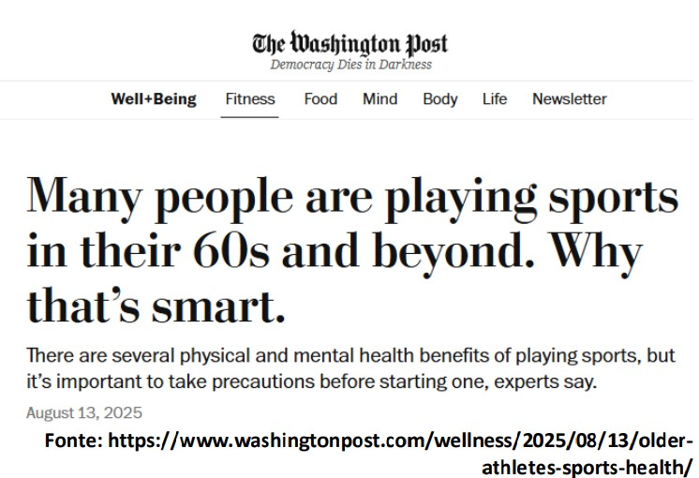
What do experts recommend before starting to play a sport?
Provas
Questão presente nas seguintes provas
Para responder a questão,
What is one main benefit mentioned in the text about playing sports?
Provas
Questão presente nas seguintes provas
Para responder a questão,
According to the headline, what are many people in their 60s and older doing?
Provas
Questão presente nas seguintes provas
- Gramática - Língua InglesaOrações condicionais | Conditional Clauses
- Gramática - Língua InglesaVerbos | Verbs
Read the sentences below.
Each item presents one type of conditional followed by an example.
Identify which conditionals are grammatically correct and logically coherent.
I.First Conditional: If it rains tomorrow, we will stay at home.
II.Second Conditional: If I will study harder, I would pass the exam.
III.Third Conditional: If she had known about the meeting, she would have come earlier.
It is correct what is stated in:
Each item presents one type of conditional followed by an example.
Identify which conditionals are grammatically correct and logically coherent.
I.First Conditional: If it rains tomorrow, we will stay at home.
II.Second Conditional: If I will study harder, I would pass the exam.
III.Third Conditional: If she had known about the meeting, she would have come earlier.
It is correct what is stated in:
Provas
Questão presente nas seguintes provas
Read the excerpt below from Saglam & Arslan (2018)
and answer the question that follows.
"The methods and approaches used in foreign language teaching are generally aimed at improving the basic language skills of the language. Speaking, listening, reading and writing are expressed in four basic language skills. In the literature, listening and reading are perceptual skills, speaking and writing are expressed as production skills."
Based on the text, and considering the relationship between skill development and text−context comprehension, which of the statements below is correct?
I.Productive skills (speaking and writing) require integrating linguistic knowledge with context and communicative purpose.
II.The balance between perceptive and productive skills is essential for learners to understand and construct meaning across different contexts.
III.Reading and listening comprehension depend solely on decoding linguistic forms, not on contextual interpretation.
It is correct what is stated in:
"The methods and approaches used in foreign language teaching are generally aimed at improving the basic language skills of the language. Speaking, listening, reading and writing are expressed in four basic language skills. In the literature, listening and reading are perceptual skills, speaking and writing are expressed as production skills."
Based on the text, and considering the relationship between skill development and text−context comprehension, which of the statements below is correct?
I.Productive skills (speaking and writing) require integrating linguistic knowledge with context and communicative purpose.
II.The balance between perceptive and productive skills is essential for learners to understand and construct meaning across different contexts.
III.Reading and listening comprehension depend solely on decoding linguistic forms, not on contextual interpretation.
It is correct what is stated in:
Provas
Questão presente nas seguintes provas
- Gramática - Língua InglesaDiscurso direto e indireto | Reported speech
- Gramática - Língua InglesaVerbos | Verbs
Read the following sentence: "I am preparing new
activities for my students," said the teacher.
Choose the alternative that correctly rewrites the sentence in reported speech:
Choose the alternative that correctly rewrites the sentence in reported speech:
Provas
Questão presente nas seguintes provas
Read the excerpt below from Ibrahim (2021) and mark
each statement as True (T) or False (F).
"Children's literature is a valuable tool to raise intercultural awareness in language classrooms. Through stories, learners can explore differences and similarities between cultures, and challenge stereotypes. Literature helps them develop empathy, curiosity, and respect for others." (Ibrahim, 2021. The role of children's literature in developing intercultural awareness in ELT. Nord University, p. 5).
(__)Children's literature can serve as a medium to challenge stereotypes and promote empathy.
(__)Intercultural awareness is limited to understanding vocabulary and grammar within texts.
(__)Stories that include cultural differences can foster curiosity and respect among learners.
(__)Avoiding cultural content in English stories enhances students' intercultural competence.
(__)The use of literature in ELT connects linguistic learning with emotional and cultural growth.
"Children's literature is a valuable tool to raise intercultural awareness in language classrooms. Through stories, learners can explore differences and similarities between cultures, and challenge stereotypes. Literature helps them develop empathy, curiosity, and respect for others." (Ibrahim, 2021. The role of children's literature in developing intercultural awareness in ELT. Nord University, p. 5).
(__)Children's literature can serve as a medium to challenge stereotypes and promote empathy.
(__)Intercultural awareness is limited to understanding vocabulary and grammar within texts.
(__)Stories that include cultural differences can foster curiosity and respect among learners.
(__)Avoiding cultural content in English stories enhances students' intercultural competence.
(__)The use of literature in ELT connects linguistic learning with emotional and cultural growth.
Provas
Questão presente nas seguintes provas
Match each phrasal verb (first column) with its correct
meaning (second column).
First column: Phrasal Verbs
1.Turn down
2.Look after
3.Give up
4.Put off
5.Run into
Second column: Meanings
(__)To meet someone unexpectedly.
(__)To postpone or delay something.
(__)To reject or refuse an offer.
(__)To take care of someone.
(__)To stop doing something.
Choose the correct sequence:
First column: Phrasal Verbs
1.Turn down
2.Look after
3.Give up
4.Put off
5.Run into
Second column: Meanings
(__)To meet someone unexpectedly.
(__)To postpone or delay something.
(__)To reject or refuse an offer.
(__)To take care of someone.
(__)To stop doing something.
Choose the correct sequence:
Provas
Questão presente nas seguintes provas
Read the following statements about the CLIL approach
and mark them as T (True) or F (False):
(__)CLIL promotes the simultaneous development of subject knowledge and language skills.
(__)In CLIL, language is taught separately from content subjects.
(__)CLIL aims to create meaningful learning situations that connect classroom language to real-life contexts.
(__)In CLIL, the teacher's role is limited to explaining grammar structures in the target language.
Choose the correct sequence:
(__)CLIL promotes the simultaneous development of subject knowledge and language skills.
(__)In CLIL, language is taught separately from content subjects.
(__)CLIL aims to create meaningful learning situations that connect classroom language to real-life contexts.
(__)In CLIL, the teacher's role is limited to explaining grammar structures in the target language.
Choose the correct sequence:
Provas
Questão presente nas seguintes provas
Cadernos
Caderno Container