Foram encontradas 46.768 questões.
Text CB1A6
First established in 2002 by the Brazilian government, and
later expanded with the support of WWF and private donors, the
conservation program known as ARPA helps protect 120
conservation areas spanning more than 60 million hectares —
about the size of Ukraine — of the Brazilian Amazon. The
program initially worked on creating new protected areas and
then on designing a durable financial mechanism to support their
protection.
A new phase, called ARPA Comunidades (Communities),
is now shifting the focus to the traditional communities who live
within the forest and help protect it. Half of the conservation
areas covered by ARPA are sustainable-use conservation units
like the Chico Mendes Extractive Reserve, inhabited by local
communities who live sustainably off the forest‘s resources.
Announced during the COP30 climate summit in the
Amazonian city of Belém, ARPA Comunidades will focus on
these 60 sustainable-use reserves, which together cover an area of
23.7 million hectares, nearly the size of the U.K. The aim is to
help reduce deforestation and improve the well-being of the local
populations by supporting the development of local
bioeconomies. Over 15 years, the program hopes to directly
impact 130,000 people. It will also seek to add a further 3 million
hectares of protected areas.
A 2023 paper by the Escolhas Institute, a Brazilian
research organization, found that a 1% reduction in extreme
poverty in the Brazilian Amazon has the potential to reduce
deforestation by 27,000 hectares in the region.
Greater recognition of local communities‘ needs and role
in protecting the forest is not a new demand, said Carlos Durigan,
a researcher at the Amazon Environmental Research Institute
(IPAM).
Internet: <https://news.mongabay.com> (adapted).
Provas
Questão presente nas seguintes provas

Text CB1A6
First established in 2002 by the Brazilian government, and
later expanded with the support of WWF and private donors, the
conservation program known as ARPA helps protect 120
conservation areas spanning more than 60 million hectares —
about the size of Ukraine — of the Brazilian Amazon. The
program initially worked on creating new protected areas and
then on designing a durable financial mechanism to support their
protection.
A new phase, called ARPA Comunidades (Communities),
is now shifting the focus to the traditional communities who live
within the forest and help protect it. Half of the conservation
areas covered by ARPA are sustainable-use conservation units
like the Chico Mendes Extractive Reserve, inhabited by local
communities who live sustainably off the forest‘s resources.
Announced during the COP30 climate summit in the
Amazonian city of Belém, ARPA Comunidades will focus on
these 60 sustainable-use reserves, which together cover an area of
23.7 million hectares, nearly the size of the U.K. The aim is to
help reduce deforestation and improve the well-being of the local
populations by supporting the development of local
bioeconomies. Over 15 years, the program hopes to directly
impact 130,000 people. It will also seek to add a further 3 million
hectares of protected areas.
A 2023 paper by the Escolhas Institute, a Brazilian
research organization, found that a 1% reduction in extreme
poverty in the Brazilian Amazon has the potential to reduce
deforestation by 27,000 hectares in the region.
Greater recognition of local communities‘ needs and role
in protecting the forest is not a new demand, said Carlos Durigan,
a researcher at the Amazon Environmental Research Institute
(IPAM).
Internet: <https://news.mongabay.com> (adapted).
Provas
Questão presente nas seguintes provas
4061021
Ano: 2026
Disciplina: Inglês (Língua Inglesa)
Banca: FUNDATEC
Orgão: Pref. Cordilheira Alta-SC
Disciplina: Inglês (Língua Inglesa)
Banca: FUNDATEC
Orgão: Pref. Cordilheira Alta-SC
Provas:
An ‘amazing feat’: how was a 13-year-old boy able to swim for four hours to save his
family?
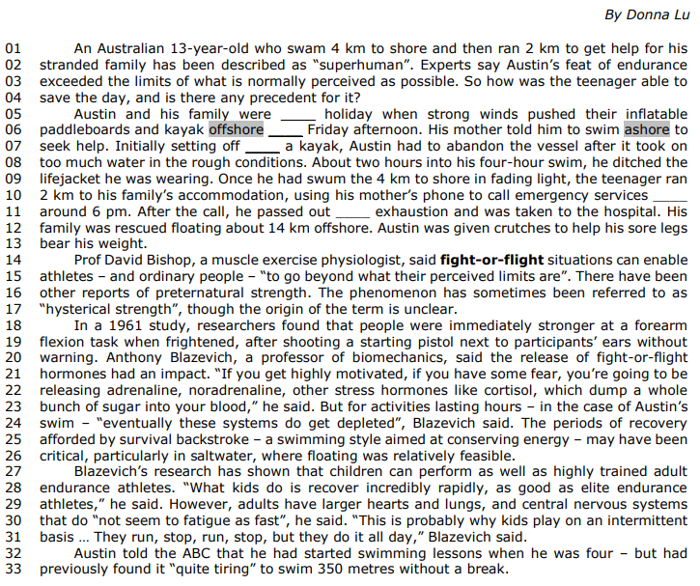
(Fight-or-flight: used to describe the reaction that people have to a dangerous situation, that makes them
either stay and deal with it, or run away)
(Available at: https://www.theguardian.com/australia-news/2026/feb/05/austin-appelbee-13-year-old-boyswims-four-hours-rescue-save-family-western-australia – text specially adapted for this test).
Provas
Questão presente nas seguintes provas
4061020
Ano: 2026
Disciplina: Inglês (Língua Inglesa)
Banca: FUNDATEC
Orgão: Pref. Cordilheira Alta-SC
Disciplina: Inglês (Língua Inglesa)
Banca: FUNDATEC
Orgão: Pref. Cordilheira Alta-SC
Provas:
- Voz Ativa e Passiva | Passive and Active Voice
- Gramática - Língua InglesaPronomes | Pronouns
- Gramática - Língua InglesaVerbos | Verbs
An ‘amazing feat’: how was a 13-year-old boy able to swim for four hours to save his
family?
(Fight-or-flight: used to describe the reaction that people have to a dangerous situation, that makes them
either stay and deal with it, or run away)
(Available at: https://www.theguardian.com/australia-news/2026/feb/05/austin-appelbee-13-year-old-boyswims-four-hours-rescue-save-family-western-australia – text specially adapted for this test).
( ) In the sentence “An Australian 13-year-old who swam 4 km to shore” (l. 01), the relative pronoun “who” could be replaced by “that” without changing the meaning.
( ) The sentence “In a 1961 study, researchers found that people were immediately stronger” (l. 18) could be rewritten using the present perfect tense without any change in meaning.
( ) In the sentence “Once he had swum the 4 km to shore in fading light” (l. 09), the verb tense used expresses an action completed before another action in the past.
( ) In the sentence “His family was rescued floating about 14 km offshore” (l. 11-12), the verb form indicates an action performed by the subject “his family”.
The correct order of filling in the parentheses, from top to bottom, is:
Provas
Questão presente nas seguintes provas
4061019
Ano: 2026
Disciplina: Inglês (Língua Inglesa)
Banca: FUNDATEC
Orgão: Pref. Cordilheira Alta-SC
Disciplina: Inglês (Língua Inglesa)
Banca: FUNDATEC
Orgão: Pref. Cordilheira Alta-SC
Provas:
An ‘amazing feat’: how was a 13-year-old boy able to swim for four hours to save his
family?
(Fight-or-flight: used to describe the reaction that people have to a dangerous situation, that makes them
either stay and deal with it, or run away)
(Available at: https://www.theguardian.com/australia-news/2026/feb/05/austin-appelbee-13-year-old-boyswims-four-hours-rescue-save-family-western-australia – text specially adapted for this test).
“However, adults have larger hearts and lungs, and central nervous systems that do ‘not seem to fatigue as fast’, he said.” (l. 29-30).
Provas
Questão presente nas seguintes provas
4061018
Ano: 2026
Disciplina: Inglês (Língua Inglesa)
Banca: FUNDATEC
Orgão: Pref. Cordilheira Alta-SC
Disciplina: Inglês (Língua Inglesa)
Banca: FUNDATEC
Orgão: Pref. Cordilheira Alta-SC
Provas:
An ‘amazing feat’: how was a 13-year-old boy able to swim for four hours to save his
family?
(Fight-or-flight: used to describe the reaction that people have to a dangerous situation, that makes them
either stay and deal with it, or run away)
(Available at: https://www.theguardian.com/australia-news/2026/feb/05/austin-appelbee-13-year-old-boyswims-four-hours-rescue-save-family-western-australia – text specially adapted for this test).
Provas
Questão presente nas seguintes provas
4061017
Ano: 2026
Disciplina: Inglês (Língua Inglesa)
Banca: FUNDATEC
Orgão: Pref. Cordilheira Alta-SC
Disciplina: Inglês (Língua Inglesa)
Banca: FUNDATEC
Orgão: Pref. Cordilheira Alta-SC
Provas:
An ‘amazing feat’: how was a 13-year-old boy able to swim for four hours to save his
family?
(Fight-or-flight: used to describe the reaction that people have to a dangerous situation, that makes them
either stay and deal with it, or run away)
(Available at: https://www.theguardian.com/australia-news/2026/feb/05/austin-appelbee-13-year-old-boyswims-four-hours-rescue-save-family-western-australia – text specially adapted for this test).
Provas
Questão presente nas seguintes provas
4061016
Ano: 2026
Disciplina: Inglês (Língua Inglesa)
Banca: FUNDATEC
Orgão: Pref. Cordilheira Alta-SC
Disciplina: Inglês (Língua Inglesa)
Banca: FUNDATEC
Orgão: Pref. Cordilheira Alta-SC
Provas:
An ‘amazing feat’: how was a 13-year-old boy able to swim for four hours to save his
family?
(Fight-or-flight: used to describe the reaction that people have to a dangerous situation, that makes them
either stay and deal with it, or run away)
(Available at: https://www.theguardian.com/australia-news/2026/feb/05/austin-appelbee-13-year-old-boyswims-four-hours-rescue-save-family-western-australia – text specially adapted for this test).
Provas
Questão presente nas seguintes provas
4061015
Ano: 2026
Disciplina: Inglês (Língua Inglesa)
Banca: FUNDATEC
Orgão: Pref. Cordilheira Alta-SC
Disciplina: Inglês (Língua Inglesa)
Banca: FUNDATEC
Orgão: Pref. Cordilheira Alta-SC
Provas:
An ‘amazing feat’: how was a 13-year-old boy able to swim for four hours to save his
family?
(Fight-or-flight: used to describe the reaction that people have to a dangerous situation, that makes them
either stay and deal with it, or run away)
(Available at: https://www.theguardian.com/australia-news/2026/feb/05/austin-appelbee-13-year-old-boyswims-four-hours-rescue-save-family-western-australia – text specially adapted for this test).
Provas
Questão presente nas seguintes provas
4061014
Ano: 2026
Disciplina: Inglês (Língua Inglesa)
Banca: FUNDATEC
Orgão: Pref. Cordilheira Alta-SC
Disciplina: Inglês (Língua Inglesa)
Banca: FUNDATEC
Orgão: Pref. Cordilheira Alta-SC
Provas:
An ‘amazing feat’: how was a 13-year-old boy able to swim for four hours to save his
family?
(Fight-or-flight: used to describe the reaction that people have to a dangerous situation, that makes them
either stay and deal with it, or run away)
(Available at: https://www.theguardian.com/australia-news/2026/feb/05/austin-appelbee-13-year-old-boyswims-four-hours-rescue-save-family-western-australia – text specially adapted for this test).
Provas
Questão presente nas seguintes provas
Cadernos
Caderno Container