Foram encontradas 40 questões.
Stop all the clocks, cut off the telephone,
Prevent the dog from barking with a juicy bone,
Silence the pianos and with muffled drum
Bring out the coffin, let the mourners come.
Let aeroplanes circle moaning overhead
Scribbling on the sky the message He Is Dead,
Put crepe bows round the white necks of the public doves,
Let the traffic policemen wear black cotton gloves.
He was my North, my South, my East and West,
My working week and my Sunday rest,
My noon, my midnight, my talk, my song;
I thought that love would last forever: I was wrong.
The stars are not wanted now: put out every one;
Pack up the moon and dismantle the sun;
Pour away the ocean and sweep up the wood.
For nothing now can ever come to any good
The Imperative form of the verbs is used in the poem to convey the urgency felt by the poetic voice, who wants everyone to share his pain and gives orders, as expressed in “Stop all the clocks, cut off the telephone” (line 01). Which of the alternatives below shows a different use for the infinitive from the one in the example?
Provas
Questão presente nas seguintes provas


Disponível em: <http://deposito-de-tirinhas.tumblr.com/>
Acesso em: abril de 2014.
O humor da tira consiste na interpretação
Provas
Questão presente nas seguintes provas
Stop all the clocks, cut off the telephone,
Prevent the dog from barking with a juicy bone,
Silence the pianos and with muffled drum
Bring out the coffin, let the mourners come.
Let aeroplanes circle moaning overhead
Scribbling on the sky the message He Is Dead,
Put crepe bows round the white necks of the public doves,
Let the traffic policemen wear black cotton gloves.
He was my North, my South, my East and West,
My working week and my Sunday rest,
My noon, my midnight, my talk, my song;
I thought that love would last forever: I was wrong.
The stars are not wanted now: put out every one;
Pack up the moon and dismantle the sun;
Pour away the ocean and sweep up the wood.
For nothing now can ever come to any good
Considering the poem as a whole, the alternative that best translates the ideas conveyed in the first stanza is:
Provas
Questão presente nas seguintes provas
Montanha chinesa (pintura subungueal), 1995-1996

ALBERNAZ ACOSTA, Daniel. montanha chinesa (pintura subungueal), 1995-1996. São Paulo:
Editora da Universidade de São Paulo, 1997, p. 115.
A metafunção responsável pela formação de um todo coerente entre os participantes internos do texto é
Provas
Questão presente nas seguintes provas
Online students can't help being sociable
By Sean CoughlanBBC News education correspondent

Online university students want to talk outside the computer screen
It was a revolution moving higher education from bricks to clicks… and now it's started to go back to bricks again.
Online university providers, which offered people the chance to study from home, are turning full circle by creating a network of learning centres where students can meet and study together.
Instead of demolishing the dusty old classrooms, the online university revolution is responsible for opening some new ones.
Coursera, a major California-based provider of online courses, is creating an international network of "learning hubs", where students can follow these virtual courses in real-life, bricks and mortar settings.
And there are thousands of meet-ups in cafes and libraries where students get together to talk about their online courses.
This is the latest stage in the rapid evolution of so-called Moocs - massive open online courses - where some of the world's leading universities have created digital versions of courses which are offered free over the internet.
Learning together
Coursera now has seven million registered users. That's bigger than the entire university populations of the UK and France combined. But it seems there is an irresistible social side to learning. Finding stuff out together seems to be more appealing than following a course alone.
The Coursera learning hubs are running in more than 30 cities, from Baghdad to Buenos Aires, Moscow to Mumbai and Shanghai to Santiago. The learning hubs are run by partner organisations, providing a place where students following Coursera online courses can come to study together and get help from mentors.
In Moscow, the learning hub is hosted by Digital October, a centre for technology and entrepreneurship. Yulia Lesnikova, director of educational programs, says it provides a more sociable way of following online courses.
'Like a village'
There have been four online courses so far followed in the Moscow learning hub. This includes a course about genetics created by the University of British Columbia, with students in Moscow being supported by an expert from one of Russia's oldest genetics institutes.
There is a course on gamification from the University of Pennsylvania's Wharton School of Business, with sub-titles in Russian.
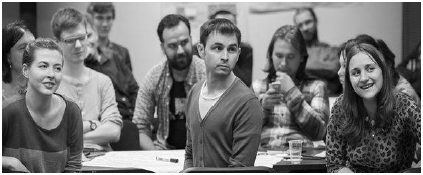
Students following an online course at the Digital October learning hub in Moscow
When students are gathered for their Mooc classes it becomes a focus for other spin-offs, such as firms wanting to recruit staff or to get students involved in developing commercial projects.
In Beijing, the learning hub has been set up with Guokr, a Chinese science-based social networking website.
Yang Liu, Guokr's education director, says studying as a group provides a way of keeping students connected. It's also introduced the word "Moocer" into China, she says.
"Learning can be very lonely, they can drop out."
It can be a more effective way of studying, she says. In a group of people there's likely to be a spread of knowledge, with students able to help one another.
"It's like a village, they form a small society."
It also allows for different types of learner to be supported. About half of the people following Coursera courses in Beijing are university students, she says.
Cutting drop-out rates
But there are also isolated individuals who like the social setting, such as older people living alone or mothers looking after children at home.
Yin Lu, responsible for Coursera's international development, says learning hubs have a wide range of local approaches. They can be based around tutors or around organised projects or else emphasise the social aspect of learning.
In India, the focus is on teacher training and professional development. It means that courses designed for students in the US or Europe are being played out in classrooms in New Delhi and Mumbai.
What has become apparent, she says, is that there is a much lower drop-out rate for students who attend a learning hub.
Moocs allow anyone to enter, with no barriers from cost or qualifications, but that also means relatively few ever finish a course. Ms Lu says that the typical completion rate for a Mooc is about 5% to 10%.
Practical projects are run alongside the online courses
For Mooc students attending learning hubs, the completion rates are between 30% and 100%, she says.
Ms Lu says it's likely that more hubs will open where there are concentrations of Coursera students.
But she says there are no plans for these learning hubs to become fully-fledged colleges, where students might take exams as well as follow courses.
"We exist to complement what universities can provide," she says. But it wouldn't be difficult to imagine the commercial possibilities if they changed their mind.
'Meet-ups'
There is something almost organic about how these digital projects have taken root in the physical world.
Moocs were meant to be the university courses of the laptop era, self-sustaining and free-standing, with students able to stop and start materials on the internet and get online support from social networking.
But you can't stop people from wanting to talk to each other, outside the computer screen.
As well as the more formal learning hubs, self-organised "meet-ups" for Coursera students have sprung up in more than 3,700 cities around the world, based around specific Coursera online courses.
For example, in London there are groups meeting in cafes at the British Library and the South Bank Centre. In Paris, there are meetings in the Pompidou Centre and in university buildings.
Meet-ups are held in a whole range of public places, where students want to discuss and debate these digital courses.
They're scheduled and arranged online, with the only vital ingredients being a laptop, wi-fi and somewhere to talk.
Even virtual students want to have a cup of coffee and a conversation after a lecture.
Available at: <http://www.bbc.com/news/business-26925463>
consulted on Apr. 12th. 2014.
When several adjectives come before a noun, they usually have to be put in a particular order. Examples from the text include “Online University providers ”, “Massive open online courses ”, among others. From the alternatives below, the one which presents a correct sequence of adjectives in the expression is
Provas
Questão presente nas seguintes provas
Tão cedo vejo que o outono se retira e o inverno dá os primeiros sinais de vida. Parece-me que a cidade passou por uma longa provação, cruel e opressiva, e, de súbito, tudo volta ao sossego. Paz de inverno. As linhas todas que distinguem Curitiba - o traçado de suas moradias e o semblante de seus habitantes - permanecem irrealizadas e estrangeiras enquanto as cerquem halos de calor. O inverno, enfim, já expulsa o sol e a canícula para plagas mais próprias de seu brilho. Alegremo-nos, curitibanos, com o amigo inverno ao nosso lado.
VAZ, Toninho. Paulo Leminski: o bandido que sabia latim. Rio de Janeiro:
Record, 2001, p. 65. (fragmento)
O poeta Paulo Leminski, aos 13 anos, publicou no boletim do Colégio Estadual, em março de 1962, a crônica “Inverno”. Nesse pequeno texto um tanto rebuscado e aparentemente influenciado pelos maneirismos estilísticos do pai, já ficava evidente o estreito relacionamento temático de sua obra com a
Provas
Questão presente nas seguintes provas
Stop all the clocks, cut off the telephone,
Prevent the dog from barking with a juicy bone,
Silence the pianos and with muffled drum
Bring out the coffin, let the mourners come.
Let aeroplanes circle moaning overhead
Scribbling on the sky the message He Is Dead,
Put crepe bows round the white necks of the public doves,
Let the traffic policemen wear black cotton gloves.
He was my North, my South, my East and West,
My working week and my Sunday rest,
My noon, my midnight, my talk, my song;
I thought that love would last forever: I was wrong.
The stars are not wanted now: put out every one;
Pack up the moon and dismantle the sun;
Pour away the ocean and sweep up the wood.
For nothing now can ever come to any good
In the third stanza, the poetic voice uses the possessive adjective my to emphasize the idea that
Provas
Questão presente nas seguintes provas
Read the sentences below.
I. It’s the end of the semester. You should study more, if you want to pass the exam.
II. Children should learn how to swim when they are little.
III. I should have posted this letter yesterday
IV. It’s 9:00. I’d better call Sally. She should be at work by now.
The alternative(s) which does(do) not present should with the idea of a recommendation or suggestion is(are) the one(s) in
Provas
Questão presente nas seguintes provas
É só isso
Não tem mais jeito
Acabou, boa sorte
Não tenho o que dizer
São só palavras
E o que sinto
Não mudará
A canção Boa Sorte (disponível em:
Provas
Questão presente nas seguintes provas
Online students can't help being sociable
By Sean CoughlanBBC News education correspondent
Online university students want to talk outside the computer screen
It was a revolution moving higher education from bricks to clicks… and now it's started to go back to bricks again.
Online university providers, which offered people the chance to study from home, are turning full circle by creating a network of learning centres where students can meet and study together.
Instead of demolishing the dusty old classrooms, the online university revolution is responsible for opening some new ones.
Coursera, a major California-based provider of online courses, is creating an international network of "learning hubs", where students can follow these virtual courses in real-life, bricks and mortar settings.
And there are thousands of meet-ups in cafes and libraries where students get together to talk about their online courses.
This is the latest stage in the rapid evolution of so-called Moocs - massive open online courses - where some of the world's leading universities have created digital versions of courses which are offered free over the internet.
Learning together
Coursera now has seven million registered users. That's bigger than the entire university populations of the UK and France combined. But it seems there is an irresistible social side to learning. Finding stuff out together seems to be more appealing than following a course alone.
The Coursera learning hubs are running in more than 30 cities, from Baghdad to Buenos Aires, Moscow to Mumbai and Shanghai to Santiago. The learning hubs are run by partner organisations, providing a place where students following Coursera online courses can come to study together and get help from mentors.
In Moscow, the learning hub is hosted by Digital October, a centre for technology and entrepreneurship. Yulia Lesnikova, director of educational programs, says it provides a more sociable way of following online courses.
'Like a village'
There have been four online courses so far followed in the Moscow learning hub. This includes a course about genetics created by the University of British Columbia, with students in Moscow being supported by an expert from one of Russia's oldest genetics institutes.
There is a course on gamification from the University of Pennsylvania's Wharton School of Business, with sub-titles in Russian.
Students following an online course at the Digital October learning hub in Moscow
When students are gathered for their Mooc classes it becomes a focus for other spin-offs, such as firms wanting to recruit staff or to get students involved in developing commercial projects.
In Beijing, the learning hub has been set up with Guokr, a Chinese science-based social networking website.
Yang Liu, Guokr's education director, says studying as a group provides a way of keeping students connected. It's also introduced the word "Moocer" into China, she says.
"Learning can be very lonely, they can drop out."
It can be a more effective way of studying, she says. In a group of people there's likely to be a spread of knowledge, with students able to help one another.
"It's like a village, they form a small society."
It also allows for different types of learner to be supported. About half of the people following Coursera courses in Beijing are university students, she says.
Cutting drop-out rates
But there are also isolated individuals who like the social setting, such as older people living alone or mothers looking after children at home.
Yin Lu, responsible for Coursera's international development, says learning hubs have a wide range of local approaches. They can be based around tutors or around organised projects or else emphasise the social aspect of learning.
In India, the focus is on teacher training and professional development. It means that courses designed for students in the US or Europe are being played out in classrooms in New Delhi and Mumbai.
What has become apparent, she says, is that there is a much lower drop-out rate for students who attend a learning hub.
Moocs allow anyone to enter, with no barriers from cost or qualifications, but that also means relatively few ever finish a course. Ms Lu says that the typical completion rate for a Mooc is about 5% to 10%.
Practical projects are run alongside the online courses
For Mooc students attending learning hubs, the completion rates are between 30% and 100%, she says.
Ms Lu says it's likely that more hubs will open where there are concentrations of Coursera students.
But she says there are no plans for these learning hubs to become fully-fledged colleges, where students might take exams as well as follow courses.
"We exist to complement what universities can provide," she says. But it wouldn't be difficult to imagine the commercial possibilities if they changed their mind.
'Meet-ups'
There is something almost organic about how these digital projects have taken root in the physical world.
Moocs were meant to be the university courses of the laptop era, self-sustaining and free-standing, with students able to stop and start materials on the internet and get online support from social networking.
But you can't stop people from wanting to talk to each other, outside the computer screen.
As well as the more formal learning hubs, self-organised "meet-ups" for Coursera students have sprung up in more than 3,700 cities around the world, based around specific Coursera online courses.
For example, in London there are groups meeting in cafes at the British Library and the South Bank Centre. In Paris, there are meetings in the Pompidou Centre and in university buildings.
Meet-ups are held in a whole range of public places, where students want to discuss and debate these digital courses.
They're scheduled and arranged online, with the only vital ingredients being a laptop, wi-fi and somewhere to talk.
Even virtual students want to have a cup of coffee and a conversation after a lecture.
Available at: <http://www.bbc.com/news/business-26925463>
consulted on Apr. 12th. 2014.
In the sentence “When students are gathered for their Mooc classes it becomes a focus for other spin-offs, such as firms wanting to recruit staff or to get students involved in developing commercial projects”, the expression in bold suggests that
Provas
Questão presente nas seguintes provas
Cadernos
Caderno Container