Foram encontradas 60 questões.
Texto 03
How is English Used as a Lingua Franca Today?
By Maria Khodorkovsky on August 19, 2013
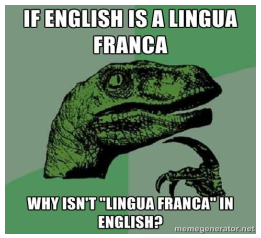
The term lingua franca was first coined in the beginning of the 17th century by the Italians. At that time, it represented a conglomeration of mostly Italian, with a smattering of French, Portuguese, Spanish, Turkish, Greek, and Arabic, and was used primarily as the language of commerce. The term literally means “Frankish language”, as “Frank” was a common designation for all western Europeans since approximately the 12th century.
Today, English is a common lingua franca across the globe. According to some estimates, almost 80 percent of English speakers in the world are non-native speakers. Below you will find more information about a phenomenon that bears on language, culture, commerce, and diplomacy.
Where is it used?
Apart from serving as a useful heuristic in Europe, where a Spaniard, a Frenchmen, and a German might all carry on a conversation in English, English as a lingua franca (ELF) plays an important role in former Anglophone colonies such as India, Pakistan, Nigeria, Uganda, and Zimbabwe, among many others.
How is it used?
ELF differs from Standard English in a number of ways. Several documented overarching similarities are variances in article usage (or no article usage at all), variances in preposition usage, and novel use of morphemes (such as importancy and smoothfully). Many instances of ELF also incorporate across-the-board third-person singular usage (such as “He go to the store.”), using “who” and “which” interchangeably, and a lack of gerunds. Verbally, noted differences include the omission of some consonants and addition of extra vowels, as well as a general tendency towards efficient communication over grammatically normative English.
Criticisms
While ELF is a widespread and useful mode of communication for many, some scholars and linguists have criticized its proliferation as a form of linguistic imperialism. This term became popular in 1992 with the publication of Robert Phillipson’s influential book of the same name. In it, Phillipson argues that English has long been a tool of submission and cultural domination of colonies. Contemporary critics of ELF cite the problems associated with studying a language in a disorganized, unstructured way. Speakers of ELF may eventually speak both their native language and English imperfectly, leading to issues with effective communication. In spite of these criticisms, ELF continues to flourish in many countries, oftentimes enriching the language with colorful aphorisms and unique turns of phrase.
(Disponível em https://www.altalang.com/beyond-words/how-is-english-used-as-a-lingua-franca-today/)
Provas

- Gramática - Língua InglesaSubstantivos e compostos | Nouns and compoundsSubstantivos contáveis e incontáveis | Countable and uncountable
Texto 03
How is English Used as a Lingua Franca Today?
By Maria Khodorkovsky on August 19, 2013
The term lingua franca was first coined in the beginning of the 17th century by the Italians. At that time, it represented a conglomeration of mostly Italian, with a smattering of French, Portuguese, Spanish, Turkish, Greek, and Arabic, and was used primarily as the language of commerce. The term literally means “Frankish language”, as “Frank” was a common designation for all western Europeans since approximately the 12th century.
Today, English is a common lingua franca across the globe. According to some estimates, almost 80 percent of English speakers in the world are non-native speakers. Below you will find more information about a phenomenon that bears on language, culture, commerce, and diplomacy.
Where is it used?
Apart from serving as a useful heuristic in Europe, where a Spaniard, a Frenchmen, and a German might all carry on a conversation in English, English as a lingua franca (ELF) plays an important role in former Anglophone colonies such as India, Pakistan, Nigeria, Uganda, and Zimbabwe, among many others.
How is it used?
ELF differs from Standard English in a number of ways. Several documented overarching similarities are variances in article usage (or no article usage at all), variances in preposition usage, and novel use of morphemes (such as importancy and smoothfully). Many instances of ELF also incorporate across-the-board third-person singular usage (such as “He go to the store.”), using “who” and “which” interchangeably, and a lack of gerunds. Verbally, noted differences include the omission of some consonants and addition of extra vowels, as well as a general tendency towards efficient communication over grammatically normative English.
Criticisms
While ELF is a widespread and useful mode of communication for many, some scholars and linguists have criticized its proliferation as a form of linguistic imperialism. This term became popular in 1992 with the publication of Robert Phillipson’s influential book of the same name. In it, Phillipson argues that English has long been a tool of submission and cultural domination of colonies. Contemporary critics of ELF cite the problems associated with studying a language in a disorganized, unstructured way. Speakers of ELF may eventually speak both their native language and English imperfectly, leading to issues with effective communication. In spite of these criticisms, ELF continues to flourish in many countries, oftentimes enriching the language with colorful aphorisms and unique turns of phrase.
(Disponível em https://www.altalang.com/beyond-words/how-is-english-used-as-a-lingua-franca-today/)
Provas
Texto 03
How is English Used as a Lingua Franca Today?
By Maria Khodorkovsky on August 19, 2013
The term lingua franca was first coined in the beginning of the 17th century by the Italians. At that time, it represented a conglomeration of mostly Italian, with a smattering of French, Portuguese, Spanish, Turkish, Greek, and Arabic, and was used primarily as the language of commerce. The term literally means “Frankish language”, as “Frank” was a common designation for all western Europeans since approximately the 12th century.
Today, English is a common lingua franca across the globe. According to some estimates, almost 80 percent of English speakers in the world are non-native speakers. Below you will find more information about a phenomenon that bears on language, culture, commerce, and diplomacy.
Where is it used?
Apart from serving as a useful heuristic in Europe, where a Spaniard, a Frenchmen, and a German might all carry on a conversation in English, English as a lingua franca (ELF) plays an important role in former Anglophone colonies such as India, Pakistan, Nigeria, Uganda, and Zimbabwe, among many others.
How is it used?
ELF differs from Standard English in a number of ways. Several documented overarching similarities are variances in article usage (or no article usage at all), variances in preposition usage, and novel use of morphemes (such as importancy and smoothfully). Many instances of ELF also incorporate across-the-board third-person singular usage (such as “He go to the store.”), using “who” and “which” interchangeably, and a lack of gerunds. Verbally, noted differences include the omission of some consonants and addition of extra vowels, as well as a general tendency towards efficient communication over grammatically normative English.
Criticisms
While ELF is a widespread and useful mode of communication for many, some scholars and linguists have criticized its proliferation as a form of linguistic imperialism. This term became popular in 1992 with the publication of Robert Phillipson’s influential book of the same name. In it, Phillipson argues that English has long been a tool of submission and cultural domination of colonies. Contemporary critics of ELF cite the problems associated with studying a language in a disorganized, unstructured way. Speakers of ELF may eventually speak both their native language and English imperfectly, leading to issues with effective communication. In spite of these criticisms, ELF continues to flourish in many countries, oftentimes enriching the language with colorful aphorisms and unique turns of phrase.
(Disponível em https://www.altalang.com/beyond-words/how-is-english-used-as-a-lingua-franca-today/)
Provas
Texto 03
How is English Used as a Lingua Franca Today?
By Maria Khodorkovsky on August 19, 2013
The term lingua franca was first coined in the beginning of the 17th century by the Italians. At that time, it represented a conglomeration of mostly Italian, with a smattering of French, Portuguese, Spanish, Turkish, Greek, and Arabic, and was used primarily as the language of commerce. The term literally means “Frankish language”, as “Frank” was a common designation for all western Europeans since approximately the 12th century.
Today, English is a common lingua franca across the globe. According to some estimates, almost 80 percent of English speakers in the world are non-native speakers. Below you will find more information about a phenomenon that bears on language, culture, commerce, and diplomacy.
Where is it used?
Apart from serving as a useful heuristic in Europe, where a Spaniard, a Frenchmen, and a German might all carry on a conversation in English, English as a lingua franca (ELF) plays an important role in former Anglophone colonies such as India, Pakistan, Nigeria, Uganda, and Zimbabwe, among many others.
How is it used?
ELF differs from Standard English in a number of ways. Several documented overarching similarities are variances in article usage (or no article usage at all), variances in preposition usage, and novel use of morphemes (such as importancy and smoothfully). Many instances of ELF also incorporate across-the-board third-person singular usage (such as “He go to the store.”), using “who” and “which” interchangeably, and a lack of gerunds. Verbally, noted differences include the omission of some consonants and addition of extra vowels, as well as a general tendency towards efficient communication over grammatically normative English.
Criticisms
While ELF is a widespread and useful mode of communication for many, some scholars and linguists have criticized its proliferation as a form of linguistic imperialism. This term became popular in 1992 with the publication of Robert Phillipson’s influential book of the same name. In it, Phillipson argues that English has long been a tool of submission and cultural domination of colonies. Contemporary critics of ELF cite the problems associated with studying a language in a disorganized, unstructured way. Speakers of ELF may eventually speak both their native language and English imperfectly, leading to issues with effective communication. In spite of these criticisms, ELF continues to flourish in many countries, oftentimes enriching the language with colorful aphorisms and unique turns of phrase.
(Disponível em https://www.altalang.com/beyond-words/how-is-english-used-as-a-lingua-franca-today/)
Provas
Texto 03
How is English Used as a Lingua Franca Today?
By Maria Khodorkovsky on August 19, 2013
The term lingua franca was first coined in the beginning of the 17th century by the Italians. At that time, it represented a conglomeration of mostly Italian, with a smattering of French, Portuguese, Spanish, Turkish, Greek, and Arabic, and was used primarily as the language of commerce. The term literally means “Frankish language”, as “Frank” was a common designation for all western Europeans since approximately the 12th century.
Today, English is a common lingua franca across the globe. According to some estimates, almost 80 percent of English speakers in the world are non-native speakers. Below you will find more information about a phenomenon that bears on language, culture, commerce, and diplomacy.
Where is it used?
Apart from serving as a useful heuristic in Europe, where a Spaniard, a Frenchmen, and a German might all carry on a conversation in English, English as a lingua franca (ELF) plays an important role in former Anglophone colonies such as India, Pakistan, Nigeria, Uganda, and Zimbabwe, among many others.
How is it used?
ELF differs from Standard English in a number of ways. Several documented overarching similarities are variances in article usage (or no article usage at all), variances in preposition usage, and novel use of morphemes (such as importancy and smoothfully). Many instances of ELF also incorporate across-the-board third-person singular usage (such as “He go to the store.”), using “who” and “which” interchangeably, and a lack of gerunds. Verbally, noted differences include the omission of some consonants and addition of extra vowels, as well as a general tendency towards efficient communication over grammatically normative English.
Criticisms
While ELF is a widespread and useful mode of communication for many, some scholars and linguists have criticized its proliferation as a form of linguistic imperialism. This term became popular in 1992 with the publication of Robert Phillipson’s influential book of the same name. In it, Phillipson argues that English has long been a tool of submission and cultural domination of colonies. Contemporary critics of ELF cite the problems associated with studying a language in a disorganized, unstructured way. Speakers of ELF may eventually speak both their native language and English imperfectly, leading to issues with effective communication. In spite of these criticisms, ELF continues to flourish in many countries, oftentimes enriching the language with colorful aphorisms and unique turns of phrase.
(Disponível em https://www.altalang.com/beyond-words/how-is-english-used-as-a-lingua-franca-today/)
Provas
Provas
Anatol Rosenfeld (1965, p. 11), em seu O teatro épico, escreve que o “gênero lírico foi [...] definido como sendo o mais subjetivo: no poema lírico uma voz central exprime um estado de alma e o traduz por meio de orações. Trata-se essencialmente da expressão de emoções e disposições psíquicas, muitas vezes também de reflexões e visões enquanto intensamente vividas e experimentadas.”
Não perdendo de vista o caráter histórico de qualquer conceito envolvendo gêneros literários, assinale, entre os excertos abaixo, aquele que se adequa ao que Rosenfeld considera como lírico:
Provas
Provas
Provas
Leia atentamente o texto a seguir para responder à questão.
NAVEGUE NAS REDES SOCIAIS SEM BOTAR A SAÚDE EM RISCO
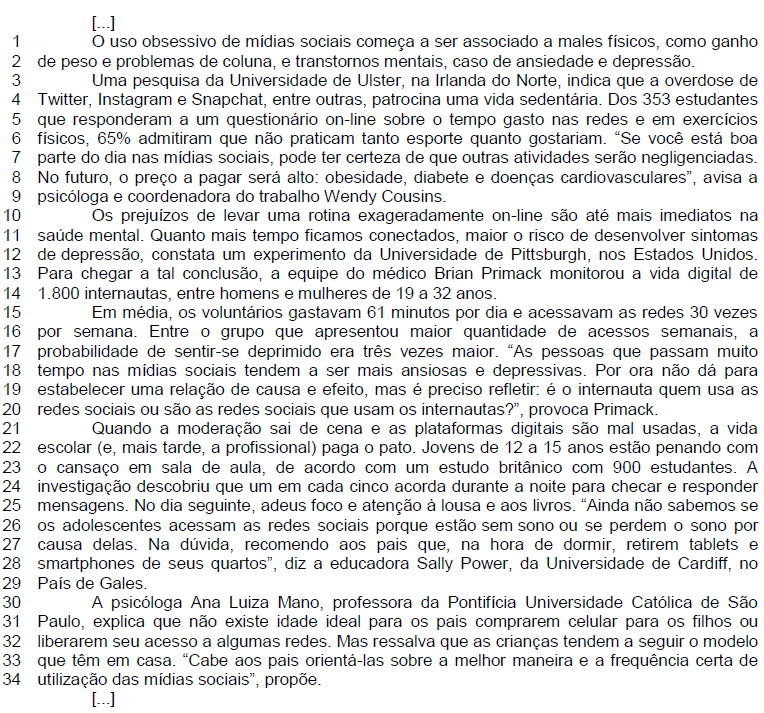
Cada vez mais conectados, encurtamos distâncias, ganhamos tempo e fazemos amigos. Mas, sem bom senso, já tem gente pagando um preço: o bem-estar
André Bernardo
Provas
Caderno Container