Magna Concursos

Foram encontradas 1.890 questões.

Sobre os diferentes tipos de motores e suas aplicações mais usuais, relacione as colunas e assinale a alternativa com a sequência correta.

1. Motor Monofásico de Indução.
2. Motor CC sem escovas.
3. Motor Trifásico de Indução.
4. Motor de Passo.

(  ) Utilizado em drones.
(  ) Utilizado em máquinas industriais.  
(  ) Utilizado em ventiladores domésticos.
(  ) Utilizado em Impressoras 3D.
 

Provas

Questão presente nas seguintes provas
Se considerarmos que um raio se comporta como uma corrente que desce por um fio retilíneo, é possível encontrar o valor da intensidade de campo magnético gerado em função da distância do evento. Ainda, considerando que praticamente todos os celulares da atualidade possuem sensores magnéticos, pode-se imaginar que, a certa distância, daria para detectar uma anomalia no campo devido a um raio por meio do celular. Considerando que um raio com intensidade de corrente média formou um canal condutor vertical com uma corrente de 30 kA e que a variação mínima que um sensor magnético de um celular pode sentir é de 1 μT, a qual distância máxima um celular (em repouso) poderia detectar a anomalia do campo causada pelo raio? 
Considere μ0 = 4π 10-7
 

Provas

Questão presente nas seguintes provas
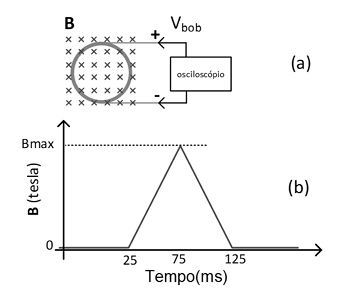
Uma bobina do tipo solenoide, núcleo a ar, foi enrolada a partir do terminal positivo, em sentido anti-horário, terminando no terminal negativo, como mostrado na figura (a) a seguir. A constante de tempo da bobina é da ordem de ms. Certa densidade de fluxo magnético B passa pelo plano de corte da bobina de forma perpendicular e possui variação temporal, como mostra a figura (b) a seguir.
                                                        Enunciado 4735970-1

Nessas condições, assinale a alternativa que apresenta a forma de onda de tensão Vbob medida nos terminais da bobina utilizando um osciloscópio.
 

Provas

Questão presente nas seguintes provas
Em uma manutenção de campo, observou-se em um motor de indução trifásico os seguintes dados de placa:

MOTOR DE INDUÇÃO TRIFÁSICO
Potência: 10 CV
Tensão: 220 / 380 V
Rendimento: 0,75
Fator de Potência: 0,8
Frequência: 60 Hz 

Os demais dados estavam apagados. Como o acesso físico aos terminais não era simples, o engenheiro, com um alicate amperímetro, apenas mediu a corrente elétrica em um dos cabos que alimentava o motor, lendo um valor muito próximo a 19 A, pois o motor operava em plena carga. Com base nessas informações, é correto afirmar que a tensão de linha e o tipo de ligação desse motor, são, respectivamente,
 

Provas

Questão presente nas seguintes provas
Um motor monofásico 220 V, com os seguintes dados de placa: 1 CV, rendimento de 0,75 e fator de potência 0,8, trabalha na potência nominal por 8 horas durante o dia. Considerando 1 CV ~ 750 W, o consumo em kWh de 30 dias e a corrente nominal desse motor são, respectivamente,
 

Provas

Questão presente nas seguintes provas
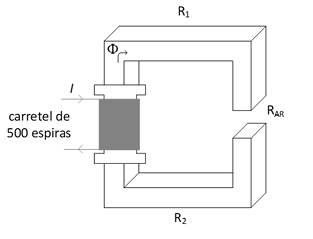
No circuito magnético da ilustração a seguir, passa um fluxo magnético constante de Φ = 500 μWb. Sabe-se que a Relutância RAR possui magnitude de 2,5 M Ae/Wb. Tanto R1 quanto R2 são relutâncias com apenas 10% do valor de RAR. 

                                                             Enunciado 4735965-1

Nessas condições de operação, é correto afirmar que a corrente I no carretel vale
 

Provas

Questão presente nas seguintes provas
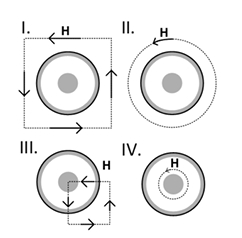
A figura a seguir ilustra a visão em corte de um cabo coaxial que está sendo utilizado para alimentar uma carga com uma corrente contínua de 2 A. A corrente entra pelo condutor interno e retorna pelo condutor externo. São mostrados quatro caminhos fechados onde aplicou-se a Lei de Ampère. Com base nesses casos, assinale a alternativa correta. 
                                                                            Enunciado 4735964-1
 

Provas

Questão presente nas seguintes provas
4170223 Ano: 2026
Disciplina: Inglês (Língua Inglesa)
Banca: AOCP
Orgão: IF-CE
Provas:

A new William Hope Hodgson blog

Welcome to Hodgsoniana, a new blog about the life and works of author William Hope Hodgson (1877–1918). The aim of this blog is to provide a home for articles and new research on Hodgson, details of Hodgson-related happenings, and just generally act as an up-to-date (hopefully) resource that’s open to anyone interested in this remarkable literary figure. At time of writing, there is a lack of other active websites covering this subject, which is why starting a blog seemed a worthwhile endeavour. At the very least, it gives me a place to post some Hodgson-related thoughts and findings I’ve been meaning to write up! My hope is that others may be moved to contribute also.

Before going any further, I want to recognise the work of the late Hodgson scholar Sam Gafford, and in particular his excellent Hodgson blog williamhopehodgson.wordpress.com. I first stumbled upon Sam’s blog back in 2016, and his work opened my eyes to the depths and complexities of Hodgson’s history and writings. I entered into brief correspondence with Sam at that time, and his enthusiasm and encouragement were key factors in starting me on the path of pursuing my own Hodgson studies.

Sam Gafford sadly passed away in 2019, leaving his site dormant. It remains a valuable treasure trove of information, and I will certainly aspire to follow Sam’s example in exploring and documenting all matters Hodgson.

2027 will see the 150th anniversary of William Hope Hodgson’s birth. There is still much to discuss regarding his work, and many areas of his life remain obscure and in need of further investigation. I hope this site can help in encouraging and chronicling such efforts.

Source: https://hodgsoniana.wordpress.com/2025/06/22/a-new-william-hope-hodgson-blog/ access on 28 february 2026.

The Hodgsoniana blog’s owner mentions the 150th anniversary alongside Hodgson's obscurity. What does this imply?
 

Provas

Questão presente nas seguintes provas
4170222 Ano: 2026
Disciplina: Inglês (Língua Inglesa)
Banca: AOCP
Orgão: IF-CE
Provas:

A new William Hope Hodgson blog

Welcome to Hodgsoniana, a new blog about the life and works of author William Hope Hodgson (1877–1918). The aim of this blog is to provide a home for articles and new research on Hodgson, details of Hodgson-related happenings, and just generally act as an up-to-date (hopefully) resource that’s open to anyone interested in this remarkable literary figure. At time of writing, there is a lack of other active websites covering this subject, which is why starting a blog seemed a worthwhile endeavour. At the very least, it gives me a place to post some Hodgson-related thoughts and findings I’ve been meaning to write up! My hope is that others may be moved to contribute also.

Before going any further, I want to recognise the work of the late Hodgson scholar Sam Gafford, and in particular his excellent Hodgson blog williamhopehodgson.wordpress.com. I first stumbled upon Sam’s blog back in 2016, and his work opened my eyes to the depths and complexities of Hodgson’s history and writings. I entered into brief correspondence with Sam at that time, and his enthusiasm and encouragement were key factors in starting me on the path of pursuing my own Hodgson studies.

Sam Gafford sadly passed away in 2019, leaving his site dormant. It remains a valuable treasure trove of information, and I will certainly aspire to follow Sam’s example in exploring and documenting all matters Hodgson.

2027 will see the 150th anniversary of William Hope Hodgson’s birth. There is still much to discuss regarding his work, and many areas of his life remain obscure and in need of further investigation. I hope this site can help in encouraging and chronicling such efforts.

Source: https://hodgsoniana.wordpress.com/2025/06/22/a-new-william-hope-hodgson-blog/ access on 28 february 2026.

Read the following statements about the Hodgsoniana blog and mark the correct alternative.
 

Provas

Questão presente nas seguintes provas
4170221 Ano: 2026
Disciplina: Inglês (Língua Inglesa)
Banca: AOCP
Orgão: IF-CE
Provas:

A new William Hope Hodgson blog

Welcome to Hodgsoniana, a new blog about the life and works of author William Hope Hodgson (1877–1918). The aim of this blog is to provide a home for articles and new research on Hodgson, details of Hodgson-related happenings, and just generally act as an up-to-date (hopefully) resource that’s open to anyone interested in this remarkable literary figure. At time of writing, there is a lack of other active websites covering this subject, which is why starting a blog seemed a worthwhile endeavour. At the very least, it gives me a place to post some Hodgson-related thoughts and findings I’ve been meaning to write up! My hope is that others may be moved to contribute also.

Before going any further, I want to recognise the work of the late Hodgson scholar Sam Gafford, and in particular his excellent Hodgson blog williamhopehodgson.wordpress.com. I first stumbled upon Sam’s blog back in 2016, and his work opened my eyes to the depths and complexities of Hodgson’s history and writings. I entered into brief correspondence with Sam at that time, and his enthusiasm and encouragement were key factors in starting me on the path of pursuing my own Hodgson studies.

Sam Gafford sadly passed away in 2019, leaving his site dormant. It remains a valuable treasure trove of information, and I will certainly aspire to follow Sam’s example in exploring and documenting all matters Hodgson.

2027 will see the 150th anniversary of William Hope Hodgson’s birth. There is still much to discuss regarding his work, and many areas of his life remain obscure and in need of further investigation. I hope this site can help in encouraging and chronicling such efforts.

Source: https://hodgsoniana.wordpress.com/2025/06/22/a-new-william-hope-hodgson-blog/ access on 28 february 2026.

The text points back to people or things mentioned earlier. Which of the following sentences is the best description of how the author avoids repeating the same names over and over?
 

Provas

Questão presente nas seguintes provas