Foram encontradas 60 questões.
Leia o texto para responder à questão.
The Research Assignment
Students today have access to so much information that they need to weigh the reliability of sources. Any resource – print, human, or electronic – used to support your research inquiry has to be evaluated for its credibility and reliability. In other words, you have to exercise some quality control over what you use. When you use the print and multimedia materials found in your college library, your evaluation task is not so complicated because librarians have already established the credibility and appropriateness of those materials for academic research. The marketplace forces publishers to be discriminating as well.
Data collected in interviews of persons whose reliability is not always clearly established should be carefully screened, especially if you present this material as expert opinion or as based on knowledge of your topic. And you may have even more difficulty establishing trustworthiness for electronic sources, especially Web and Internet sources.
Because the Internet and World Wide Web are easy to use and accessible, Web material is volatile – it changes, becomes outdated, or is deleted. Its lack of consistency and sometimes crude form make Web information suspect for people who use it for research. Because there is frequently no quality control over Web information, you must critically evaluate all the material you find there, text and graphics alike.
(http://www.umuc.edu/writingcenter/onlineguide/ chapter4-07.cfm-27.10.2013. Adaptado)
Provas

Leia o texto para responder à questão.
The Research Assignment
Students today have access to so much information that they need to weigh the reliability of sources. Any resource – print, human, or electronic – used to support your research inquiry has to be evaluated for its credibility and reliability. In other words, you have to exercise some quality control over what you use. When you use the print and multimedia materials found in your college library, your evaluation task is not so complicated because librarians have already established the credibility and appropriateness of those materials for academic research. The marketplace forces publishers to be discriminating as well.
Data collected in interviews of persons whose reliability is not always clearly established should be carefully screened, especially if you present this material as expert opinion or as based on knowledge of your topic. And you may have even more difficulty establishing trustworthiness for electronic sources, especially Web and Internet sources.
Because the Internet and World Wide Web are easy to use and accessible, Web material is volatile – it changes, becomes outdated, or is deleted. Its lack of consistency and sometimes crude form make Web information suspect for people who use it for research. Because there is frequently no quality control over Web information, you must critically evaluate all the material you find there, text and graphics alike.
(http://www.umuc.edu/writingcenter/onlineguide/ chapter4-07.cfm-27.10.2013. Adaptado)
Provas
Leia o texto para responder à questão.
The Research Assignment
Students today have access to so much information that they need to weigh the reliability of sources. Any resource – print, human, or electronic – used to support your research inquiry has to be evaluated for its credibility and reliability. In other words, you have to exercise some quality control over what you use. When you use the print and multimedia materials found in your college library, your evaluation task is not so complicated because librarians have already established the credibility and appropriateness of those materials for academic research. The marketplace forces publishers to be discriminating as well.
Data collected in interviews of persons whose reliability is not always clearly established should be carefully screened, especially if you present this material as expert opinion or as based on knowledge of your topic. And you may have even more difficulty establishing trustworthiness for electronic sources, especially Web and Internet sources.
Because the Internet and World Wide Web are easy to use and accessible, Web material is volatile – it changes, becomes outdated, or is deleted. Its lack of consistency and sometimes crude form make Web information suspect for people who use it for research. Because there is frequently no quality control over Web information, you must critically evaluate all the material you find there, text and graphics alike.
(http://www.umuc.edu/writingcenter/onlineguide/ chapter4-07.cfm-27.10.2013. Adaptado)
Provas
Leia o texto para responder à questão.
The Research Assignment
Students today have access to so much information that they need to weigh the reliability of sources. Any resource – print, human, or electronic – used to support your research inquiry has to be evaluated for its credibility and reliability. In other words, you have to exercise some quality control over what you use. When you use the print and multimedia materials found in your college library, your evaluation task is not so complicated because librarians have already established the credibility and appropriateness of those materials for academic research. The marketplace forces publishers to be discriminating as well.
Data collected in interviews of persons whose reliability is not always clearly established should be carefully screened, especially if you present this material as expert opinion or as based on knowledge of your topic. And you may have even more difficulty establishing trustworthiness for electronic sources, especially Web and Internet sources.
Because the Internet and World Wide Web are easy to use and accessible, Web material is volatile – it changes, becomes outdated, or is deleted. Its lack of consistency and sometimes crude form make Web information suspect for people who use it for research. Because there is frequently no quality control over Web information, you must critically evaluate all the material you find there, text and graphics alike.
(http://www.umuc.edu/writingcenter/onlineguide/ chapter4-07.cfm-27.10.2013. Adaptado)
Provas
Leia o texto para responder à questão.
The Research Assignment
Students today have access to so much information that they need to weigh the reliability of sources. Any resource – print, human, or electronic – used to support your research inquiry has to be evaluated for its credibility and reliability. In other words, you have to exercise some quality control over what you use. When you use the print and multimedia materials found in your college library, your evaluation task is not so complicated because librarians have already established the credibility and appropriateness of those materials for academic research. The marketplace forces publishers to be discriminating as well.
Data collected in interviews of persons whose reliability is not always clearly established should be carefully screened, especially if you present this material as expert opinion or as based on knowledge of your topic. And you may have even more difficulty establishing trustworthiness for electronic sources, especially Web and Internet sources.
Because the Internet and World Wide Web are easy to use and accessible, Web material is volatile – it changes, becomes outdated, or is deleted. Its lack of consistency and sometimes crude form make Web information suspect for people who use it for research. Because there is frequently no quality control over Web information, you must critically evaluate all the material you find there, text and graphics alike.
(http://www.umuc.edu/writingcenter/onlineguide/ chapter4-07.cfm-27.10.2013. Adaptado)
Provas
(http://www.estadao.com.br/noticias/nacional,governo-cria-grupo-exumar--restos-mortais-de- jango,1094178,0.htm 07. 11.2013. Adaptado)
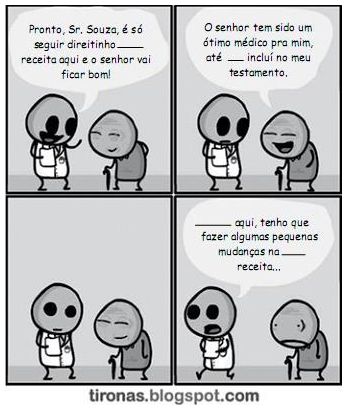
Segundo a norma-padrão da língua portuguesa, as lacunas da frase devem ser completadas, correta e respectivamente, por:
Provas
Provas
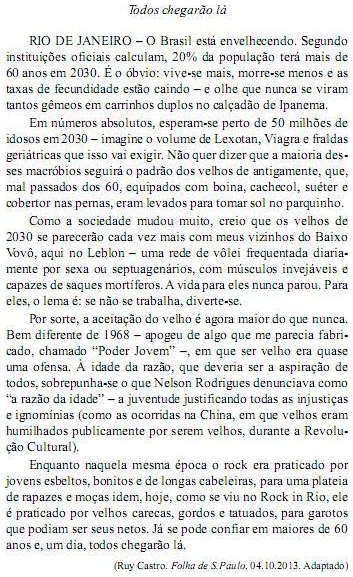
RIO DE JANEIRO - O Brasil está envelhecendo. Segundo instituições oficiais calculam, 20% da população terá mais de 60 anos em 2030. É o óbvio: vive-se mais, morre-se menos e as taxas de fecundidade estão caindo - e olhe que nunca se viram tantos gêmeos em carrinhos duplos no calçadão de Ipanema.
Em números absolutos, esperam-se perto de 50 milhões de idosos em 2030 - imagine o volume de Lexotan, Viagra e fraldas geriátricas que isso vai exigir. Não quer dizer que a maioria desses macróbios seguirá o padrão dos velhos de antigamente, que, mal passados dos 60, equipados com boina, cachecol, suéter e cobertor nas pernas, eram levados para tomar sol no parquinho.
Como a sociedade mudou muito, creio que os velhos de 2030 se parecerão cada vez mais com meus vizinhos do Baixo Vovô, aqui no Leblon - uma rede de vôlei frequentada diarmente por sexa ou septuagenários, com músculos invejáveis e capazes de saques mortíferos. A vida para eles nunca parou. Para eles, o lema é: se não se trabalha, diverte-se. Por sorte, a aceitação do velho é agora maior do que nunca.
Bem diferente de 1968 - apogeu de algo que me parecia fabri- cado, chamado “Poder Jovem” -, em que ser velho era quase uma ofensa. idade da razão, que deveria ser a aspiração de todos, sobrepunha-se o que Nelson Rodrigues denunciava como “a razão da idade” - a juventude justificando todas as injustiças e ignomínias (como as ocorridas na China, em que velhos eram humilhados publicamente por serem velhos, durante a Revolução Cultural).
Enquanto naquela mesma época o rock era praticado por jovens esbeltos, bonitos e de longas cabeleiras, para uma plateia de rapazes e moças idem, hoje, como se viu no Rock in Rio, ele é praticado por velhos carecas, gordos e tatuados, para garotos que podiam ser seus netos. Já se pode confiar em maiores de 60 anos e, um dia, todos chegarão lá.
(...) seguirá o padrão dos velhos de antigamente, que, mal passados dos 60(...) eram levados (...) (2.° parágrafo)
(...) hoje, como se viu no Rock in Rio, ele é praticado por velhos carecas,(...) (5.° parágrafo)
É correto afirmar que os termos destacados estabelecem, respectivamente, entre as orações, relações de sentido deas passagens do texto:
Provas
– Bem diferente de 1968 – apogeu de algo que me parecia fabricado, chamado “Poder Jovem” –, em que ser velho era quase uma ofensa. (4.° parágrafo)
– idade da razão, que deveria ser a aspiração de todos, sobrepunha-se o que Nelson Rodrigues denunciava como “a razão da idade” – a juventude justificando todas as injustiças e ignomínias (como as ocorridas na China, em que velhos eram humilhados publicamente por serem velhos, durante a Revolução Cultural). (4.° parágrafo).
Os termos destacados podem ser substituídos, correta e respectivamente, sem prejuízo do sentido do texto, por:
Provas
'
Provas
Caderno Container