Foram encontradas 70 questões.
2661065
Ano: 2015
Disciplina: Segurança e Saúde no Trabalho (SST)
Banca: CESGRANRIO
Orgão: BR Distribuidora
Disciplina: Segurança e Saúde no Trabalho (SST)
Banca: CESGRANRIO
Orgão: BR Distribuidora
Uma Brigada de Incêndio é definida como um grupo organizado de pessoas preferencialmente voluntárias ou indicadas, treinadas e capacitadas para atuar na prevenção e no combate ao princípio de incêndio, abandono de área e primeiros socorros, dentro de uma área preestabelecida na planta. Uma brigada é composta por profissionais designados por brigadistas.
Associe os outros profissionais às respectivas funções:

São corretas as associações:
Provas
Questão presente nas seguintes provas

2661064
Ano: 2015
Disciplina: Segurança e Saúde no Trabalho (SST)
Banca: CESGRANRIO
Orgão: BR Distribuidora
Disciplina: Segurança e Saúde no Trabalho (SST)
Banca: CESGRANRIO
Orgão: BR Distribuidora
A NR 15 determina, através do Anexo 3, limites de tolerância para exposição ao calor. Essa exposição deve ser avaliada através do Índice de Bulbo Úmido Termômetro de Globo (IBUTG). Nesse contexto, um profissional de segurança fez vistoria (acompanhada de medições ambientais com os equipamentos prescritos nas Normas) em um galpão coberto.
Qual o IBUTG a ser considerado para fins de caracterização de insalubridade, sabendo-se que a temperatura de bulbo úmido natural foi de 24ºC, a temperatura de globofoi 26ºC e a de bulbo seco foi de 38ºC?
Provas
Questão presente nas seguintes provas
2661063
Ano: 2015
Disciplina: Segurança e Saúde no Trabalho (SST)
Banca: CESGRANRIO
Orgão: BR Distribuidora
Disciplina: Segurança e Saúde no Trabalho (SST)
Banca: CESGRANRIO
Orgão: BR Distribuidora
Para fins do Programa de Prevenção de Riscos Ambientais (PPRA.), consideram-se agentes químicos as substâncias, os compostos ou produtos que possam penetrar no organismo pela via respiratória, nas formas de poeiras, fumos, névoas, neblinas, gases ou vapores, ou que, pelanatureza da atividade de exposição, possam ter contato ou ser absorvidos pelo organismo através da pele ou por ingestão.
Dessa forma, quando o profissional elabora um programa de proteção respiratória, ele deve atentar para o fato de que
Provas
Questão presente nas seguintes provas
2661062
Ano: 2015
Disciplina: Legislação Específica das Agências Reguladoras
Banca: CESGRANRIO
Orgão: BR Distribuidora
Disciplina: Legislação Específica das Agências Reguladoras
Banca: CESGRANRIO
Orgão: BR Distribuidora
Para o transporte de produtos perigosos, as substâncias (incluindo misturas e soluções) e artigos sujeitos aos regulamentos específicos de transporte (tais como a Resolução ANTT 420) são alocados a uma das 9 classes, de acordo com o risco ou o mais sério dos riscos que apresentam. Algumas dessas classes são subdivididas em subclasses.
Associe as classes e subclasses às respectivas definições.
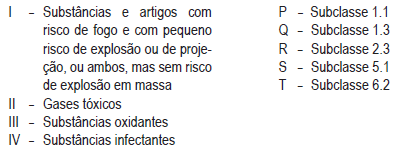
As associações corretas são:
Provas
Questão presente nas seguintes provas
2661040
Ano: 2015
Disciplina: Inglês (Língua Inglesa)
Banca: CESGRANRIO
Orgão: BR Distribuidora
Disciplina: Inglês (Língua Inglesa)
Banca: CESGRANRIO
Orgão: BR Distribuidora
Provas:
Natural gas waits for its moment
Paul Stenquist
Cars and trucks powered by natural gas make up a significant portion of the vehicle fleet in many parts of the world. Iran has more than two million natural gas vehicles on the road. As of 2009, Argentina had more than 1.8 million in operation and almost 2,000 natural gas filling stations. Brazil was not far behind. Italy and Germany have substantial natural gas vehicle fleets. Is America next?
With natural gas in plentiful supply at bargain prices in the United States, issues that have limited its use in cars are being rethought, and its market share could increase, perhaps substantially.
According to Energy Department Price Information from July, natural gas offers economic advantages over gasoline and diesel fuels. If a gasoline-engine vehicle can take you 40 miles on one gallon, the same vehicle running on compressed natural gas can do it for about $1.50 less at today’s prices. To that savings add lower maintenance costs. A study of New York City cabs running on natural gas found that oil changes need not be as frequent because of the clean burn of the fuel, and exhaustsystem parts last longer because natural gas is less corrosive than other fuels.
Today, those economic benefits are nullified by the initial cost of a natural gas vehicle — 20 to 30 percent more than a comparable gasoline-engine vehicle. But were production to increase significantly, economies of scale would bring prices down. In an interview by phone, Jon Coleman, fleet sustainability manager at the Ford Motor Company, said that given sufficient volume, the selling price of natural gas vehicles could be comparable to that of conventional vehicles.
It may be years before the economic benefits of natural gas vehicles can be realized, but the environmental benefits appear to be immediate. According to the Energy Department’s website, natural gas vehicles have smaller carbon footprints than gasoline or diesel automobiles, even when taking into account the natural gas production process, which releases carbon-rich methane into the atmosphere.
The United States government appears to favor natural gas as a motor vehicle fuel. To promote the production of vehicles with fewer carbon emissions, it has allowed automakers to count certain vehicle types more than once when calculating their Corporate Average Fuel Economy, under regulations mandating a fleet average of 54.5 miles per gallon by 2025. Plug-in hybrids and natural gas vehicles can be counted 1.6 times under the CAFE standards, and electric vehicles can be counted twice.
Adapting natural gas as a vehicle fuel introduces engineering challenges. While the fuel burns clean, it is less energy dense than gasoline, so if it is burned in an engine designed to run on conventional fuel, performance and efficiency are degraded.
But since natural gas has an octane rating of 130, compared with 93 for the best gasoline, an engine designed for it can run with very high cylinder pressure, which would cause a regular gasoline engine to knock from premature ignition. More cylinder pressure yields more power, and thus the energy-density advantage of gasoline can be nullified.[...]
Until the pressurized fuel tanks of natural gas vehicles can be easily and quickly refueled, the fleet cannot grow substantially. The number of commercial refueling stations for compressed natural gas has been increasing at a rate of 16 percent yearly, the Energy Department says. And, while the total is still small, advances in refueling equipment should increase the rate of expansion. Much of the infrastructure is already in place: America has millions of miles of natural gas pipeline. Connecting that network to refueling equipment is not difficult.
Although commercial refueling stations will be necessary to support a substantial fleet of natural gas vehicles, home refueling may be the magic bullet that makes the vehicles practical. Electric vehicles depend largely on home charging and most have less than half the range of a fully fueled natural gas vehicle. Somecompressed natural gas home refueling products are available, but they can cost as much as $5,000.
Seeking to change that, the Energy Department has awarded grants to a number of companies in an effort to develop affordable home-refueling equipment.
[...]
Available at: <http://www.nytimes.com/2013/10/30/automobiles/
natural-gas-waits-for-its-moment.html?page wanted=all&module=Search&mabReward=relbias%3A r%2C%7B%222%22%3A%22RI%3A18%22%7D>. Retrieved on: Sept 3rd, 2014. Adapted.
In the sentence of the text “Although commercial refueling stations will be necessary to support a substantial fleet of natural gas vehicles, home refueling may be the magic bullet that makes the vehicles practical”, the word although implies facts that are
Provas
Questão presente nas seguintes provas
2661039
Ano: 2015
Disciplina: Inglês (Língua Inglesa)
Banca: CESGRANRIO
Orgão: BR Distribuidora
Disciplina: Inglês (Língua Inglesa)
Banca: CESGRANRIO
Orgão: BR Distribuidora
Provas:
Natural gas waits for its moment
Paul Stenquist
Cars and trucks powered by natural gas make up a significant portion of the vehicle fleet in many parts of the world. Iran has more than two million natural gas vehicles on the road. As of 2009, Argentina had more than 1.8 million in operation and almost 2,000 natural gas filling stations. Brazil was not far behind. Italy and Germany have substantial natural gas vehicle fleets. Is America next?
With natural gas in plentiful supply at bargain prices in the United States, issues that have limited its use in cars are being rethought, and its market share could increase, perhaps substantially.
According to Energy Department Price Information from July, natural gas offers economic advantages over gasoline and diesel fuels. If a gasoline-engine vehicle can take you 40 miles on one gallon, the same vehicle running on compressed natural gas can do it for about $1.50 less at today’s prices. To that savings add lower maintenance costs. A study of New York City cabs running on natural gas found that oil changes need not be as frequent because of the clean burn of the fuel, and exhaustsystem parts last longer because natural gas is less corrosive than other fuels.
Today, those economic benefits are nullified by the initial cost of a natural gas vehicle — 20 to 30 percent more than a comparable gasoline-engine vehicle. But were production to increase significantly, economies of scale would bring prices down. In an interview by phone, Jon Coleman, fleet sustainability manager at the Ford Motor Company, said that given sufficient volume, the selling price of natural gas vehicles could be comparable to that of conventional vehicles.
It may be years before the economic benefits of natural gas vehicles can be realized, but the environmental benefits appear to be immediate. According to the Energy Department’s website, natural gas vehicles have smaller carbon footprints than gasoline or diesel automobiles, even when taking into account the natural gas production process, which releases carbon-rich methane into the atmosphere.
The United States government appears to favor natural gas as a motor vehicle fuel. To promote the production of vehicles with fewer carbon emissions, it has allowed automakers to count certain vehicle types more than once when calculating their Corporate Average Fuel Economy, under regulations mandating a fleet average of 54.5 miles per gallon by 2025. Plug-in hybrids and natural gas vehicles can be counted 1.6 times under the CAFE standards, and electric vehicles can be counted twice.
Adapting natural gas as a vehicle fuel introduces engineering challenges. While the fuel burns clean, it is less energy dense than gasoline, so if it is burned in an engine designed to run on conventional fuel, performance and efficiency are degraded.
But since natural gas has an octane rating of 130, compared with 93 for the best gasoline, an engine designed for it can run with very high cylinder pressure, which would cause a regular gasoline engine to knock from premature ignition. More cylinder pressure yields more power, and thus the energy-density advantage of gasoline can be nullified.[...]
Until the pressurized fuel tanks of natural gas vehicles can be easily and quickly refueled, the fleet cannot grow substantially. The number of commercial refueling stations for compressed natural gas has been increasing at a rate of 16 percent yearly, the Energy Department says. And, while the total is still small, advances in refueling equipment should increase the rate of expansion. Much of the infrastructure is already in place: America has millions of miles of natural gas pipeline. Connecting that network to refueling equipment is not difficult.
Although commercial refueling stations will be necessary to support a substantial fleet of natural gas vehicles, home refueling may be the magic bullet that makes the vehicles practical. Electric vehicles depend largely on home charging and most have less than half the range of a fully fueled natural gas vehicle. Somecompressed natural gas home refueling products are available, but they can cost as much as $5,000.
Seeking to change that, the Energy Department has awarded grants to a number of companies in an effort to develop affordable home-refueling equipment.
[...]
Available at: <http://www.nytimes.com/2013/10/30/automobiles/
natural-gas-waits-for-its-moment.html?page wanted=all&module=Search&mabReward=relbias%3A r%2C%7B%222%22%3A%22RI%3A18%22%7D>. Retrieved on: Sept 3rd, 2014. Adapted.
According to the 9th paragraph in the text (lines 65-75), refueling stations in the United States
Provas
Questão presente nas seguintes provas
2661038
Ano: 2015
Disciplina: Inglês (Língua Inglesa)
Banca: CESGRANRIO
Orgão: BR Distribuidora
Disciplina: Inglês (Língua Inglesa)
Banca: CESGRANRIO
Orgão: BR Distribuidora
Provas:
Natural gas waits for its moment
Paul Stenquist
Cars and trucks powered by natural gas make up a significant portion of the vehicle fleet in many parts of the world. Iran has more than two million natural gas vehicles on the road. As of 2009, Argentina had more than 1.8 million in operation and almost 2,000 natural gas filling stations. Brazil was not far behind. Italy and Germany have substantial natural gas vehicle fleets. Is America next?
With natural gas in plentiful supply at bargain prices in the United States, issues that have limited its use in cars are being rethought, and its market share could increase, perhaps substantially.
According to Energy Department Price Information from July, natural gas offers economic advantages over gasoline and diesel fuels. If a gasoline-engine vehicle can take you 40 miles on one gallon, the same vehicle running on compressed natural gas can do it for about $1.50 less at today’s prices. To that savings add lower maintenance costs. A study of New York City cabs running on natural gas found that oil changes need not be as frequent because of the clean burn of the fuel, and exhaustsystem parts last longer because natural gas is less corrosive than other fuels.
Today, those economic benefits are nullified by the initial cost of a natural gas vehicle — 20 to 30 percent more than a comparable gasoline-engine vehicle. But were production to increase significantly, economies of scale would bring prices down. In an interview by phone, Jon Coleman, fleet sustainability manager at the Ford Motor Company, said that given sufficient volume, the selling price of natural gas vehicles could be comparable to that of conventional vehicles.
It may be years before the economic benefits of natural gas vehicles can be realized, but the environmental benefits appear to be immediate. According to the Energy Department’s website, natural gas vehicles have smaller carbon footprints than gasoline or diesel automobiles, even when taking into account the natural gas production process, which releases carbon-rich methane into the atmosphere.
The United States government appears to favor natural gas as a motor vehicle fuel. To promote the production of vehicles with fewer carbon emissions, it has allowed automakers to count certain vehicle types more than once when calculating their Corporate Average Fuel Economy, under regulations mandating a fleet average of 54.5 miles per gallon by 2025. Plug-in hybrids and natural gas vehicles can be counted 1.6 times under the CAFE standards, and electric vehicles can be counted twice.
Adapting natural gas as a vehicle fuel introduces engineering challenges. While the fuel burns clean, it is less energy dense than gasoline, so if it is burned in an engine designed to run on conventional fuel, performance and efficiency are degraded.
But since natural gas has an octane rating of 130, compared with 93 for the best gasoline, an engine designed for it can run with very high cylinder pressure, which would cause a regular gasoline engine to knock from premature ignition. More cylinder pressure yields more power, and thus the energy-density advantage of gasoline can be nullified.[...]
Until the pressurized fuel tanks of natural gas vehicles can be easily and quickly refueled, the fleet cannot grow substantially. The number of commercial refueling stations for compressed natural gas has been increasing at a rate of 16 percent yearly, the Energy Department says. And, while the total is still small, advances in refueling equipment should increase the rate of expansion. Much of the infrastructure is already in place: America has millions of miles of natural gas pipeline. Connecting that network to refueling equipment is not difficult.
Although commercial refueling stations will be necessary to support a substantial fleet of natural gas vehicles, home refueling may be the magic bullet that makes the vehicles practical. Electric vehicles depend largely on home charging and most have less than half the range of a fully fueled natural gas vehicle. Somecompressed natural gas home refueling products are available, but they can cost as much as $5,000.
Seeking to change that, the Energy Department has awarded grants to a number of companies in an effort to develop affordable home-refueling equipment.
[...]
Available at: <http://www.nytimes.com/2013/10/30/automobiles/
natural-gas-waits-for-its-moment.html?page wanted=all&module=Search&mabReward=relbias%3A r%2C%7B%222%22%3A%22RI%3A18%22%7D>. Retrieved on: Sept 3rd, 2014. Adapted.
The personal pronoun it in “so if it is burned in an engine designed to run on conventional fuel” refers to
Provas
Questão presente nas seguintes provas
2661037
Ano: 2015
Disciplina: Inglês (Língua Inglesa)
Banca: CESGRANRIO
Orgão: BR Distribuidora
Disciplina: Inglês (Língua Inglesa)
Banca: CESGRANRIO
Orgão: BR Distribuidora
Provas:
Natural gas waits for its moment
Paul Stenquist
Cars and trucks powered by natural gas make up a significant portion of the vehicle fleet in many parts of the world. Iran has more than two million natural gas vehicles on the road. As of 2009, Argentina had more than 1.8 million in operation and almost 2,000 natural gas filling stations. Brazil was not far behind. Italy and Germany have substantial natural gas vehicle fleets. Is America next?
With natural gas in plentiful supply at bargain prices in the United States, issues that have limited its use in cars are being rethought, and its market share could increase, perhaps substantially.
According to Energy Department Price Information from July, natural gas offers economic advantages over gasoline and diesel fuels. If a gasoline-engine vehicle can take you 40 miles on one gallon, the same vehicle running on compressed natural gas can do it for about $1.50 less at today’s prices. To that savings add lower maintenance costs. A study of New York City cabs running on natural gas found that oil changes need not be as frequent because of the clean burn of the fuel, and exhaustsystem parts last longer because natural gas is less corrosive than other fuels.
Today, those economic benefits are nullified by the initial cost of a natural gas vehicle — 20 to 30 percent more than a comparable gasoline-engine vehicle. But were production to increase significantly, economies of scale would bring prices down. In an interview by phone, Jon Coleman, fleet sustainability manager at the Ford Motor Company, said that given sufficient volume, the selling price of natural gas vehicles could be comparable to that of conventional vehicles.
It may be years before the economic benefits of natural gas vehicles can be realized, but the environmental benefits appear to be immediate. According to the Energy Department’s website, natural gas vehicles have smaller carbon footprints than gasoline or diesel automobiles, even when taking into account the natural gas production process, which releases carbon-rich methane into the atmosphere.
The United States government appears to favor natural gas as a motor vehicle fuel. To promote the production of vehicles with fewer carbon emissions, it has allowed automakers to count certain vehicle types more than once when calculating their Corporate Average Fuel Economy, under regulations mandating a fleet average of 54.5 miles per gallon by 2025. Plug-in hybrids and natural gas vehicles can be counted 1.6 times under the CAFE standards, and electric vehicles can be counted twice.
Adapting natural gas as a vehicle fuel introduces engineering challenges. While the fuel burns clean, it is less energy dense than gasoline, so if it is burned in an engine designed to run on conventional fuel, performance and efficiency are degraded.
But since natural gas has an octane rating of 130, compared with 93 for the best gasoline, an engine designed for it can run with very high cylinder pressure, which would cause a regular gasoline engine to knock from premature ignition. More cylinder pressure yields more power, and thus the energy-density advantage of gasoline can be nullified.[...]
Until the pressurized fuel tanks of natural gas vehicles can be easily and quickly refueled, the fleet cannot grow substantially. The number of commercial refueling stations for compressed natural gas has been increasing at a rate of 16 percent yearly, the Energy Department says. And, while the total is still small, advances in refueling equipment should increase the rate of expansion. Much of the infrastructure is already in place: America has millions of miles of natural gas pipeline. Connecting that network to refueling equipment is not difficult.
Although commercial refueling stations will be necessary to support a substantial fleet of natural gas vehicles, home refueling may be the magic bullet that makes the vehicles practical. Electric vehicles depend largely on home charging and most have less than half the range of a fully fueled natural gas vehicle. Somecompressed natural gas home refueling products are available, but they can cost as much as $5,000.
Seeking to change that, the Energy Department has awarded grants to a number of companies in an effort to develop affordable home-refueling equipment.
[...]
Available at: <http://www.nytimes.com/2013/10/30/automobiles/
natural-gas-waits-for-its-moment.html?page wanted=all&module=Search&mabReward=relbias%3A r%2C%7B%222%22%3A%22RI%3A18%22%7D>. Retrieved on: Sept 3rd, 2014. Adapted.
According to the 6th paragraph in the text (lines 43-52), one of the Corporate Average Fuel Economy goals for the fleet in the United States is average 54.5 miles per gallon
Provas
Questão presente nas seguintes provas
2661036
Ano: 2015
Disciplina: Inglês (Língua Inglesa)
Banca: CESGRANRIO
Orgão: BR Distribuidora
Disciplina: Inglês (Língua Inglesa)
Banca: CESGRANRIO
Orgão: BR Distribuidora
Provas:
Natural gas waits for its moment
Paul Stenquist
Cars and trucks powered by natural gas make up a significant portion of the vehicle fleet in many parts of the world. Iran has more than two million natural gas vehicles on the road. As of 2009, Argentina had more than 1.8 million in operation and almost 2,000 natural gas filling stations. Brazil was not far behind. Italy and Germany have substantial natural gas vehicle fleets. Is America next?
With natural gas in plentiful supply at bargain prices in the United States, issues that have limited its use in cars are being rethought, and its market share could increase, perhaps substantially.
According to Energy Department Price Information from July, natural gas offers economic advantages over gasoline and diesel fuels. If a gasoline-engine vehicle can take you 40 miles on one gallon, the same vehicle running on compressed natural gas can do it for about $1.50 less at today’s prices. To that savings add lower maintenance costs. A study of New York City cabs running on natural gas found that oil changes need not be as frequent because of the clean burn of the fuel, and exhaustsystem parts last longer because natural gas is less corrosive than other fuels.
Today, those economic benefits are nullified by the initial cost of a natural gas vehicle — 20 to 30 percent more than a comparable gasoline-engine vehicle. But were production to increase significantly, economies of scale would bring prices down. In an interview by phone, Jon Coleman, fleet sustainability manager at the Ford Motor Company, said that given sufficient volume, the selling price of natural gas vehicles could be comparable to that of conventional vehicles.
It may be years before the economic benefits of natural gas vehicles can be realized, but the environmental benefits appear to be immediate. According to the Energy Department’s website, natural gas vehicles have smaller carbon footprints than gasoline or diesel automobiles, even when taking into account the natural gas production process, which releases carbon-rich methane into the atmosphere.
The United States government appears to favor natural gas as a motor vehicle fuel. To promote the production of vehicles with fewer carbon emissions, it has allowed automakers to count certain vehicle types more than once when calculating their Corporate Average Fuel Economy, under regulations mandating a fleet average of 54.5 miles per gallon by 2025. Plug-in hybrids and natural gas vehicles can be counted 1.6 times under the CAFE standards, and electric vehicles can be counted twice.
Adapting natural gas as a vehicle fuel introduces engineering challenges. While the fuel burns clean, it is less energy dense than gasoline, so if it is burned in an engine designed to run on conventional fuel, performance and efficiency are degraded.
But since natural gas has an octane rating of 130, compared with 93 for the best gasoline, an engine designed for it can run with very high cylinder pressure, which would cause a regular gasoline engine to knock from premature ignition. More cylinder pressure yields more power, and thus the energy-density advantage of gasoline can be nullified.[...]
Until the pressurized fuel tanks of natural gas vehicles can be easily and quickly refueled, the fleet cannot grow substantially. The number of commercial refueling stations for compressed natural gas has been increasing at a rate of 16 percent yearly, the Energy Department says. And, while the total is still small, advances in refueling equipment should increase the rate of expansion. Much of the infrastructure is already in place: America has millions of miles of natural gas pipeline. Connecting that network to refueling equipment is not difficult.
Although commercial refueling stations will be necessary to support a substantial fleet of natural gas vehicles, home refueling may be the magic bullet that makes the vehicles practical. Electric vehicles depend largely on home charging and most have less than half the range of a fully fueled natural gas vehicle. Somecompressed natural gas home refueling products are available, but they can cost as much as $5,000.
Seeking to change that, the Energy Department has awarded grants to a number of companies in an effort to develop affordable home-refueling equipment.
[...]
Available at: <http://www.nytimes.com/2013/10/30/automobiles/
natural-gas-waits-for-its-moment.html?page wanted=all&module=Search&mabReward=relbias%3A r%2C%7B%222%22%3A%22RI%3A18%22%7D>. Retrieved on: Sept 3rd, 2014. Adapted.
The modal verb may in the fragment of the text “It may be years before the economic benefits of natural gas vehicles can be realized” is associated with the idea of
Provas
Questão presente nas seguintes provas
2661035
Ano: 2015
Disciplina: Inglês (Língua Inglesa)
Banca: CESGRANRIO
Orgão: BR Distribuidora
Disciplina: Inglês (Língua Inglesa)
Banca: CESGRANRIO
Orgão: BR Distribuidora
Provas:
Natural gas waits for its moment
Paul Stenquist
Cars and trucks powered by natural gas make up a significant portion of the vehicle fleet in many parts of the world. Iran has more than two million natural gas vehicles on the road. As of 2009, Argentina had more than 1.8 million in operation and almost 2,000 natural gas filling stations. Brazil was not far behind. Italy and Germany have substantial natural gas vehicle fleets. Is America next?
With natural gas in plentiful supply at bargain prices in the United States, issues that have limited its use in cars are being rethought, and its market share could increase, perhaps substantially.
According to Energy Department Price Information from July, natural gas offers economic advantages over gasoline and diesel fuels. If a gasoline-engine vehicle can take you 40 miles on one gallon, the same vehicle running on compressed natural gas can do it for about $1.50 less at today’s prices. To that savings add lower maintenance costs. A study of New York City cabs running on natural gas found that oil changes need not be as frequent because of the clean burn of the fuel, and exhaustsystem parts last longer because natural gas is less corrosive than other fuels.
Today, those economic benefits are nullified by the initial cost of a natural gas vehicle — 20 to 30 percent more than a comparable gasoline-engine vehicle. But were production to increase significantly, economies of scale would bring prices down. In an interview by phone, Jon Coleman, fleet sustainability manager at the Ford Motor Company, said that given sufficient volume, the selling price of natural gas vehicles could be comparable to that of conventional vehicles.
It may be years before the economic benefits of natural gas vehicles can be realized, but the environmental benefits appear to be immediate. According to the Energy Department’s website, natural gas vehicles have smaller carbon footprints than gasoline or diesel automobiles, even when taking into account the natural gas production process, which releases carbon-rich methane into the atmosphere.
The United States government appears to favor natural gas as a motor vehicle fuel. To promote the production of vehicles with fewer carbon emissions, it has allowed automakers to count certain vehicle types more than once when calculating their Corporate Average Fuel Economy, under regulations mandating a fleet average of 54.5 miles per gallon by 2025. Plug-in hybrids and natural gas vehicles can be counted 1.6 times under the CAFE standards, and electric vehicles can be counted twice.
Adapting natural gas as a vehicle fuel introduces engineering challenges. While the fuel burns clean, it is less energy dense than gasoline, so if it is burned in an engine designed to run on conventional fuel, performance and efficiency are degraded.
But since natural gas has an octane rating of 130, compared with 93 for the best gasoline, an engine designed for it can run with very high cylinder pressure, which would cause a regular gasoline engine to knock from premature ignition. More cylinder pressure yields more power, and thus the energy-density advantage of gasoline can be nullified.[...]
Until the pressurized fuel tanks of natural gas vehicles can be easily and quickly refueled, the fleet cannot grow substantially. The number of commercial refueling stations for compressed natural gas has been increasing at a rate of 16 percent yearly, the Energy Department says. And, while the total is still small, advances in refueling equipment should increase the rate of expansion. Much of the infrastructure is already in place: America has millions of miles of natural gas pipeline. Connecting that network to refueling equipment is not difficult.
Although commercial refueling stations will be necessary to support a substantial fleet of natural gas vehicles, home refueling may be the magic bullet that makes the vehicles practical. Electric vehicles depend largely on home charging and most have less than half the range of a fully fueled natural gas vehicle. Somecompressed natural gas home refueling products are available, but they can cost as much as $5,000.
Seeking to change that, the Energy Department has awarded grants to a number of companies in an effort to develop affordable home-refueling equipment.
[...]
Available at: <http://www.nytimes.com/2013/10/30/automobiles/
natural-gas-waits-for-its-moment.html?page wanted=all&module=Search&mabReward=relbias%3A r%2C%7B%222%22%3A%22RI%3A18%22%7D>. Retrieved on: Sept 3rd, 2014. Adapted.
In the 5th paragraph, limited by lines 35-42 in the text, the author defends the idea that
Provas
Questão presente nas seguintes provas
Cadernos
Caderno Container