Foram encontradas 105 questões.
Freedom of IMFormation
By Reza Moghadam
Posted on September 17, 2009 by iMFdirect
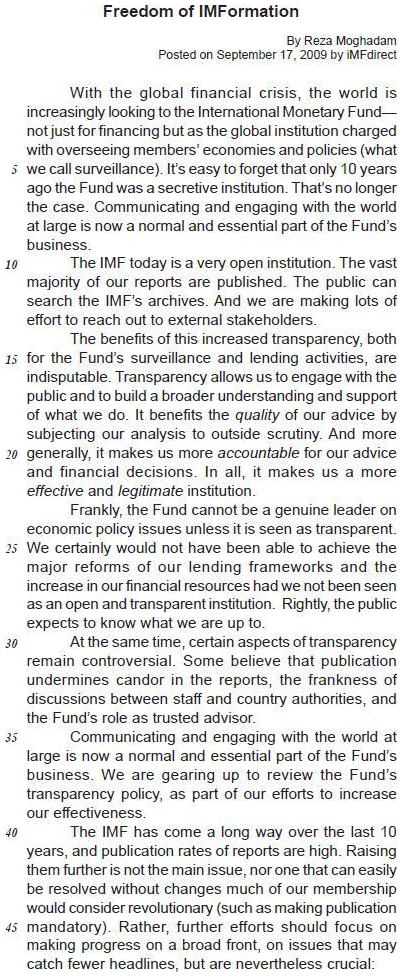
With the global financial crisis, the world is increasingly looking to the International Monetary Fund- not just for financing but as the global institution charged with overseeing members' economies and policies (what we call surveillance). It's easy to forget that only 10 years ago the Fund was a secretive institution. That's no longer the case. Communicating and engaging with the world at large is now a normal and essential part of the Fund's business.
The IMF today is a very open institution. The vast majority of our reports are published. The public can search the IMF's archives. And we are making lots of effort to reach out to external stakeholders.
The benefits of this increased transparency, both for the Fund's surveillance and lending activities, are indisputable. Transparency allows us to engage with the public and to build a broader understanding and support of what we do. It benefits the quality of our advice by subjecting our analysis to outside scrutiny. And more generally, it makes us more accountable for our advice and financial decisions. In all, it makes us a more effective and legitimate institution.
Frankly, the Fund cannot be a genuine leader on economic policy issues unless it is seen as transparent. We certainly would not have been able to achieve the major reforms of our lending frameworks and the increase in our financial resources had we not been seen as an open and transparent institution. Rightly, the public expects to know what we are up to.
At the same time, certain aspects of transparency remain controversial. Some believe that publication undermines candor in the reports, the frankness of discussions between staff and country authorities, and the Fund's role as trusted advisor.
Communicating and engaging with the world at large is now a normal and essential part of the Fund's business. We are gearing up to review the Fund's transparency policy, as part of our efforts to increase our effectiveness.
The IMF has come a long way over the last 10 years, and publication rates of reports are high. Raising them further is not the main issue, nor one that can easily be resolved without changes much of our membership would consider revolutionary (such as making publication mandatory). Rather, further efforts should focus on making progress on a broad front, on issues that may catch fewer headlines, but are nevertheless crucial:
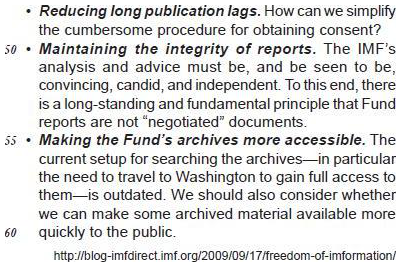
- Reducing long publication lags. How can we simplify the cumbersome procedure for obtaining consent?
- Maintaining the integrity of reports. The IMF's analysis and advice must be, and be seen to be, convincing, candid, and independent. To this end, there is a long-standing and fundamental principle that Fund reports are not "negotiated" documents.
- Making the Fund's archives more accessible. The current setup for searching the archives-in particular the need to travel to Washington to gain full access to them-is outdated. We should also consider whether we can make some archived material available more quickly to the public.
http://blog-imfdirect.imf.org/2009/09/17/freedom-of-imformation/
The wordplay in the title refers to the fact that the
Provas

Freedom of IMFormation
By Reza Moghadam
Posted on September 17, 2009 by iMFdirect
With the global financial crisis, the world is increasingly
looking to the International Monetary Fund- not just for financing but
as the global institution charged with overseeing members' economies and
policies (what we call surveillance). It's easy to forget that only 10
years ago the Fund was a secretive institution. That's no longer the
case. Communicating and engaging with the world at large is now a normal
and essential part of the Fund's business.
The IMF
today is a very open institution. The vast majority of our reports are
published. The public can search the IMF's archives. And we are making
lots of effort to reach out to external stakeholders.
The benefits of this increased transparency, both for the Fund's
surveillance and lending activities, are indisputable. Transparency
allows us to engage with the public and to build a broader understanding
and support of what we do. It benefits the quality of our advice
by subjecting our analysis to outside scrutiny. And more generally, it
makes us more accountable for our advice and financial decisions. In
all, it makes us a more effective and legitimate institution.
Frankly, the Fund cannot be a genuine leader on economic policy
issues unless it is seen as transparent. We certainly would not have
been able to achieve the major reforms of our lending frameworks and the
increase in our financial resources had we not been seen as an open and
transparent institution. Rightly, the public expects to know what we
are up to.
At the same time, certain aspects of
transparency remain controversial. Some believe that publication
undermines candor in the reports, the frankness of discussions between
staff and country authorities, and the Fund's role as trusted advisor.
Communicating and engaging with the world at large is now a
normal and essential part of the Fund's business. We are gearing up to
review the Fund's transparency policy, as part of our efforts to
increase our effectiveness.
The IMF has come a long way over the last 10 years, and publication rates of reports are high. Raising them
further is not the main issue, nor one that can easily be resolved
without changes much of our membership would consider revolutionary
(such as making publication mandatory). Rather, further efforts should
focus on making progress on a broad front, on issues that may catch
fewer headlines, but are nevertheless crucial:
- Reducing long publication lags. How can we simplify the cumbersome procedure for obtaining consent?
- Maintaining the integrity of reports. The IMF's analysis and advice must be, and be seen to be, convincing, candid, and independent. To this end, there is a long-standing and fundamental principle that Fund reports are not "negotiated" documents.
- Making the Fund's archives more accessible. The current setup for searching the archives-in particular the need to travel to Washington to gain full access to them-is outdated. We should also consider whether we can make some archived material available more quickly to the public.
http://blog-imfdirect.imf.org/2009/09/17/freedom-of-imformation/
In terms of meaning, it is correct to affirm that
Provas
" Rahim, on December 14th, 2009 at 12:41 am http://blog-imfdirect.imf.org/2009/09/17/freedom-of-imformation/ #comment-579
The comment above is in tune with Moghadam's ideas, because Rahim states that
Provas
Freedom of IMFormation
By Reza Moghadam
Posted on September 17, 2009 by iMFdirect
With the global financial crisis, the world is increasingly
looking to the International Monetary Fund- not just for financing but
as the global institution charged with overseeing members' economies and
policies (what we call surveillance). It's easy to forget that only 10
years ago the Fund was a secretive institution. That's no longer the
case. Communicating and engaging with the world at large is now a normal
and essential part of the Fund's business.
The IMF
today is a very open institution. The vast majority of our reports are
published. The public can search the IMF's archives. And we are making
lots of effort to reach out to external stakeholders.
The benefits of this increased transparency, both for the Fund's
surveillance and lending activities, are indisputable. Transparency
allows us to engage with the public and to build a broader understanding
and support of what we do. It benefits the quality of our advice
by subjecting our analysis to outside scrutiny. And more generally, it
makes us more accountable for our advice and financial decisions. In
all, it makes us a more effective and legitimate institution.
Frankly, the Fund cannot be a genuine leader on economic policy
issues unless it is seen as transparent. We certainly would not have
been able to achieve the major reforms of our lending frameworks and the
increase in our financial resources had we not been seen as an open and
transparent institution. Rightly, the public expects to know what we
are up to.
At the same time, certain aspects of
transparency remain controversial. Some believe that publication
undermines candor in the reports, the frankness of discussions between
staff and country authorities, and the Fund's role as trusted advisor.
Communicating and engaging with the world at large is now a
normal and essential part of the Fund's business. We are gearing up to
review the Fund's transparency policy, as part of our efforts to
increase our effectiveness.
The IMF has come a long way over the last 10 years, and publication rates of reports are high. Raising them
further is not the main issue, nor one that can easily be resolved
without changes much of our membership would consider revolutionary
(such as making publication mandatory). Rather, further efforts should
focus on making progress on a broad front, on issues that may catch
fewer headlines, but are nevertheless crucial:
- Reducing long publication lags. How can we simplify the cumbersome procedure for obtaining consent?
- Maintaining the integrity of reports. The IMF's analysis and advice must be, and be seen to be, convincing, candid, and independent. To this end, there is a long-standing and fundamental principle that Fund reports are not "negotiated" documents.
- Making the Fund's archives more accessible. The current setup for searching the archives-in particular the need to travel to Washington to gain full access to them-is outdated. We should also consider whether we can make some archived material available more quickly to the public.
http://blog-imfdirect.imf.org/2009/09/17/freedom-of-imformation/
The only argument that CANNOT be considered supportive of publishing the IMF documents is that the
Provas
Freedom of IMFormation
By Reza Moghadam
Posted on September 17, 2009 by iMFdirect
With the global financial crisis, the world is increasingly looking to the International Monetary Fund- not just for financing but as the global institution charged with overseeing members' economies and policies (what we call surveillance). It's easy to forget that only 10 years ago the Fund was a secretive institution. That's no longer the case. Communicating and engaging with the world at large is now a normal and essential part of the Fund's business.
The IMF today is a very open institution. The vast majority of our reports are published. The public can search the IMF's archives. And we are making lots of effort to reach out to external stakeholders.
The benefits of this increased transparency, both for the Fund's surveillance and lending activities, are indisputable. Transparency allows us to engage with the public and to build a broader understanding and support of what we do. It benefits the quality of our advice by subjecting our analysis to outside scrutiny. And more generally, it makes us more accountable for our advice and financial decisions. In all, it makes us a more effective and legitimate institution.
Frankly, the Fund cannot be a genuine leader on economic policy issues unless it is seen as transparent. We certainly would not have been able to achieve the major reforms of our lending frameworks and the increase in our financial resources had we not been seen as an open and transparent institution. Rightly, the public expects to know what we are up to.
At the same time, certain aspects of transparency remain controversial. Some believe that publication undermines candor in the reports, the frankness of discussions between staff and country authorities, and the Fund's role as trusted advisor.
Communicating and engaging with the world at large is now a normal and essential part of the Fund's business. We are gearing up to review the Fund's transparency policy, as part of our efforts to increase our effectiveness.
The IMF has come a long way over the last 10 years, and publication rates of reports are high. Raising them further is not the main issue, nor one that can easily be resolved without changes much of our membership would consider revolutionary (such as making publication mandatory). Rather, further efforts should focus on making progress on a broad front, on issues that may catch fewer headlines, but are nevertheless crucial:
- Reducing long publication lags. How can we simplify the cumbersome procedure for obtaining consent?
- Maintaining the integrity of reports. The IMF's analysis and advice must be, and be seen to be, convincing, candid, and independent. To this end, there is a long-standing and fundamental principle that Fund reports are not "negotiated" documents.
- Making the Fund's archives more accessible. The current setup for searching the archives-in particular the need to travel to Washington to gain full access to them-is outdated. We should also consider whether we can make some archived material available more quickly to the public.
http://blog-imfdirect.imf.org/2009/09/17/freedom-of-imformation/
The expression in boldtype and the item in parenthesis are semantically equivalent in
Provas
Provas
A cidade moderna são os ecos [de um] labirinto - presídio complexo de ruas cruzadas e rios aparentemente sem embocadura - onde a iniciação itinerante e o fio de Ariadne se mostram tênues ou nulos. Invertendo- se uma das interpretações do mito, o labirinto aqui não é a trilha para chegar-se ao centro; é, antes, marca da dispersão. Indica a vitória do material sobre o espiritual, do perecível sobre o eterno. Ou mais, o lugar do descartável e do novo e sempre-igual.
O homem citadino é presa dessa cidade, está enredado em suas malhas. Não consegue sair desse espaço denso, uma vez que a civilização urbana espraiou-se para além dos centros metropolitanos e continua a preencher grandes áreas que gravitam em torno desses centros. A partir da Revolução Industrial, o fenômeno urbano parece ter ultrapassado as fronteiras das ?cidades? e ter-se difundido pelo espaço físico. O signo do progresso transforma a urbanização em movimento centrífugo, gerando a metrópole que se dispersa. Assim, o citadino - homem à deriva - está na cidade como em labirinto, não pode sair dela sem cair em outra, idêntica ainda que seja distinta.
GOMES, Renato Cordeiro. Todas as cidades, a cidade. Rio de Janeiro: Rocco, 1994.
Na visão do autor, a cidade é um espaço caracterizado por antíteses, por opostos que se somam num todo quase sempre contraditório. Esse ponto de vista se faz presente de forma particularmente significativa em
Provas

Provas
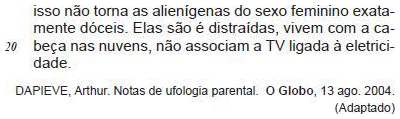
No Brasil das últimas décadas, a miséria teve diversas caras.
Houve um tempo em que, romântica, ela batia à nossa porta. Pedia-nos um prato de comida. Algumas vezes, suplicava por uma roupinha velha.
Conhecíamos os nossos mendigos. Cabiam nos dedos de uma das mãos. Eram parte da vizinhança. Ao alimentá-los e vesti-los, aliviávamos nossas consciências. Dormíamos o sono dos justos.
A urbanização do Brasil deu à miséria certa impessoalidade. Ela passou a apresentar-se como um elemento da paisagem, algo para ser visto pela janelinha do carro, ora esparramada sobre a calçada, ora refugiada sob o viaduto.
A modernidade trouxe novas formas de contato com a riqueza. Logo a miséria estava batendo, suja, esfarrapada, no vidro de nosso carro.
Os semáforos ganharam uma inesperada função social. Passamos a exercitar nossa infinita bondade pingando esmolas em mãos rotas. Continuávamos de bem com nossos travesseiros.
Com o tempo, a miséria conquistou os tubos de imagem dos aparelhos de TV. Aos poucos, foi perdendo a docilidade. A rua oferecia-nos algo além de água encanada e luz elétrica.
Os telejornais passaram a despejar violência sobre o tapete da sala, aos pés de nossos sofás. Era como se dispuséssemos de um eficiente sistema de miséria encanada. Tão simples quanto virar uma torneira ou acionar o interruptor, bastava apertar o botão da TV. Embora violenta, a miséria ainda nos excluía.
Súbito, a miséria cansou de esmolar. Ela agora não pede; exige. Ela já não suplica; toma.
A miséria não bate mais à nossa porta; invade. Não estende a mão diante do vidro do carro; arranca os relógios dos braços distraídos.
Acuada, a cidade passou de opressora a vítima dos morros. No Brasil de hoje, a riqueza é refém da miséria.
A constituição do perfil da miséria no Brasil está diretamente relacionada com a crescente modernização do país.
SOUZA, Josias de. "A vingança da miséria". Folha de S. Paulo, São Paulo, 31 out. 1994.Caderno Opinião, p.2. (Adaptado)
A circunstância expressa pelos termos em destaque está corretamente indicada em
Provas
Provas
Caderno Container