Foram encontradas 46.768 questões.
Disciplina: Inglês (Língua Inglesa)
Banca: UNIVIDA
Orgão: Pref. Bom Sucesso Sul-PR
Read Text I and answer question.
Text I
How to have a healthier relationship with your phone
A few years ago, a Google employee sent an email to thousands of her co-workers: What if for six weeks straight, you spent one night per week without technology? The email was from Laura Mae Martin, Google’s executive productivity adviser, a role that, among other things, was created to help staff members foster healthier relationships with their gadgets and apps. After she sent the note, Ms. Martin was flooded with responses from coworkers eager for a respite from some of the very products they helped build. Thousands of employees have since participated in the annual “No-Tech Tuesday Night Challenge,” said Ms. Martin.
The problem she was trying to solve isn’t unique to Google workers. One survey found that Americans say they spend too much time on their phones. But dramatic solutions – a digital detox, a phone downgrade or a complete exit from social media – may feel impractical.
Is it possible to have a healthy relationship with technology while still using it daily? Fortunately, according to experts, the answer is a resounding ‘yes’ and here are a few things you can try:
First, start with one simple question.
You know that urge you get to reach for your phone without realizing it? And then, before you know it, you’re an hour into a social media binge? If you want to peacefully coexist with technology, you need to get a handle on those impulses, said Richard J. Davidson, the founder and director of the Center for Healthy Minds at the University of Wisconsin-Madison. According to him, people should start by noticing when they have an urge to lift their phone or open social media on their browser window. By becoming conscious of what you’re about to do, you’re interrupting an automatic behavior and awakening the part of your brain that governs self-control, he added. As one research article suggests, awareness of your actions can help you rein in bad habits.
Secondly, take the “mobile” out of your mobile devices.
Dr. Anna Lembke, a professor of psychiatry and addiction medicine at Stanford University School of Medicine, said one of the biggest problems with smartphones is what she calls “texting while running to catch a bus.” Using our devices while we’re on the move – walking from meeting to meeting, taking a child to school or catching a bus – prevents us from being more engaged in our lives, Dr. Lembke said.
One way to create harmony with technology is to limit your phone use when you’re on the move. Headed out for a walk? Turn off your notifications. Going to grab a coffee? Leave your phone on your desk. If you’re feeling brave, try powering down your phone while in transit. It won’t buzz with notifications, text messages or phone calls, which Dr. Lembke said could help you focus on the world around you.
Last of all, make technology work for you.
One thing experts agree on: To forge a healthy relationship with technology, you need to be in control of it and not the other way around. Think about your gadgets as tools that you decide how to use.
“Make it work for you, not against you; whether it’s an email program or your dishwasher, it’s the intention behind how you’re using it that really makes the big difference”, said Ms. Martin, the productivity expert at Google.
(Adapted from: https://www.nytimes.com/2024/03/21/well/social-media-phone-addiction.html)
( ) One survey found that, due to spending too much time on their phones, almost fifty percent of people from all around the world are about to make dramatic moves, such as opt for a digital detox or a complete exit from social media. ( ) Experts say it’s quite unlikely for someone to have a healthy relationship with technology while still using it daily because they’re already so addicted to their gadgets that there’s no way to overcome it. ( ) According to the founder and director of the Center for Healthy Minds at the University of Wisconsin-Madison, if someone desires to peacefully coexist with technology, they need to get a handle on impulses that make them reach for their phone without even realizing it.
The statements are, in the order presented, respectively:
Provas

Disciplina: Inglês (Língua Inglesa)
Banca: FUNDATEC
Orgão: Pref. Panambi-RS
- Vocabulário | Vocabulary
- Formação de palavras (prefixos e sufixos) | Word formation (prefix and suffix)
Analyze the cartoon below:

Why is the hyphen used in “solar-powered”?
Provas
Disciplina: Inglês (Língua Inglesa)
Banca: FUNDATEC
Orgão: Pref. Panambi-RS
Which of the alternatives below is an example of a correctly written indirect question?
Provas
Disciplina: Inglês (Língua Inglesa)
Banca: FUNDATEC
Orgão: Pref. Panambi-RS
- Gramática - Língua InglesaSubstantivos e compostos | Nouns and compoundsSubstantivos contáveis e incontáveis | Countable and uncountable
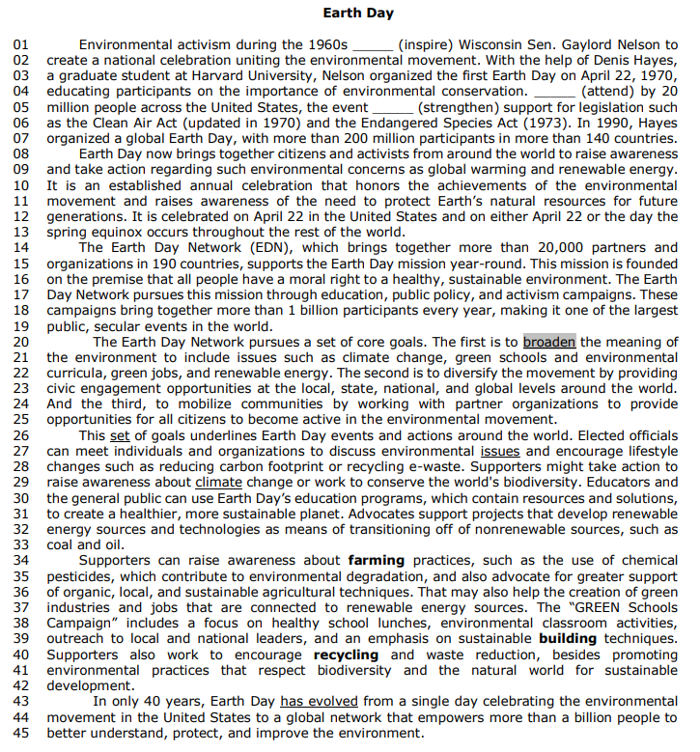
(Available at: education.nationalgeographic.org/resource/earth-day/– text specially adapted for this test).
I. The noun “set” (l. 26) is countable, just as in the sentence “There are two sets of pens over the table, take one to your office”.
II. The word “issues” (l. 27) is uncountable, just as in the sentence “Have you seen the latest issue of the paper? I’m sure it arrived this morning”.
III. The word “climate” (l. 29) is uncountable, just as in the sentence “A climate of uncertainty took over the room”.
Which ones are correct?
Provas
Disciplina: Inglês (Língua Inglesa)
Banca: FUNDATEC
Orgão: Pref. Panambi-RS
(Available at: education.nationalgeographic.org/resource/earth-day/– text specially adapted for this test).
Provas
Disciplina: Inglês (Língua Inglesa)
Banca: FUNDATEC
Orgão: Pref. Panambi-RS
(Available at: education.nationalgeographic.org/resource/earth-day/– text specially adapted for this test).
Provas
Disciplina: Inglês (Língua Inglesa)
Banca: FUNDATEC
Orgão: Pref. Panambi-RS
(Available at: education.nationalgeographic.org/resource/earth-day/– text specially adapted for this test).
Provas
Disciplina: Inglês (Língua Inglesa)
Banca: FUNDATEC
Orgão: Pref. Panambi-RS
- Gramática - Língua InglesaAdjetivos | Adjectives
- Gramática - Língua InglesaVerbos | VerbsInfinitivo e gerúndio | Infinitive and gerund
(Available at: education.nationalgeographic.org/resource/earth-day/– text specially adapted for this test).
I. The verb “farm” is in its gerund form in line 34 because it follows the preposition “about”.
II. The verb “build” is in its gerund form in line 39 because it serves as an adjective for “techniques”.
III. The verb “recycle” is in its gerund form in line 40 because it follows the verb “encourage”.
Which ones are correct?
Provas
Disciplina: Inglês (Língua Inglesa)
Banca: FUNDATEC
Orgão: Pref. Panambi-RS
(Available at: education.nationalgeographic.org/resource/earth-day/– text specially adapted for this test).
Provas
Disciplina: Inglês (Língua Inglesa)
Banca: FUNDATEC
Orgão: Pref. Panambi-RS
(Available at: education.nationalgeographic.org/resource/earth-day/– text specially adapted for this test).
( ) The first Earth Day event gathered 20 million people in the United States.
( ) Earth Days usually happens on the Spring equinox, which is on April 22.
( ) The Clean Air Act and the Endangered Species Act were proposed by Sen. Gaylord Nelson after the first Earth Day, in 1970.
The correct order of filling the parentheses, from top to bottom, is:
Provas
Caderno Container