Foram encontradas 46.768 questões.
3864448
Ano: 2024
Disciplina: Inglês (Língua Inglesa)
Banca: Avança SP
Orgão: Pref. Caçapava-SP
Disciplina: Inglês (Língua Inglesa)
Banca: Avança SP
Orgão: Pref. Caçapava-SP
Provas:
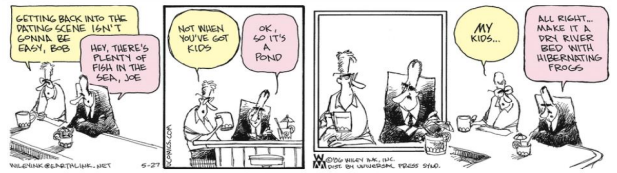
Available at: https://www.gocomics.com/nonsequitur/2006/05/27
The expression "plenty of fish in the sea" is used in the comic to:
Provas
Questão presente nas seguintes provas

3864447
Ano: 2024
Disciplina: Inglês (Língua Inglesa)
Banca: Avança SP
Orgão: Pref. Caçapava-SP
Disciplina: Inglês (Língua Inglesa)
Banca: Avança SP
Orgão: Pref. Caçapava-SP
Provas:
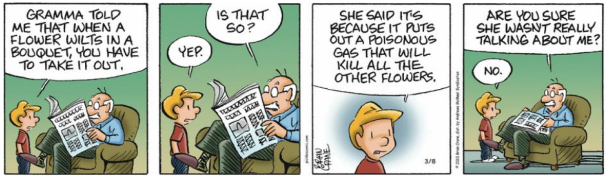
Available at: https://www.gocomics.com/pickles/2024/03/08
The phrase "puts out a poisonous gas" in the second panel suggests that the wilted flower releases a substance that is:
Provas
Questão presente nas seguintes provas
3864446
Ano: 2024
Disciplina: Inglês (Língua Inglesa)
Banca: Avança SP
Orgão: Pref. Caçapava-SP
Disciplina: Inglês (Língua Inglesa)
Banca: Avança SP
Orgão: Pref. Caçapava-SP
Provas:
Identify the sentence that correctly uses a modal verb to express probability.
Provas
Questão presente nas seguintes provas
3864445
Ano: 2024
Disciplina: Inglês (Língua Inglesa)
Banca: Avança SP
Orgão: Pref. Caçapava-SP
Disciplina: Inglês (Língua Inglesa)
Banca: Avança SP
Orgão: Pref. Caçapava-SP
Provas:
Which of the following approaches emphasizes learner autonomy, with the teacher facilitating rather
than instructing, and is particularly effective in promoting communicative competence in language
learning?
Provas
Questão presente nas seguintes provas
3864444
Ano: 2024
Disciplina: Inglês (Língua Inglesa)
Banca: Avança SP
Orgão: Pref. Caçapava-SP
Disciplina: Inglês (Língua Inglesa)
Banca: Avança SP
Orgão: Pref. Caçapava-SP
Provas:
Which of the following sentences correctly uses inversion in a conditional sentence, often found in
formal English?
Provas
Questão presente nas seguintes provas
3864443
Ano: 2024
Disciplina: Inglês (Língua Inglesa)
Banca: Avança SP
Orgão: Pref. Caçapava-SP
Disciplina: Inglês (Língua Inglesa)
Banca: Avança SP
Orgão: Pref. Caçapava-SP
Provas:
Select the option where the adverbs of frequency in English are correctly ordered from least frequent
to most frequent:
Provas
Questão presente nas seguintes provas
3864442
Ano: 2024
Disciplina: Inglês (Língua Inglesa)
Banca: Avança SP
Orgão: Pref. Caçapava-SP
Disciplina: Inglês (Língua Inglesa)
Banca: Avança SP
Orgão: Pref. Caçapava-SP
Provas:
Select the pair that represents true cognates, sharing similar meanings in both English and Portuguese.
Provas
Questão presente nas seguintes provas
3864441
Ano: 2024
Disciplina: Inglês (Língua Inglesa)
Banca: Avança SP
Orgão: Pref. Caçapava-SP
Disciplina: Inglês (Língua Inglesa)
Banca: Avança SP
Orgão: Pref. Caçapava-SP
Provas:

Available at: https://www.gocomics.com/peanuts/1969/12/24
In the comic strip provided, the character expresses doubt about an individual's sanity for flying at night in a sleigh pulled by reindeer. To whom is the character most likely referring?
Provas
Questão presente nas seguintes provas
3864440
Ano: 2024
Disciplina: Inglês (Língua Inglesa)
Banca: Avança SP
Orgão: Pref. Caçapava-SP
Disciplina: Inglês (Língua Inglesa)
Banca: Avança SP
Orgão: Pref. Caçapava-SP
Provas:
Read the text to answer question.
"I’m not a naturally wrathful person. I don’t like to (and usually don’t) lose my temper. The
exception is when drivers ignore pedestrian right of way. I will, whether I’m a few steps or a few miles
into my walk, admonish them — loudly and none too gently. (They, of course, cannot hear me inside
their cars.)
It’s hard to shake the impression that New York City’s drivers have become more aggressive.
They run reds, viciously honk and yell at pedestrians who clearly have the right of way and generally
endanger the lives of those on foot.
From 2009 to 2022, an average of 136 pedestrians were killed each year by traffic in the city.
The numbers have gone down slightly — to 99 in 2023 — but cyclist deaths have climbed, though they
remain a small fraction of pedestrian deaths. (The city’s decision to give pedestrians a head start at
many intersections, where walk signals turn white before streetlights go green, may be helping.)
In the United States generally, walking has become far more dangerous. The number of
pedestrian fatalities nationally has climbed more than 80 percent in the past 15 years, largely because
of increasingly hazardous automotive design. Some police departments effectively no longer punish
drivers for any traffic infractions. San Francisco’s police officers “have almost entirely abandoned
enforcement of traffic laws,” The Times’s Heather Knight reported.
All of this calls not just for policy changes such as automobile regulation, improved policing
and better urban planning but also for a more assertive pedestrian culture. Aggressive drivers have
exacerbated this problem; aggressive pedestrians can help solve it."
Available at: https://www.nytimes.com/live/2024/02/27/opinion/thepoint#pedestrian-safetyassertiveness
Provas
Questão presente nas seguintes provas
3864439
Ano: 2024
Disciplina: Inglês (Língua Inglesa)
Banca: Avança SP
Orgão: Pref. Caçapava-SP
Disciplina: Inglês (Língua Inglesa)
Banca: Avança SP
Orgão: Pref. Caçapava-SP
Provas:
Read the text to answer question.
"I’m not a naturally wrathful person. I don’t like to (and usually don’t) lose my temper. The
exception is when drivers ignore pedestrian right of way. I will, whether I’m a few steps or a few miles
into my walk, admonish them — loudly and none too gently. (They, of course, cannot hear me inside
their cars.)
It’s hard to shake the impression that New York City’s drivers have become more aggressive.
They run reds, viciously honk and yell at pedestrians who clearly have the right of way and generally
endanger the lives of those on foot.
From 2009 to 2022, an average of 136 pedestrians were killed each year by traffic in the city.
The numbers have gone down slightly — to 99 in 2023 — but cyclist deaths have climbed, though they
remain a small fraction of pedestrian deaths. (The city’s decision to give pedestrians a head start at
many intersections, where walk signals turn white before streetlights go green, may be helping.)
In the United States generally, walking has become far more dangerous. The number of
pedestrian fatalities nationally has climbed more than 80 percent in the past 15 years, largely because
of increasingly hazardous automotive design. Some police departments effectively no longer punish
drivers for any traffic infractions. San Francisco’s police officers “have almost entirely abandoned
enforcement of traffic laws,” The Times’s Heather Knight reported.
All of this calls not just for policy changes such as automobile regulation, improved policing
and better urban planning but also for a more assertive pedestrian culture. Aggressive drivers have
exacerbated this problem; aggressive pedestrians can help solve it."
Available at: https://www.nytimes.com/live/2024/02/27/opinion/thepoint#pedestrian-safetyassertiveness
Provas
Questão presente nas seguintes provas
Cadernos
Caderno Container