Foram encontradas 45.579 questões.
Text I
Based on the text below, answer question.
Ships and seamanship Although shipbuilding in Viking-Age Scandinavia were not fundamentally different from those in other parts of northern Europe, archaeological evidence shows that Viking ships were lighter, slimmer, faster, and thus probably better sailers than the heavier vessels used by the English and, presumably, the Franks at that time.
There are two main reasons for these differences. The first is geographical. In Scandinavia waterways and access to the sea were more important factors in determining the location of settlements than they were in other parts of northern Europe. In Norway and Sweden most people lived near the coast or around large lakes, while the forests and mountains were very sparsely settled. Inland waterways were not only sheltered; they were also routes to the sea. No part of Viking-Age Denmark was far from the sea; it was virtually an archipelago, joined to the Continent by a narrow strip of land, and separated from the interior of the great Scandinavian peninsula by a deep barrier of forest. These natural features also meant that the authority of many rulers in Viking-Age Scandinavia, unlike that of their contemporaries in Europe, to a large extent depended on ships and control of the sea. The extensive empire that Danish kings ruled at the end of the eighth century was to a significant degree based on naval power.
The second reason is historical. Scandinavia was sufficiently remote from the Romans and, later, the Franks for its political and religious life to flourish relatively unaffected by the transformations that occurred in other parts of Europe in the first millennium AD. One feature that survived was the central role of the ship as both a religious and secular symbol, a role that is illustrated by the fact that Bronze-Age stone ship-settings metal representations of ships were already well developed over a thousand years before Christ. The symbolic significance of ships naturally led to refinements in their construction: a fine ship conferred prestige on its owner. In the clash between Christian and Nordic culture that occurred in the Viking Age, ship burials were more frequent than they had previously been, implying that ships had acquired even greater significance as a religious symbol, at least among the pagans who resisted the advance of the new religion.
The symbolic and practical importance of ships in early Scandinavian society resulted in such improvements in ship design that Scandinavians were well equipped in comparison with other north Europeans. The contrast was all the greater because in many parts of Europe one of the main functions of ships had long been to carry cargoes, a purpose for which speed and elegance were not highly prized qualities. On the Atlantic and the North Sea Viking ships met the same challenges as the ships of the English, Frisians, and Franks, but they did so for different reasons.
(From: The Oxford Illustrated History of the Vikings.)
Choose the correct option according to the text:
Provas
Text I
Based on the text below, answer question.
Ships and seamanship Although shipbuilding in Viking-Age Scandinavia were not fundamentally different from those in other parts of northern Europe, archaeological evidence shows that Viking ships were lighter, slimmer, faster, and thus probably better sailers than the heavier vessels used by the English and, presumably, the Franks at that time.
There are two main reasons for these differences. The first is geographical. In Scandinavia waterways and access to the sea were more important factors in determining the location of settlements than they were in other parts of northern Europe. In Norway and Sweden most people lived near the coast or around large lakes, while the forests and mountains were very sparsely settled. Inland waterways were not only sheltered; they were also routes to the sea. No part of Viking-Age Denmark was far from the sea; it was virtually an archipelago, joined to the Continent by a narrow strip of land, and separated from the interior of the great Scandinavian peninsula by a deep barrier of forest. These natural features also meant that the authority of many rulers in Viking-Age Scandinavia, unlike that of their contemporaries in Europe, to a large extent depended on ships and control of the sea. The extensive empire that Danish kings ruled at the end of the eighth century was to a significant degree based on naval power.
The second reason is historical. Scandinavia was sufficiently remote from the Romans and, later, the Franks for its political and religious life to flourish relatively unaffected by the transformations that occurred in other parts of Europe in the first millennium AD. One feature that survived was the central role of the ship as both a religious and secular symbol, a role that is illustrated by the fact that Bronze-Age stone ship-settings metal representations of ships were already well developed over a thousand years before Christ. The symbolic significance of ships naturally led to refinements in their construction: a fine ship conferred prestige on its owner. In the clash between Christian and Nordic culture that occurred in the Viking Age, ship burials were more frequent than they had previously been, implying that ships had acquired even greater significance as a religious symbol, at least among the pagans who resisted the advance of the new religion.
The symbolic and practical importance of ships in early Scandinavian society resulted in such improvements in ship design that Scandinavians were well equipped in comparison with other north Europeans. The contrast was all the greater because in many parts of Europe one of the main functions of ships had long been to carry cargoes, a purpose for which speed and elegance were not highly prized qualities. On the Atlantic and the North Sea Viking ships met the same challenges as the ships of the English, Frisians, and Franks, but they did so for different reasons.
(From: The Oxford Illustrated History of the Vikings.)
In “On the Atlantic and the North Sea Viking ships met the same challenges as the ships of the English, Frisians, and Franks, but they did so for different reasons” the verb ‘met’ is the past tense of the verb ‘meet’. The verb ‘meet’ is an irregular verb. Choose the option that contains only irregular verbs:
Provas

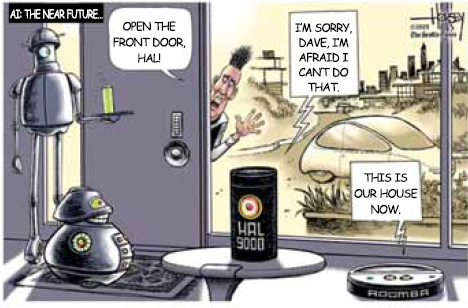
The humour in the cartoon derives from the fact that
Provas
Leia a matéria para responder à questão.
Plastic Waste In The Oceans
In the last few years there has been more and more evidence that plastic pollution in our oceans is becoming a massive problem. Large pieces of plastic which end up in the sea can entangle marine animals or can also suffocate them.
Tiny pieces of plastic — broken down by the action of water and the sun — cause harm by entering the marine food chain. If the animals eat plastic it will make them feel artificially full so that they do not eat and they starve to death. Furthermore, when fish have eaten plastic it becomes part of their body; if we then eat that fish our food contains plastic — we are eating our own plastic waste.

(www.reducereuserecycle.co.uk. Adaptado.)
No trecho do segundo parágrafo, “when fish have eaten plastic it becomes part of their body; if we then eat that fish our food contains plastic — we are eating our own plastic waste”, a frase sublinhada, no contexto em que se apresenta, expressa
Provas
Leia a matéria para responder à questão.
Plastic Waste In The Oceans
In the last few years there has been more and more evidence that plastic pollution in our oceans is becoming a massive problem. Large pieces of plastic which end up in the sea can entangle marine animals or can also suffocate them.
Tiny pieces of plastic — broken down by the action of water and the sun — cause harm by entering the marine food chain. If the animals eat plastic it will make them feel artificially full so that they do not eat and they starve to death. Furthermore, when fish have eaten plastic it becomes part of their body; if we then eat that fish our food contains plastic — we are eating our own plastic waste.

(www.reducereuserecycle.co.uk. Adaptado.)
No trecho do segundo parágrafo “Furthermore, when fish have eaten plastic it becomes part of their body”, o termo sublinhado pode ser substituído, sem alteração de sentido, por:
Provas
Leia a matéria para responder à questão.
Plastic Waste In The Oceans
In the last few years there has been more and more evidence that plastic pollution in our oceans is becoming a massive problem. Large pieces of plastic which end up in the sea can entangle marine animals or can also suffocate them.
Tiny pieces of plastic — broken down by the action of water and the sun — cause harm by entering the marine food chain. If the animals eat plastic it will make them feel artificially full so that they do not eat and they starve to death. Furthermore, when fish have eaten plastic it becomes part of their body; if we then eat that fish our food contains plastic — we are eating our own plastic waste.

(www.reducereuserecycle.co.uk. Adaptado.)
O trecho dos dois parágrafos iniciais da matéria que está representado no infográfico é:
Provas
Leia o texto para responder à questão.

They power tiny phones and two-tonne electric cars. They form the guts of a growing number of grid-storage systems1 that smooth the flow of electricity from wind and solar power stations. Without them, the electrification needed to avoid the worst effects of global warming would be unimaginable.
But lithium-ion (Li-ion) batteries have downsides. Lithium is scarce, for one. And the best Li-ion batteries, those with layered-oxide cathodes, also require cobalt and nickel. These metals are scarce, too — and cobalt is also problematic because a lot of it is mined in the Democratic Republic of Congo, where working conditions leave much to be desired. A second sort of Li-ion battery, a so-called polyanionic design that uses lithium iron phosphate (LFP), does not need nickel or cobalt. However, such batteries cannot store as much energy per kilogram as layered-oxide ones.
A group of companies, though, think they have an alternative: making batteries with sodium instead. Unlike lithium, sodium is abundant: it makes up most of the salt in the oceans. And chemists have found that layered-oxide cathodes which use sodium rather than lithium can get by without cobalt or nickel to increase their quality. The idea of making sodium-ion (Na-ion) batteries at scale is therefore gaining traction. Engineers are adjusting designs. Factories, particularly in China, are springing up. For the first time since the Li-ion revolution began, lithium’s place on the electrochemical pedestal is being challenged.
(www.economist.com, 25.10.2023. Adaptado.)
1 grid-storage system: sistema de armazenamento de energia elétrica.
In the excerpt from the third paragraph “Factories, particularly in China, are springing up”, the underlined expression means
Provas
Leia o texto para responder à questão.

They power tiny phones and two-tonne electric cars. They form the guts of a growing number of grid-storage systems1 that smooth the flow of electricity from wind and solar power stations. Without them, the electrification needed to avoid the worst effects of global warming would be unimaginable.
But lithium-ion (Li-ion) batteries have downsides. Lithium is scarce, for one. And the best Li-ion batteries, those with layered-oxide cathodes, also require cobalt and nickel. These metals are scarce, too — and cobalt is also problematic because a lot of it is mined in the Democratic Republic of Congo, where working conditions leave much to be desired. A second sort of Li-ion battery, a so-called polyanionic design that uses lithium iron phosphate (LFP), does not need nickel or cobalt. However, such batteries cannot store as much energy per kilogram as layered-oxide ones.
A group of companies, though, think they have an alternative: making batteries with sodium instead. Unlike lithium, sodium is abundant: it makes up most of the salt in the oceans. And chemists have found that layered-oxide cathodes which use sodium rather than lithium can get by without cobalt or nickel to increase their quality. The idea of making sodium-ion (Na-ion) batteries at scale is therefore gaining traction. Engineers are adjusting designs. Factories, particularly in China, are springing up. For the first time since the Li-ion revolution began, lithium’s place on the electrochemical pedestal is being challenged.
(www.economist.com, 25.10.2023. Adaptado.)
1 grid-storage system: sistema de armazenamento de energia elétrica.
De acordo com o terceiro parágrafo, baterias de íons de sódio são vantajosas principalmente porque
Provas
Leia o texto para responder à questão.

They power tiny phones and two-tonne electric cars. They form the guts of a growing number of grid-storage systems1 that smooth the flow of electricity from wind and solar power stations. Without them, the electrification needed to avoid the worst effects of global warming would be unimaginable.
But lithium-ion (Li-ion) batteries have downsides. Lithium is scarce, for one. And the best Li-ion batteries, those with layered-oxide cathodes, also require cobalt and nickel. These metals are scarce, too — and cobalt is also problematic because a lot of it is mined in the Democratic Republic of Congo, where working conditions leave much to be desired. A second sort of Li-ion battery, a so-called polyanionic design that uses lithium iron phosphate (LFP), does not need nickel or cobalt. However, such batteries cannot store as much energy per kilogram as layered-oxide ones.
A group of companies, though, think they have an alternative: making batteries with sodium instead. Unlike lithium, sodium is abundant: it makes up most of the salt in the oceans. And chemists have found that layered-oxide cathodes which use sodium rather than lithium can get by without cobalt or nickel to increase their quality. The idea of making sodium-ion (Na-ion) batteries at scale is therefore gaining traction. Engineers are adjusting designs. Factories, particularly in China, are springing up. For the first time since the Li-ion revolution began, lithium’s place on the electrochemical pedestal is being challenged.
(www.economist.com, 25.10.2023. Adaptado.)
1 grid-storage system: sistema de armazenamento de energia elétrica.
A República Democrática do Congo é mencionada no segundo parágrafo porque
Provas
Leia o texto para responder à questão.

They power tiny phones and two-tonne electric cars. They form the guts of a growing number of grid-storage systems1 that smooth the flow of electricity from wind and solar power stations. Without them, the electrification needed to avoid the worst effects of global warming would be unimaginable.
But lithium-ion (Li-ion) batteries have downsides. Lithium is scarce, for one. And the best Li-ion batteries, those with layered-oxide cathodes, also require cobalt and nickel. These metals are scarce, too — and cobalt is also problematic because a lot of it is mined in the Democratic Republic of Congo, where working conditions leave much to be desired. A second sort of Li-ion battery, a so-called polyanionic design that uses lithium iron phosphate (LFP), does not need nickel or cobalt. However, such batteries cannot store as much energy per kilogram as layered-oxide ones.
A group of companies, though, think they have an alternative: making batteries with sodium instead. Unlike lithium, sodium is abundant: it makes up most of the salt in the oceans. And chemists have found that layered-oxide cathodes which use sodium rather than lithium can get by without cobalt or nickel to increase their quality. The idea of making sodium-ion (Na-ion) batteries at scale is therefore gaining traction. Engineers are adjusting designs. Factories, particularly in China, are springing up. For the first time since the Li-ion revolution began, lithium’s place on the electrochemical pedestal is being challenged.
(www.economist.com, 25.10.2023. Adaptado.)
1 grid-storage system: sistema de armazenamento de energia elétrica.
According to the second paragraph, one of the disadvantages of lithium is that it is
Provas
Caderno Container