Magna Concursos

Foram encontradas 40 questões.

A Polícia Militar (PM) de uma cidade de Minas Gerais verificou que vários moradores da cidade estavam sendo vítimas de estelionatários e caindo em golpes, como, por exemplo, o “Sequestro Virtual”, com o qual o infrator finge que algum parente da vítima foi sequestrado e, surpreendida pela notícia, a vítima faz o pagamento exigido na ligação e/ou mensagens recebidas para que o parente seja liberado. A PM, então, decidiu alertar a população sobre esses golpes e emitiu o seguinte alerta:

“Se receber uma ligação de um número que você não conhece, não forneça seu nome nem o número de sua conta bancária.”

Com a informação, Francisco, morador da cidade, assustado com a situação, decidiu acatar o conselho da PM. Ao receber uma determinada ligação, Francisco forneceu sua conta bancária à pessoa que estava do outro lado da linha. É possível afirmar logicamente que Francisco


Provas

Questão presente nas seguintes provas
TEXTO 3
“Um dos fatos mais lamentáveis da nossa história pós-redemocratização”
O professor de direito constitucional da PUC, Marcelo Figueiredo, disse neste sábado à rádio Jovem Pan que a censura imposta à Crusoé e a O Antagonista fere a democracia.
“O episódio é um precedente perigoso para a liberdade de imprensa porque se cada ministro se sentir agravado com uma reportagem e mandar cassar o veículo de comunicação, nós voltamos a um Estado ditatorial, antidemocrático”, afirmou.
“A censura ao site Antagonista e à revista Crusoé entrará como um dos fatos mais lamentáveis da nossa história pós-redemocratização.
Por outro lado, tem que se celebrar. A mobilização da sociedade e o posicionamento certeiro de ministros do Supremo que discordam do conjunto de absurdos que têm sido praticados.”
(Fonte: https://www.oantagonista.com/brasil/um-dos-fatos-mais-
lamentaveis-da-nossa-historia-pos-redemocratizacao/)
Leia novamente o último parágrafo do Texto 3:
“A censura ao site Antagonista e à revista Crusoé entrará como um dos fatos mais lamentáveis da nossa história pós-redemocratização. Por outro lado, tem que se celebrar. A mobilização da sociedade e o posicionamento certeiro de ministros do Supremo que discordam do conjunto de absurdos que têm sido praticados”. Escolha, dentre as alternativas abaixo, a que melhor representa a reescrita do parágrafo acima, de acordo com a norma culta:
 

Provas

Questão presente nas seguintes provas
TEXTO 1
Andarilho beija-flor
(Composição: Marquinhos da Serrinha/ Intérprete: Flávio José)
Eu não creio que somente palavras me façam viver
Nem que os sonhos perdidos me impeçam de sentir prazer
Nada quanto sonhei ou que fiz e errei foi em vão
Eu prefiro escutar o que pede esse meu coração
Eu não posso negar que ainda sofro lembrando você
E que, às vezes, faz mal um só peito tentando querer
Mas também superei pra mim mesmo e parei de sonhar
E aprendi que, quem ama, é preciso primeiro se amar
Não mudo, não!
Meu coração me fez assim,
Me ensinou gostar de mim, deu mais sentido em meu viver
Prefiro ser um andarilho beija-flor
Pra que vou dar o meu amor pra quem sequer amor quer ter?
(Fonte: https://www.letras.mus.br/flavio-jose/andarilho-beija-flor/)
TEXTO 2
Codinome beija-flor
(Composição: Agenor Neto / Jose Neves / Reinaldo Arias; Intérprete: Cazuza)
Pra que mentir, fingir que perdoou
Tentar ficar amigos sem rancor
A emoção acabou
Que coincidência é o amor
A nossa música nunca mais tocou
Pra que usar de tanta educação
Pra destilar terceiras intenções
Desperdiçando o meu mel
Devagarinho, flor em flor
Entre os meus inimigos, beija-flor
Eu protegi teu nome por amor
Em um codinome, Beija-flor
Não responda nunca, meu amor (nunca)
Pra qualquer um na rua, Beija-flor
Que só eu que podia
Dentro da tua orelha fria
Dizer segredos de liquidificador
Você sonhava acordada
Um jeito de não sentir dor
Prendia o choro e aguava o bom do amor
(Fonte: https://www.letras.mus.br/cazuza/468416/)
4ª QUESTÃO
Comparando as letras das canções Andarilho beija-flor e Codinome beija-flor, é CORRETO afirmar:
 

Provas

Questão presente nas seguintes provas
1655658 Ano: 2019
Disciplina: Inglês (Língua Inglesa)
Banca: UEPB
Orgão: Pref. São Domingos do Cariri-PB
Provas:
Affordances and limitations of technology: Voices from EFL teachers and learners.
(Mohammad Amiryousefi)
Abstract
With the developments of new technologies appearing very quickly, the attention has been focused more on technology than learning. English centers and institutes have mostly been busy accommodating new programs and technologies and hence have not spent enough time to evaluate the CALL (Computer Assisted Language Learning) programs and technologies employed to find their affordances and limitations. The present study was an attempt to study the perceptions and evaluation of the Iranian EFL learners and teachers about CALL.
To this end, 240 students and teachers of two big institutes in Iran where CALL is used in their English learning program participated in the study. The required data were collected through a mixed-method design.
The results of data analysis showed that CALL can enhance language learning and English listening, reading, and writing skills. It can also increase students' motivation and interest in learning and their exposure to language. However, it cannot improve speaking skill well. It also causes technology addiction, lacks good standards and an interactive nature necessary for the development of communicative proficiency, and may give the confidence to the teachers that everything is prepared by CALL courseware designers and hence they may come unprepared. The present study argues that the mere focus on technological support is not adequate, and a pedagogical understanding of language teachers’ and learners’ new roles and identities in CALL environment should be developed.
Keywords: Computer Assisted Language Learning; evaluation; perception; language learning; language skills
(Source: Journal of English Language Teaching and Learning. Article 2, Volume 9, Issue 19, Winter and Spring 2017, page 1-24. Available at: https://elt.tabrizu.ac.ir/article_6252.html . Accessed on April 20th, 2019)
The research results indicate that
 

Provas

Questão presente nas seguintes provas
1628247 Ano: 2019
Disciplina: Inglês (Língua Inglesa)
Banca: UEPB
Orgão: Pref. São Domingos do Cariri-PB
Provas:
“[...] It is essential that teachers acknowledge the fact that reading hypertexts is a more cognitively demanding process which requires skills such as navigating through hyperlinks and constructing meaning from multiple sources. Besides, teachers need to develop students’ awareness when reading digital texts by showing them that the strategies employed in this space might be borrowed from traditional forms of reading, but, many times, should be selected from a pool of specific strategies that are unique to the digital environment. In this way, fostering the students’ metacognition in reading in a second/foreign language is essential to improve their competence as readers of both printed and digital texts.” (p. 143)
Besides, teachers need to develop students' awareness when reading digital texts by showing them that the strategies employed in this space might be borrowed from traditional forms of reading [...]”.The word besides indicates
 

Provas

Questão presente nas seguintes provas
1571841 Ano: 2019
Disciplina: Inglês (Língua Inglesa)
Banca: UEPB
Orgão: Pref. São Domingos do Cariri-PB
Provas:
Affordances and limitations of technology: Voices from EFL teachers and learners.
(Mohammad Amiryousefi)
Abstract
With the developments of new technologies appearing very quickly, the attention has been focused more on technology than learning. English centers and institutes have mostly been busy accommodating new programs and technologies and hence have not spent enough time to evaluate the CALL (Computer Assisted Language Learning) programs and technologies employed to find their affordances and limitations. The present study was an attempt to study the perceptions and evaluation of the Iranian EFL learners and teachers about CALL.
To this end, 240 students and teachers of two big institutes in Iran where CALL is used in their English learning program participated in the study. The required data were collected through a mixed-method design.
The results of data analysis showed that CALL can enhance language learning and English listening, reading, and writing skills. It can also increase students' motivation and interest in learning and their exposure to language. However, it cannot improve speaking skill well. It also causes technology addiction, lacks good standards and an interactive nature necessary for the development of communicative proficiency, and may give the confidence to the teachers that everything is prepared by CALL courseware designers and hence they may come unprepared. The present study argues that the mere focus on technological support is not adequate, and a pedagogical understanding of language teachers’ and learners’ new roles and identities in CALL environment should be developed.
Keywords: Computer Assisted Language Learning; evaluation; perception; language learning; language skills
(Source: Journal of English Language Teaching and Learning. Article 2, Volume 9, Issue 19, Winter and Spring 2017, page 1-24. Available at: https://elt.tabrizu.ac.ir/article_6252.html . Accessed on April 20th, 2019)
The phrase “To this end” refers to
 

Provas

Questão presente nas seguintes provas
691634 Ano: 2019
Disciplina: Inglês (Língua Inglesa)
Banca: UEPB
Orgão: Pref. São Domingos do Cariri-PB
Provas:
The teaching of English as a foreign language in the context of Brazilian regular schools: a retrospective and prospective view of policies and practices.
(Ricardo Luiz Teixeira de Almeida).
(…) A brief overview of the recent history of ELT in Brazilian regular schools
During the 1970s, the so-called audiolingual method, based on behaviorist and structuralist assumptions, was still considered the only scientific way of teaching a foreign language. Its emphasis on the oral skills and on the exhaustive repetition of structural exercises seemed to work well in the contexts of private language institutes. Those contexts were characterized by the gathering of small numbers of highly motivated students per class, a weekly time-table superior in the number of hours to the one adopted in regular schools, and plenty of audiovisual resources. Questionable in itself, both because of its results (which in time were revealed to be less efficient than believed, especially in terms of fluency) and its theoretical assumptions, the method ended up being adopted by regular schools due to its positive reputation at the time. The failure of the methodology in this context would soon become evident, generating extreme frustration both amongst teachers and students.
From the 1980s on, with the spread of ideas connected to the so-called communicative approach and the growth of English for Specific Purposes (ESP), the community of researchers and teachers interested in the context of regular schools started reviewing the assumptions and logic of English Language Teaching (ELT). Recognizing that each and every school discipline needs to justify its presence in the curriculum socially and educationally, this movement identified the skill of reading as the most relevant one for the students attending the majority of Brazilian regular schools. This understanding was achieved by considering not only the possibility of real use outside school, but also the role this approach could play in the achievement of other educational goals, such as the improvement of student's reading abilities in Portuguese as a mother tongue (MOITA LOPES, 1996)*. This movement reached its climax with the publication of the Brazilian National Curricular Parameters (PCN) for the teaching of foreign languages at basic education level by the end of the 1990s. The document recommended the focus on the teaching of reading within a view of language as discourse. However, it did not close the door on the teaching of any other skill, as long as the context made it possible and relevant.
It is important at this point to clarify a few things about the emergence of this educational policy. First of all, it was not formulated apart from the community of teachers and researchers and then imposed upon them. On the contrary, great names in Brazilian Applied Linguistics, such as Luiz Paulo da Moita Lopes and Maria Antonieta Celani among others, were involved in the formulation of the Parameters. Even more important than that, a lot of teachers, individually or collectively, with or without supervision, were already trying the focus on reading as an alternative to the failure of previous practices before the Parameters were elaborated. Two well-known examples are those from Rio de Janeiro and São Paulo during the late 1980s and early 1990s. In São Paulo, The Catholic University (PUCSP) became a national center for foreign language teacher education, through the development of a Brazilian ESP project focusing on reading (CELANI, 2005)**. In Rio de Janeiro, a discussion conducted by the city educational authorities and the teachers in public schools (concerning the contents and methodology of each school discipline), during the administrations of Saturnino Braga and Marcelo Alencar, led to the proposition that the focus on reading for foreign language teaching reflected the will of most teachers who participated in the discussion.
Another important characteristic of the Parameters that should not be overlooked is their emphasis on teacher's autonomy. This emphasis can be seen clearly in the fact that no content or method is imposed upon the teachers.
What one can find are suggestions and relevant information for teachers to make their own decisions, taking into consideration the context within which they work. In other words, the Parameters do not force any teacher to limit their focus on the teaching of reading, if they believe they can go further than that.
In spite of all these positive points, since their publication, it is possible to identify a strong resistance to the focus on reading on the part of many teachers. The reasons for this resistance will be discussed in the following sections of this paper. […] (p.333-334)
*MOITA LOPES, Luiz Paulo da. Oficina de Lingüística Aplicada: a natureza social e educacional
dos processos de ensino / aprendizagem de línguas. Campinas: Mercado de Letras, 1996.
**CELANI, M. A. Introduction. In: CELANI, M. A. et al. ESP in Brazil: 25 years of evolution and
reflection. Campinas-SP: Mercado de Letras, São Paulo: Educ, 2005. p. 13-26.
(Adapted from: Revista Brasileira de Linguística Aplicada. vol.12. nº.2. Belo Horizonte.
Apr./June 2012, p. 331-348. Available at:
http://www.scielo.br/scielo.php?script=sci_arttext&pid=S1984-63982012000200006
Accessed on April 15th, 2019)
Some relevant theoretical assumptions underlying Brazilian National Curricular Parameters (PCN) concerning ELT are:
 

Provas

Questão presente nas seguintes provas
Sônia, Jaqueline e Tatiana são mães de Augusto, Rafael e Eduardo, não necessariamente nessa ordem. Elas moram no mesmo condomínio e resolveram organizar uma tarde no parque com seus filhos. No dia do passeio, cada uma levou um lanche (melancia, iogurte e biscoito) e, ao chegarem no parque, cada uma das crianças sugeriu uma brincadeira (esconde-esconde, telefone sem fio e amarelinha).
Sabe-se que:
- A mulher que levou iogurte é mãe da criança que sugeriu telefone sem fio;
- Rafael não é filho de Tatiana;
- A mãe de Augusto levou melancia;
- A mãe da criança que sugeriu brincar de esconde-esconde não levou biscoito;
- O filho de Jaqueline não sugeriu amarelinha.
Logo, é CORRETO afirmar que:
Questão Anulada

Provas

Questão presente nas seguintes provas
TEXTO 4
“Menino foge de casa em Curitiba, burla segurança de aeroporto e voa até Congonhas, em São Paulo [...] O menino, _____________ só foi abordado _____________ chegou a São Paulo, no desembarque, fugiu de casa depois de ter tirado notas baixas na escola. O garoto havia falsificado a assinatura dos pais no boletim e, quando a professora descobriu, ele acabou sendo suspenso. Para evitar o confronto com os pais, ele foi até o aeroporto, se misturou com uma família e embarcou no avião, _____________ tinha assentos disponíveis. Ele foi abordado em Congonhas pois, _____________ desembarcar, não sabia para _______________ ir. [...]”.
(Fonte: Yahoo Notícias. Disponível em: https://br.yahoo.com/noticias/menino-foge-de-casa-
em-curitiba-burla-seguranca-de-aeroporto-e-voa-ate-congonhas-emsao- paulo-174241876.html)
Em sequência, as expressões que completam as lacunas do Texto acima são:
Questão Anulada

Provas

Questão presente nas seguintes provas
1703856 Ano: 2019
Disciplina: Inglês (Língua Inglesa)
Banca: UEPB
Orgão: Pref. São Domingos do Cariri-PB
Provas:
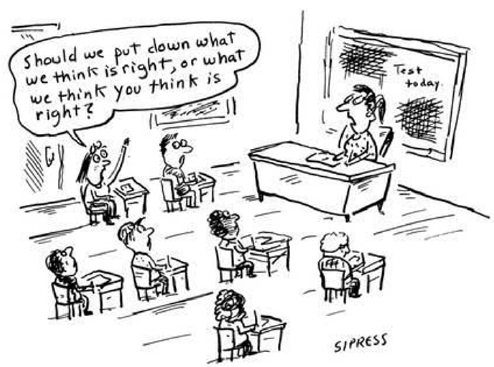
Enunciado 1703856-1
(Available at: https://br.pinterest.com/pin/56506170312404719/
Accessed on March 29th, 2019).
In the cartoon, the student's question reveals
Questão Anulada

Provas

Questão presente nas seguintes provas