Foram encontradas 40 questões.
Read the text below in order to answer questions 24 to 28.
1 When the sun rises on a warm and sunny day you can see the trumpet-
shaped flowers of the morning glory open up. When they close late in the
3 afternoon primrose flowers open and before daylight arrives the next morning
they close again.
5 Biological rhythms, like the opening and closing of flowers happen all over
nature. But not all of them are daily rhythms. Some, like the beating of your
7 heart, occur every second. Other rhythms are based on months, seasons or
years.
9 Scientists use the term biological clock to describe the timing that controls
biological rhythms. But what is this clock and where can you find it? In animals it
11 is probably controlled by the brain, but in plants and other living things that
have no brain it must be something else.
13 The biological rhythms of seashore organisms are connected to the rise and fall of the water. When the tide comes in they open their shells and get food,
15 when the water goes back the shells close to protect the animals from the dry
air.
17 The migration of animals is also an event that happens when a signal is sent
out. When days become shorter birds leave the northern parts of the world and
19 fly south where it is warm and they have enough food. In the summer they fly
back to have babies.
21 Humans also have biological clocks that control their daily rhythms. Body
temperature, blood pressure sleeping and waking up have a 24-hour rhythm.
23 Many illnesses have a yearly rhythm. Colds and flus often happen in winter.
Measles occur mostly during the spring and summer.
25 When people travel by plane from one continent to another they often cross
many time zones. Their internal clocks don’t seem to work correctly. We call this
27 jet lag. It makes you feel tired and it takes many days for your
body’s biological clock to get used to the new place.
29 People who work night shifts also have problems with their biological
clocks. In general, they may not be as alert or active as people who work during
31 the daytime. They also have more accidents during work. Sometimes they
ave more health and sleeping problems than other people.
33 By using the right medicine you can fight off problems that are connected with
different times of day. Heart attacks and strokes often 35 happen in the morning hours—
between the time you get up and noon. Asthma often occurs between midnight and the morning hours. So when people 37 with weak hearts take their medicine right after
waking up it might prevent a heart attack.
39 Biological clocks control many rhythms of life. We are learning more and more
about these rhythms. Doctors are looking for new ways to make travelling more
41 comfortable and medical treatment more effective.
(http://www.english-online.at/biology/biological-clock/biological-rhythms-in-nature.htm. Acesso em: 10 fev.2104)
“But not all of them are daily rhythms”… (line 6). In this case, "Them" refers to:
Provas

Read the text below in order to answer questions 24 to 28.
1 When the sun rises on a warm and sunny day you can see the trumpet-
shaped flowers of the morning glory open up. When they close late in the
3 afternoon primrose flowers open and before daylight arrives the next morning
they close again.
5 Biological rhythms, like the opening and closing of flowers happen all over
nature. But not all of them are daily rhythms. Some, like the beating of your
7 heart, occur every second. Other rhythms are based on months, seasons or
years.
9 Scientists use the term biological clock to describe the timing that controls
biological rhythms. But what is this clock and where can you find it? In animals it
11 is probably controlled by the brain, but in plants and other living things that
have no brain it must be something else.
13 The biological rhythms of seashore organisms are connected to the rise and fall of the water. When the tide comes in they open their shells and get food,
15 when the water goes back the shells close to protect the animals from the dry
air.
17 The migration of animals is also an event that happens when a signal is sent
out. When days become shorter birds leave the northern parts of the world and
19 fly south where it is warm and they have enough food. In the summer they fly
back to have babies.
21 Humans also have biological clocks that control their daily rhythms. Body
temperature, blood pressure sleeping and waking up have a 24-hour rhythm.
23 Many illnesses have a yearly rhythm. Colds and flus often happen in winter.
Measles occur mostly during the spring and summer.
25 When people travel by plane from one continent to another they often cross
many time zones. Their internal clocks don’t seem to work correctly. We call this
27 jet lag. It makes you feel tired and it takes many days for your
body’s biological clock to get used to the new place.
29 People who work night shifts also have problems with their biological
clocks. In general, they may not be as alert or active as people who work during
31 the daytime. They also have more accidents during work. Sometimes they
ave more health and sleeping problems than other people.
33 By using the right medicine you can fight off problems that are connected with
different times of day. Heart attacks and strokes often 35 happen in the morning hours—
between the time you get up and noon. Asthma often occurs between midnight and the morning hours. So when people 37 with weak hearts take their medicine right after
waking up it might prevent a heart attack.
39 Biological clocks control many rhythms of life. We are learning more and more
about these rhythms. Doctors are looking for new ways to make travelling more
41 comfortable and medical treatment more effective.
(http://www.english-online.at/biology/biological-clock/biological-rhythms-in-nature.htm. Acesso em: 10 fev.2104)
According to the text, we can substitute “jet lag” (line 27) without changing the meaning in:
Provas
Read the text below in order to answer questions 24 to 28.
1 When the sun rises on a warm and sunny day you can see the trumpet-
shaped flowers of the morning glory open up. When they close late in the
3 afternoon primrose flowers open and before daylight arrives the next morning
they close again.
5 Biological rhythms, like the opening and closing of flowers happen all over
nature. But not all of them are daily rhythms. Some, like the beating of your
7 heart, occur every second. Other rhythms are based on months, seasons or
years.
9 Scientists use the term biological clock to describe the timing that controls
biological rhythms. But what is this clock and where can you find it? In animals it
11 is probably controlled by the brain, but in plants and other living things that
have no brain it must be something else.
13 The biological rhythms of seashore organisms are connected to the rise and fall of the water. When the tide comes in they open their shells and get food,
15 when the water goes back the shells close to protect the animals from the dry
air.
17 The migration of animals is also an event that happens when a signal is sent
out. When days become shorter birds leave the northern parts of the world and
19 fly south where it is warm and they have enough food. In the summer they fly
back to have babies.
21 Humans also have biological clocks that control their daily rhythms. Body
temperature, blood pressure sleeping and waking up have a 24-hour rhythm.
23 Many illnesses have a yearly rhythm. Colds and flus often happen in winter.
Measles occur mostly during the spring and summer.
25 When people travel by plane from one continent to another they often cross
many time zones. Their internal clocks don’t seem to work correctly. We call this
27 jet lag. It makes you feel tired and it takes many days for your
body’s biological clock to get used to the new place.
29 People who work night shifts also have problems with their biological
clocks. In general, they may not be as alert or active as people who work during
31 the daytime. They also have more accidents during work. Sometimes they
ave more health and sleeping problems than other people.
33 By using the right medicine you can fight off problems that are connected with
different times of day. Heart attacks and strokes often 35 happen in the morning hours—
between the time you get up and noon. Asthma often occurs between midnight and the morning hours. So when people 37 with weak hearts take their medicine right after
waking up it might prevent a heart attack.
39 Biological clocks control many rhythms of life. We are learning more and more
about these rhythms. Doctors are looking for new ways to make travelling more
41 comfortable and medical treatment more effective.
(http://www.english-online.at/biology/biological-clock/biological-rhythms-in-nature.htm. Acesso em: 10 fev.2104)
According to the text we can state that:
I – There is a daily routine that controls life on Earth.
II – Plants need a special central nervous system to control their biological clock.
III – Oceans and seas do not have an important role to control biological rhythm of seashore organisms.
IV – Measles never occur during the winter. The CORRECT alternative is:
Provas
Read the comic strip below and then answer the following question 23.
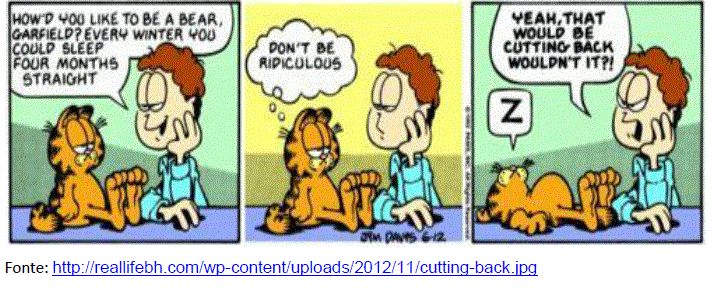
According to the comic strip above, “Cutting back” means:
Provas
Considering the first and the second stanzas, we can conclude:
Provas
WAKE ME UP WHEN SEPTEMBER ENDS
Music: GREEN DAY
Album: American Idiot (2004)
Summer has come and passed
The innocent can never last
Wake me up when September ends
Like my father's come to pass
Seven years has gone so fast
Wake me up when September ends
Here comes the rain again
Falling from the stars
Drenched in my pain again
Becoming who we are
As my memory rests
But never forgets what I lost
Wake me up when September ends
(…)
(http://www.vagalume.com.br/green-day/wake-me-up-when-september-ends.html#ixzz2x4QQMCVj adapted.Acesso
em: 22 abr.2014)
Green Day’s songs are used as a form of protest against a negative time. In “Wake me up when September ends”, we can deduce that they are:Provas
Como todo processo em que predominam práticas administrativas, a tendência tecnicista privilegia as funções de planejar, organizar, dirigir, e controlar, intensificando a burocracia que leva à divisão de trabalho.
PORQUE
Os técnicos são responsáveis pelo planejamento e controle, o diretor é o intermediário entre eles e os professores, agora reduzidos a simples executores. Com isso, o plano pedagógico se submete ao administrativo.
A respeito dessas duas asserções, assinale a opção CORRETA.
Provas
O professor desenvolve dois tipos de ação pedagógica. Uma é o planejamento da situação de aprendizagem, para a qual tenta criar as condições ideais: oferecer informações, montar proposta de trabalho de tal forma que o aluno possa por em jogo o que sabe, arriscar-se, avançar e compreender mais à frente do que sabia. O outro eixo de seu trabalho é a intervenção propriamente dita no processo que está acontecendo, no qual o aluno, os grupos ou classes, diante de uma situação proposta, realizam coisas, e o professor participa, desenvolvendo vários papeis. [...] Uma intervenção clássica é a correção. Não é a única intervenção possível, nem a mais importante, mas é a que mais tem preocupado os professores.
(WEISZ, Telma. O diálogo entre o ensino e a aprendizagem. São Paulo: Ática, 2002, 83.)
Sob a perspectiva da correção como prática de intervenção, assinale a alternativa INCORRETA.
Provas
Pacheco (2007) defende a ideia da criação de comunidades de aprendizagem, nas quais os estudantes vão construindo o seu próprio conhecimento a partir da interação entre professor-aluno e aluno-aluno. Partindo dessa perspectiva, o professor deve atuar como mediador no processo de aprendizagem. Seu livro “Caminhos para a Inclusão” traz um consenso de três medidas educacionais que devem auxiliar a prática da sala de aula inclusiva. A respeito desse tema, a alternativa que NÃO corresponde às medidas educacionais apontadas pelo autor.
Provas
“As pesquisas pedagógicas demonstram cientificamente – através de amostragens, de coleta de dados – aquilo que percebemos pela nossa observação atenta do cotidiano da escola: a situação atual da sala de aula, em grandes linhas, pode ser caracterizada como baseada numa metodologia tradicional, de cunho academicista, uma vez que a pedagogia liberal tradicional é viva e atuante em nossas escolas [...] sendo que esta se aproxima mais do modelo de escola predominante em nossa história educacional”.
(VASCONCELLOS, C. S. A construção do conhecimento em sala de aula. São Paulo: Libertad, 1999, p. 17.)
Segundo essa perspectiva, o autor Vasconcelos faz uma crítica à metodologia expositiva e aponta que ela não leva em consideração:
Provas
Caderno Container