Foram encontradas 50 questões.
O sistema circulatório é formado pelos vasos sanguíneos e pelo coração, sendo que o padrão de divisão das cavidades do coração varia entre os vertebrados.
Com relação ao sistema circulatório, é correto afirmar:
Provas

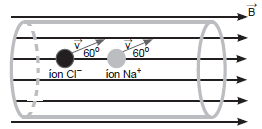
A figura representa o trecho de uma artéria de formato cilíndrico, em perspectiva longitudinal, na qual fluem plasmas sanguíneos que contêm, predominantemente, os íons Na+ e Cl –, imersos na região de um campo magnético uniforme de intensidade B.
Desprezando-se a força de resistência viscosa do plasma sanguíneo e admitindo-se que as velocidades dos íons têm módulos iguais a v e que as direções formam um ângulo de 60º com as linhas de indução magnética, é correto afirmar que os íons Na+ e Cl–, submetidos à ação de uma força magnética descrevem
Provas
O corpo humano é formado por quatro tipos de tecidos: conjutivo, epitelial, muscular e nervoso. Cada um desses tecidos é formado por conjuntos de células que atuam de maneira integrada, desempenhando funções específicas.
Considerando-se os conhecimentos sobre histologia, é correto afirmar:
Provas
Pesquisas demonstram que o estudo da biologia molecular ou celular utiliza-se de conceitos e de modelos teóricos e experimentais desenvolvidos pela Química. Pode-se analisar, por exemplo, por que íons de elementos químicos de um mesmo grupo periódico, como o Na+ e o K+, apresentam diferentes funções biológicas, e quais propriedades diferenciam íons Ca 2+, encontrados nos fluídos corpóreos, dos íons Mg 2+, que se concentram dentro das células dos animais.
Considerando-se essas informações, a estrutura atômica e as propriedades dos elementos químicos, é correto afirmar:
Provas
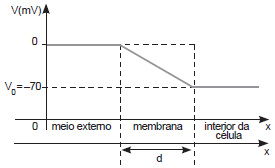
MARQUES, Adriana Benetti et al. Ser Protagonista: Física 3: ensino médio. São Paulo:
Edições SM, 2009, p. 59.
A figura representa a variação de potencial elétrico entre as partes externa e interna de uma célula, denominado potencial de membrana. Esse potencial é medido posicionando-se um dos polos de um medidor de voltagem no interior de uma célula e o outro no líquido extracelular.
Com base nessa informação e considerando-se a intensidade do campo elétrico em uma membrana celular igual a 7,5.106N/C e a carga elétrica fundamental igual a 1,6.10–19C, é correto afirmar:
Provas
Em 1665, o físico e biólogo Robert Hooke analisou fatias de cortiça em um microscópio composto, construído por ele, e observou compartimentos aos quais denominou células.
Dispinível em: <http://www.ufrgs.br/livrodehisto>.
Acesso em: 15 out. 2015. Adaptado.
Com base nos conhecimentos sobre citologia, é correto afirmar:
Provas
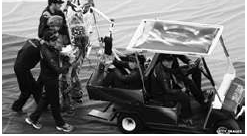
Juliano Pinto, a 29-year-old with complete paralysis of the lower trunk, performed the symbolic kick-off at the Corinthians Arena in Sao Paulo, during the 2014 FIFA World Cup. Using his robotic suit, Mr Pinto kicked the official ball a short distance along a mat laid down by the touchline.
His robotic exoskeleton was created by a team of more than 150 researchers led(a) by Brazilian neuroscientist Dr Miguel Nicolelis. The neuroscientist, who is based at Duke University in the US, is a leading figure in the field of brain-machine interfaces. In breakthrough work published in 2003, he showed that monkeys could control the movement of virtual arms on an avatar using just their brain activity.
Dr Nicolelis had been training eight patients at his lab in Sao Paulo, all of whom were over 20 years of age, with the oldest(b) about 35. "It's the first time an exoskeleton has been controlled by brain activity and offered feedback to the patients," Dr Nicolelis said. "Doing a demonstration in a stadium is something very much outside our routine in robotics. It's never been done(c) before."
The exoskeleton uses a cap placed on the patient's head to pick up brain signals and relay them to a computer in the exoskeleton's backpack.(d) This(d) then decodes the signals and sends them to the legs. The robotic suit is powered by hydraulics, and a battery in the backpack allows for approximately two hours of use. "The basic idea is that we are recording from the brain and then that signal is being translated into commands for the robot to start moving," Dr Gordon Cheng, a member of the team, told the BBC.
Dr Cheng led the development of a form of artificial skin for the exoskeleton. This skin consists of flexible printed circuit boards, each containing pressure, temperature and speed sensors.
It is applied on the soles of the feet and allows the patient to receive tactile stimulation when walking with the exoskeleton. When the robotic suit starts to move and touches the ground, signals are transmitted to an electronic vibration device on the patient's arm, which stimulates their skin.
After lots of practice, the brain starts associating the movements of the legs with the vibration in the arm. In theory, the patient should(e) start to develop the sensation that they have legs and that they are walking.
The suit has been named Bra-Santos Dumont, which combines the three-letter designation for Brazil and Alberto Santos Dumont, the aviation pioneer who was born in the country's southern state of Minas Gerais.
MARTINS, Alejandra; RINCON, Paul. Paraplegic in robotic suit kicks off World Cup.
Disponível em: <www.bbc.com/news/science-environment-27812218>. Acesso em: 20
ago. 2015. Adaptado.
Considering language use in the text, it’s correct to say:
Provas
Juliano Pinto, a 29-year-old with complete paralysis of the lower trunk, performed the symbolic kick-off at the Corinthians Arena in Sao Paulo, during the 2014 FIFA World Cup. Using his robotic suit, Mr Pinto kicked the official ball a short distance along a mat laid down by the touchline.
His robotic exoskeleton was created by a team of more than 150 researchers led by Brazilian neuroscientist Dr Miguel Nicolelis. The neuroscientist, who is based at Duke University in the US, is a leading figure in the field of brain-machine interfaces. In breakthrough(a) work published in 2003, he showed that monkeys could control the movement of virtual arms on an avatar using just their brain activity.
Dr Nicolelis had been training eight patients at his lab in Sao Paulo, all of whom were over 20 years of age, with the oldest about 35. "It's the first time an exoskeleton has been controlled by brain activity and offered feedback(b) to the patients," Dr Nicolelis said. "Doing a demonstration in a stadium is something very much outside our routine in robotics. It's never been done before."
The exoskeleton uses a cap placed on the patient's head to pick up(c) brain signals and relay them to a computer in the exoskeleton's backpack. This then decodes the signals and sends them to the legs. The robotic suit is powered by hydraulics, and a battery in the backpack allows(d) for approximately two hours of use. "The basic idea is that we are recording from the brain and then that signal is being translated into commands for the robot to start moving," Dr Gordon Cheng, a member of the team, told the BBC.
Dr Cheng led the development of a form of artificial skin for the exoskeleton. This skin consists of flexible printed circuit boards, each containing pressure, temperature and speed sensors.
It is applied on the soles of the feet and allows the patient to receive tactile stimulation when walking with the exoskeleton. When the robotic suit starts to move and touches the ground, signals are transmitted to an electronic vibration device(e) on the patient's arm, which stimulates their skin.
After lots of practice, the brain starts associating the movements of the legs with the vibration in the arm. In theory, the patient should start to develop the sensation that they have legs and that they are walking.
The suit has been named Bra-Santos Dumont, which combines the three-letter designation for Brazil and Alberto Santos Dumont, the aviation pioneer who was born in the country's southern state of Minas Gerais.
MARTINS, Alejandra; RINCON, Paul. Paraplegic in robotic suit kicks off World Cup.
Disponível em: <www.bbc.com/news/science-environment-27812218>. Acesso em: 20
ago. 2015. Adaptado.
The word or expression from the text has not been suitably defined is
Provas
Juliano Pinto, a 29-year-old with complete paralysis of the lower trunk, performed the symbolic kick-off at the Corinthians Arena in Sao Paulo, during the 2014 FIFA World Cup. Using his robotic suit, Mr Pinto kicked the official ball a short distance along a mat laid down by the touchline.
His robotic exoskeleton was created by a team of more than 150 researchers led by Brazilian neuroscientist Dr Miguel Nicolelis. The neuroscientist, who is based at Duke University in the US, is a leading figure in the field of brain-machine interfaces. In breakthrough work published in 2003, he showed that monkeys could control the movement of virtual arms on an avatar using just their brain activity.
Dr Nicolelis had been training eight patients at his lab in Sao Paulo, all of whom were over 20 years of age, with the oldest about 35. "It's the first time an exoskeleton has been controlled by brain activity and offered feedback to the patients," Dr Nicolelis said. "Doing a demonstration in a stadium is something very much outside our routine in robotics. It's never been done before."
The exoskeleton uses a cap placed on the patient's head to pick up brain signals and relay them to a computer in the exoskeleton's backpack. This then decodes the signals and sends them to the legs. The robotic suit is powered by hydraulics, and a battery in the backpack allows for approximately two hours of use. "The basic idea is that we are recording from the brain and then that signal is being translated into commands for the robot to start moving," Dr Gordon Cheng, a member of the team, told the BBC.
Dr Cheng led the development of a form of artificial skin for the exoskeleton. This skin consists of flexible printed circuit boards, each containing pressure, temperature and speed sensors.
It is applied on the soles of the feet and allows the patient to receive tactile stimulation when walking with the exoskeleton. When the robotic suit starts to move and touches the ground, signals are transmitted to an electronic vibration device on the patient's arm, which stimulates their skin.
After lots of practice, the brain starts associating the movements of the legs with the vibration in the arm. In theory, the patient should start to develop the sensation that they have legs and that they are walking.
The suit has been named Bra-Santos Dumont, which combines the three-letter designation for Brazil and Alberto Santos Dumont, the aviation pioneer who was born in the country's southern state of Minas Gerais.
MARTINS, Alejandra; RINCON, Paul. Paraplegic in robotic suit kicks off World Cup.
Disponível em: <www.bbc.com/news/science-environment-27812218>. Acesso em: 20
ago. 2015. Adaptado.
Fill in the parentheses with T (True) or F (False).
The text has answers to the following questions
( ) Where does Dr. Nicolelis have his main office?
( ) How often has an exoskeleton controlled by a human’s brain been successfully used?
( ) Why did monkeys fail to use their brain activity to make virtual limbs move?
( ) Who was the robotic suit from the text named after? The correct sequence, from top to bottom, is
Provas
Juliano Pinto, a 29-year-old with complete paralysis of the lower trunk, performed the symbolic kick-off at the Corinthians Arena in Sao Paulo, during the 2014 FIFA World Cup. Using his robotic suit, Mr Pinto kicked the official ball a short distance along a mat laid down by the touchline.
His robotic exoskeleton was created by a team of more than 150 researchers led by Brazilian neuroscientist Dr Miguel Nicolelis. The neuroscientist, who is based at Duke University in the US, is a leading figure in the field of brain-machine interfaces. In breakthrough work published in 2003, he showed that monkeys could control the movement of virtual arms on an avatar using just their brain activity.
Dr Nicolelis had been training eight patients at his lab in Sao Paulo, all of whom were over 20 years of age, with the oldest about 35. "It's the first time an exoskeleton has been controlled by brain activity and offered feedback to the patients," Dr Nicolelis said. "Doing a demonstration in a stadium is something very much outside our routine in robotics. It's never been done before."
The exoskeleton uses a cap placed on the patient's head to pick up brain signals and relay them to a computer in the exoskeleton's backpack. This then decodes the signals and sends them to the legs. The robotic suit is powered by hydraulics, and a battery in the backpack allows for approximately two hours of use. "The basic idea is that we are recording from the brain and then that signal is being translated into commands for the robot to start moving," Dr Gordon Cheng, a member of the team, told the BBC.
Dr Cheng led the development of a form of artificial skin for the exoskeleton. This skin consists of flexible printed circuit boards, each containing pressure, temperature and speed sensors.
It is applied on the soles of the feet and allows the patient to receive tactile stimulation when walking with the exoskeleton. When the robotic suit starts to move and touches the ground, signals are transmitted to an electronic vibration device on the patient's arm, which stimulates their skin.
After lots of practice, the brain starts associating the movements of the legs with the vibration in the arm. In theory, the patient should start to develop the sensation that they have legs and that they are walking.
The suit has been named Bra-Santos Dumont, which combines the three-letter designation for Brazil and Alberto Santos Dumont, the aviation pioneer who was born in the country's southern state of Minas Gerais.
MARTINS, Alejandra; RINCON, Paul. Paraplegic in robotic suit kicks off World Cup.
Disponível em: <www.bbc.com/news/science-environment-27812218>. Acesso em: 20
ago. 2015. Adaptado.
The exoskeleton mentioned in the text
Provas
Caderno Container