Foram encontradas 46.411 questões.
Leia o texto para responder a questão.
France wants to put a lid on the tourist crowds that flood historic landmarks and natural treasures each year, though officials have said it would not be easy. Tourism Minister Olivia Gregoire unveiled a plan to regulate visitor flows at the most popular sites and lay out a strategy against overtourism. She said France, the world’s biggest tourist destination, particularly needed to better manage the peak-season influxes that threatened “the environment, the quality of life for locals, and the experiences for its visitors”. The issue is urgent for prime destinations worldwide as international travel surges after covid-19 lockdowns. Many of the most revered French sites, such as the Mont-Saint-Michel abbey in Normandy, say they are overwhelmed by the number of visitors.
On the famed Channel beach of Etretat, which saw a tourism surge thanks to the plot of the Netflix detective series “Lupin”, the 1,200 residents see up to 10,000 tourists a day in the high season. “This massive influx ends up eroding the cliffs and endangers the beach cliffs,” co-head of the Etretat Tomorrow residents’ association Shai Mallet said. She also laments the lack of local economic benefits, with visitors staying just a few hours, maybe grabbing an ice cream but not constantly frequenting restaurants or hotels.
The government’s announcement comes as Paris, which is dealing with a housing shortage in part because homeowners prefer short-term rentals to tourists, said last week it expects 37 million tourists this year, just short of the pre-pandemic level of 38.5 million in 2019. Limits are already being set, with officials limiting day visits to the gorgeous Brittany island of Brehat at 4,700 during the peak summer months.
(www.euronews.com, 20.06.2023. Adaptado.)
The main purpose of the text is to
Provas


The benefits of computer games in education are clear. They engage students, improve problem-solving skills, enhance creativity and imagination, allow for personalized learning, remote learning, learning on demand, and contacting peers around the world. With the increasing use of technology in schools, it is essential that teachers explore the potential benefits of computer games and incorporate them into their teaching methods. Doing so can create a more engaging and effective learning environment for their students.
(Ruby Butz. https://gamingrespawn.com, 23.03.2023. Adaptado.)
According to the text, one of the advantages of computer games in education is:
Provas
Leia a tira de Bill Amend para responder a questão.

(www.pressthebuttons.com)
No terceiro quadrinho, o termo “that” refere-se a
Provas
Leia a tira de Bill Amend para responder a questão.
(www.pressthebuttons.com)
No primeiro quadrinho, a fala “Is she out of her mind?!” indica que o menino
Provas
Leia a tira de Bill Amend para responder a questão.
(www.pressthebuttons.com)
From the comic strip, one can say that
Provas
Leia o texto e examine o gráfico para responder a questão.

The first Game Developers Conference, in 1988, attracted 25 participants and took place in a programmer’s sitting room in California. This 2023 summit, which began on March 20 in a giant exhibition centre in San Francisco, demonstrates how the industry has grown. Some 3.2 billion people now play, thanks largely to the spread of the smartphone. Women are now almost as likely as men to call themselves gamers. Gaming is catching on among all age groups. In Britain, for instance, half of those aged 55-64 play video games, though for less time than the young. Worldwide there are now more console owners aged 35-44 than 16-24.
The bigger the audience, the bigger the market. Consumers will spend 185 billion dollars on games in 2023, more than half on mobile games. That is about five times the value of the cinema box office, and two-thirds more than the video-streaming business. As gaming continues to grow, it is beginning to rival television as the world’s favourite entertainment medium.
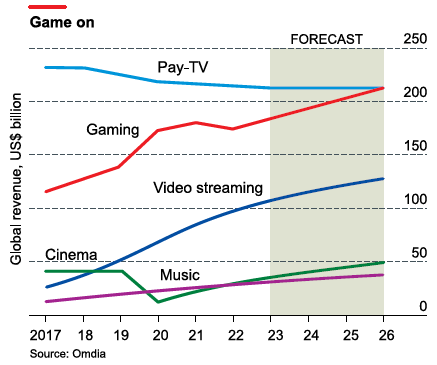
(https://view.e.economist.com, 20.03.2023. Adaptado.)
No trecho do segundo parágrafo “As gaming continues to grow, it is beginning to rival television as the world’s favourite entertainment medium”, os termos sublinhados equivalem, em português, respectivamente, a
Provas
Leia o texto e examine o gráfico para responder a questão.
The first Game Developers Conference, in 1988, attracted 25 participants and took place in a programmer’s sitting room in California. This 2023 summit, which began on March 20 in a giant exhibition centre in San Francisco, demonstrates how the industry has grown. Some 3.2 billion people now play, thanks largely to the spread of the smartphone. Women are now almost as likely as men to call themselves gamers. Gaming is catching on among all age groups. In Britain, for instance, half of those aged 55-64 play video games, though for less time than the young. Worldwide there are now more console owners aged 35-44 than 16-24.
The bigger the audience, the bigger the market. Consumers will spend 185 billion dollars on games in 2023, more than half on mobile games. That is about five times the value of the cinema box office, and two-thirds more than the video-streaming business. As gaming continues to grow, it is beginning to rival television as the world’s favourite entertainment medium.
(https://view.e.economist.com, 20.03.2023. Adaptado.)
A frase do texto cujo significado pode ser verificado no gráfico é:
Provas
Leia o texto e examine o gráfico para responder a questão.
The first Game Developers Conference, in 1988, attracted 25 participants and took place in a programmer’s sitting room in California. This 2023 summit, which began on March 20 in a giant exhibition centre in San Francisco, demonstrates how the industry has grown. Some 3.2 billion people now play, thanks largely to the spread of the smartphone. Women are now almost as likely as men to call themselves gamers. Gaming is catching on among all age groups. In Britain, for instance, half of those aged 55-64 play video games, though for less time than the young. Worldwide there are now more console owners aged 35-44 than 16-24.
The bigger the audience, the bigger the market. Consumers will spend 185 billion dollars on games in 2023, more than half on mobile games. That is about five times the value of the cinema box office, and two-thirds more than the video-streaming business. As gaming continues to grow, it is beginning to rival television as the world’s favourite entertainment medium.
(https://view.e.economist.com, 20.03.2023. Adaptado.)
Uma interpretação matemática plausível da frase do segundo parágrafo “The bigger the audience, the bigger the market”, considerando o público e o mercado de games, é de
Provas
Leia o texto e examine o gráfico para responder a questão.
The first Game Developers Conference, in 1988, attracted 25 participants and took place in a programmer’s sitting room in California. This 2023 summit, which began on March 20 in a giant exhibition centre in San Francisco, demonstrates how the industry has grown. Some 3.2 billion people now play, thanks largely to the spread of the smartphone. Women are now almost as likely as men to call themselves gamers. Gaming is catching on among all age groups. In Britain, for instance, half of those aged 55-64 play video games, though for less time than the young. Worldwide there are now more console owners aged 35-44 than 16-24.
The bigger the audience, the bigger the market. Consumers will spend 185 billion dollars on games in 2023, more than half on mobile games. That is about five times the value of the cinema box office, and two-thirds more than the video-streaming business. As gaming continues to grow, it is beginning to rival television as the world’s favourite entertainment medium.
(https://view.e.economist.com, 20.03.2023. Adaptado.)
No trecho do primeiro parágrafo “though for less time than the young”, o termo sublinhado introduz, em relação à frase anterior,
Provas
Leia o texto e examine o gráfico para responder a questão.
The first Game Developers Conference, in 1988, attracted 25 participants and took place in a programmer’s sitting room in California. This 2023 summit, which began on March 20 in a giant exhibition centre in San Francisco, demonstrates how the industry has grown. Some 3.2 billion people now play, thanks largely to the spread of the smartphone. Women are now almost as likely as men to call themselves gamers. Gaming is catching on among all age groups. In Britain, for instance, half of those aged 55-64 play video games, though for less time than the young. Worldwide there are now more console owners aged 35-44 than 16-24.
The bigger the audience, the bigger the market. Consumers will spend 185 billion dollars on games in 2023, more than half on mobile games. That is about five times the value of the cinema box office, and two-thirds more than the video-streaming business. As gaming continues to grow, it is beginning to rival television as the world’s favourite entertainment medium.
(https://view.e.economist.com, 20.03.2023. Adaptado.)
According to the first paragraph, the Game Developers Conference growth from 1988 to 2023 can be evaluated by the
Provas
Caderno Container