Magna Concursos

Foram encontradas 47.586 questões.

Garcia (2009) é quem expande o conceito de translinguagem, que parte de uma visão heteroglóssica, em que o sujeito possui um único repertório linguístico e suas práticas linguísticas e dinâmicas semióticas são superiores às línguas convencionais de países e estados. Liberali (2013) defende esta perspectiva e enfatiza a necessidade de termos que considerar o currículo da educação multi/bilíngue a partir das atividades e práticas sociais e permitir aos alunos expandirem seu repertório e suas formas de participação. A educação bilíngue consiste em um programa educacional formal que se faz presente pelo aprendizado de componentes curriculares pela instrução em duas línguas e não manter o foco apenas no aprendizado da língua. Aqui no Brasil, podemos distinguir a educação bilíngue em dois grandes grupos: dominante (educação bilíngue de línguas de prestígio, frequentemente de escolas particulares de elite em que se objetiva o aprendizado de uma segunda língua, como o inglês) e minoritários (educação indígena, migrantes de crise, educação em regiões de fronteiras, educação de surdos).
Projeto-piloto: escola bilíngue com adequações. Disponível em: www.ibipora.pr.gov.br. Acesso em: 2 maio 2025 (adaptado).
Which perspective on bilingual education is coherent to the text?
 

Provas

Questão presente nas seguintes provas
Enunciado 4880852-1
FRANCO, C. English Vibes. São Paulo: FTD, 2020.
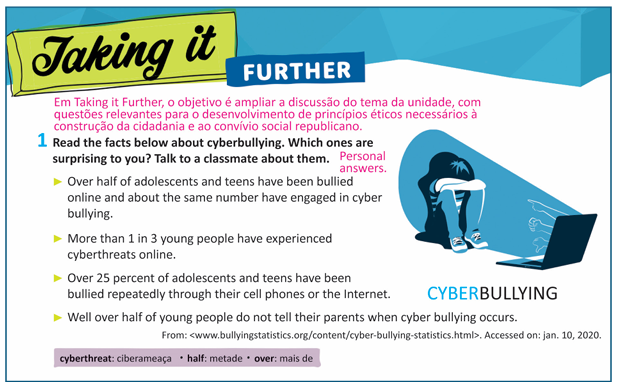
In light of Base Nacional Comum Curricular (BNCC) and Programa Nacional do Livro Didático (PNLD) guidelines for English language teaching, how does the activity about cyberbullying reflect current educational policies and priorities?
 

Provas

Questão presente nas seguintes provas
Enunciado 4880851-1
FRANCO, C. English Vibes. São Paulo: FTD, 2020.
Which of the following teaching methodologies reflects the text’s pedagogical foundation?
 

Provas

Questão presente nas seguintes provas

In a high school EFL 50-minute lesson, the teacher selects a short authentic news article on climate change to introduce some reading strategies. The teacher begins by activating students’ background knowledge through a quick discussion in English about environmental issues. Then, she explains two key reading strategies — skimming and scanning — using visual aids and simple English definitions.

Students are first asked to skim the text in pairs to get the main idea, take some notes, and discuss the overall topic. Then, they scan the article to answer questions such as “What year was the article published?” or “Which countries are mentioned?”. The teacher monitors the group work, encouraging students to interact in English and supporting them when needed. Afterwards, the class discusses the purpose of each strategy and how they help understand texts more efficiently.

Based on the description of the lesson plan, which procedure corresponds to the warm-up stage?
 

Provas

Questão presente nas seguintes provas
 In a high school EFL 50-minute lesson, the teacher selects a short authentic news article on climate change to introduce some reading strategies. The teacher begins by activating students’ background knowledge through a quick discussion in English about environmental issues. Then, she explains two key reading strategies — skimming and scanning — using visual aids and simple English definitions.
Students are first asked to skim the text in pairs to get the main idea, take some notes, and discuss the overall topic. Then, they scan the article to answer questions such as “What year was the article published?” or “Which countries are mentioned?”. The teacher monitors the group work, encouraging students to interact in English and supporting them when needed. Afterwards, the class discusses the purpose of each strategy and how they help understand texts more efficiently.
Considering the teaching situation, we can affirm that the lesson is based on the
 

Provas

Questão presente nas seguintes provas

In a high school EFL 50-minute lesson, the teacher selects a short authentic news article on climate change to introduce some reading strategies. The teacher begins by activating students’ background knowledge through a quick discussion in English about environmental issues. Then, she explains two key reading strategies — skimming and scanning — using visual aids and simple English definitions.

Students are first asked to skim the text in pairs to get the main idea, take some notes, and discuss the overall topic. Then, they scan the article to answer questions such as “What year was the article published?” or “Which countries are mentioned?”. The teacher monitors the group work, encouraging students to interact in English and supporting them when needed. Afterwards, the class discusses the purpose of each strategy and how they help understand texts more efficiently.

The teacher’s approach reveals a concept of language as
 

Provas

Questão presente nas seguintes provas
3927235 Ano: 2025
Disciplina: Inglês (Língua Inglesa)
Banca: OBJETIVA
Orgão: Pref. Canoas-RS
    The public school district in Seattle has filed a novel lawsuit against the tech giants behind TikTok, Instagram, Facebook, YouTube and Snapchat, seeking to hold them accountable for the mental health crisis among youth.
    Seattle Public Schools filed the lawsuit Friday in U.S. District Court. The 91-page complaint says the social media companies have created a public nuisance by targeting their products to children.
    It blames them for worsening mental health and behavioral disorders including anxiety, depression, disordered eating and cyberbullying; making it more difficult to educate students; and forcing schools to take steps such as hiring additional mental health professionals, developing lesson plans about the effects of social media, and providing additional training to teachers.
    "Defendants have successfully exploited the vulnerable brains of youth, hooking tens of millions of students across the country into positive feedback loops of excessive use and abuse of Defendants' social media platforms," the complaint said. "Worse, the content Defendants curate and direct to youth is too often harmful and exploitive ...."
    Meta, Google, Snap and TikTok did not immediately respond to requests for comment Saturday.
  While federal law — Section 230 of the Communications Decency Act — helps protect online companies from liability arising from what third-party users post on their platforms, the lawsuit argues that provision does not protect the tech giants' behavior in this case.
    "Plaintiff is not alleging Defendants are liable for what third-parties have said on Defendants' platforms but, rather, for Defendants' own conduct," the lawsuit said. "Defendants affirmatively recommend and promote harmful content to youth, such as pro-anorexia and eating disorder content."
    The lawsuit says that from 2009 to 2019, there was on average a 30% increase in the number of Seattle Public Schools students who reported feeling "so sad or hopeless almost every day for two weeks or more in a row" that they stopped doing some typical activities.
    The school district is asking the court to order the companies to stop creating the public nuisance, to award damages, and to pay for prevention education and treatment for excessive and problematic use of social media.
    While hundreds of families are pursuing lawsuits against the companies over harms they allege their children have suffered from social media, it's not clear if any other school districts have filed a complaint like Seattle's.
   Internal studies revealed by Facebook whistleblower Frances Haugen in 2021 showed that the company knew that Instagram negatively affected teenagers by harming their body image and making eating disorders and thoughts of suicide worse. She alleged that the platform prioritized profits over safety and hid its own research from investors and the public. 
Available at: ttps://www.npr.org/2023/01/08/1147735477/seattlesschools-are-suing-tech-giants-for-harming-young-peoplesmental-health
Considering the translation of the excerpt "Internal studies revealed by Facebook whistleblower Frances Haugen in 2021" (paragraph 11) to Brazilian Portuguese, mark the CORRECT answer.
 

Provas

Questão presente nas seguintes provas
3927234 Ano: 2025
Disciplina: Inglês (Língua Inglesa)
Banca: OBJETIVA
Orgão: Pref. Canoas-RS
    The public school district in Seattle has filed a novel lawsuit against the tech giants behind TikTok, Instagram, Facebook, YouTube and Snapchat, seeking to hold them accountable for the mental health crisis among youth.
    Seattle Public Schools filed the lawsuit Friday in U.S. District Court. The 91-page complaint says the social media companies have created a public nuisance by targeting their products to children.
    It blames them for worsening mental health and behavioral disorders including anxiety, depression, disordered eating and cyberbullying; making it more difficult to educate students; and forcing schools to take steps such as hiring additional mental health professionals, developing lesson plans about the effects of social media, and providing additional training to teachers.
    "Defendants have successfully exploited the vulnerable brains of youth, hooking tens of millions of students across the country into positive feedback loops of excessive use and abuse of Defendants' social media platforms," the complaint said. "Worse, the content Defendants curate and direct to youth is too often harmful and exploitive ...."
    Meta, Google, Snap and TikTok did not immediately respond to requests for comment Saturday.
  While federal law — Section 230 of the Communications Decency Act — helps protect online companies from liability arising from what third-party users post on their platforms, the lawsuit argues that provision does not protect the tech giants' behavior in this case.
    "Plaintiff is not alleging Defendants are liable for what third-parties have said on Defendants' platforms but, rather, for Defendants' own conduct," the lawsuit said. "Defendants affirmatively recommend and promote harmful content to youth, such as pro-anorexia and eating disorder content."
    The lawsuit says that from 2009 to 2019, there was on average a 30% increase in the number of Seattle Public Schools students who reported feeling "so sad or hopeless almost every day for two weeks or more in a row" that they stopped doing some typical activities.
    The school district is asking the court to order the companies to stop creating the public nuisance, to award damages, and to pay for prevention education and treatment for excessive and problematic use of social media.
    While hundreds of families are pursuing lawsuits against the companies over harms they allege their children have suffered from social media, it's not clear if any other school districts have filed a complaint like Seattle's.
   Internal studies revealed by Facebook whistleblower Frances Haugen in 2021 showed that the company knew that Instagram negatively affected teenagers by harming their body image and making eating disorders and thoughts of suicide worse. She alleged that the platform prioritized profits over safety and hid its own research from investors and the public. 
Available at: ttps://www.npr.org/2023/01/08/1147735477/seattlesschools-are-suing-tech-giants-for-harming-young-peoplesmental-health
In “[...] there was on average a 30% increase in the number of Seattle Public Schools students who reported feeling [...]” (paragraph 8), the clause “who reported feeling” is an example of what kind of clause?
 

Provas

Questão presente nas seguintes provas
3927233 Ano: 2025
Disciplina: Inglês (Língua Inglesa)
Banca: OBJETIVA
Orgão: Pref. Canoas-RS
    The public school district in Seattle has filed a novel lawsuit against the tech giants behind TikTok, Instagram, Facebook, YouTube and Snapchat, seeking to hold them accountable for the mental health crisis among youth.
    Seattle Public Schools filed the lawsuit Friday in U.S. District Court. The 91-page complaint says the social media companies have created a public nuisance by targeting their products to children.
    It blames them for worsening mental health and behavioral disorders including anxiety, depression, disordered eating and cyberbullying; making it more difficult to educate students; and forcing schools to take steps such as hiring additional mental health professionals, developing lesson plans about the effects of social media, and providing additional training to teachers.
    "Defendants have successfully exploited the vulnerable brains of youth, hooking tens of millions of students across the country into positive feedback loops of excessive use and abuse of Defendants' social media platforms," the complaint said. "Worse, the content Defendants curate and direct to youth is too often harmful and exploitive ...."
    Meta, Google, Snap and TikTok did not immediately respond to requests for comment Saturday.
  While federal law — Section 230 of the Communications Decency Act — helps protect online companies from liability arising from what third-party users post on their platforms, the lawsuit argues that provision does not protect the tech giants' behavior in this case.
    "Plaintiff is not alleging Defendants are liable for what third-parties have said on Defendants' platforms but, rather, for Defendants' own conduct," the lawsuit said. "Defendants affirmatively recommend and promote harmful content to youth, such as pro-anorexia and eating disorder content."
    The lawsuit says that from 2009 to 2019, there was on average a 30% increase in the number of Seattle Public Schools students who reported feeling "so sad or hopeless almost every day for two weeks or more in a row" that they stopped doing some typical activities.
    The school district is asking the court to order the companies to stop creating the public nuisance, to award damages, and to pay for prevention education and treatment for excessive and problematic use of social media.
    While hundreds of families are pursuing lawsuits against the companies over harms they allege their children have suffered from social media, it's not clear if any other school districts have filed a complaint like Seattle's.
   Internal studies revealed by Facebook whistleblower Frances Haugen in 2021 showed that the company knew that Instagram negatively affected teenagers by harming their body image and making eating disorders and thoughts of suicide worse. She alleged that the platform prioritized profits over safety and hid its own research from investors and the public. 
Available at: ttps://www.npr.org/2023/01/08/1147735477/seattlesschools-are-suing-tech-giants-for-harming-young-peoplesmental-health
The word “lawsuit” (paragraph 1) is a compound word. Which word below is also a compound word?
 

Provas

Questão presente nas seguintes provas
3927232 Ano: 2025
Disciplina: Inglês (Língua Inglesa)
Banca: OBJETIVA
Orgão: Pref. Canoas-RS
    The public school district in Seattle has filed a novel lawsuit against the tech giants behind TikTok, Instagram, Facebook, YouTube and Snapchat, seeking to hold them accountable for the mental health crisis among youth.
    Seattle Public Schools filed the lawsuit Friday in U.S. District Court. The 91-page complaint says the social media companies have created a public nuisance by targeting their products to children.
    It blames them for worsening mental health and behavioral disorders including anxiety, depression, disordered eating and cyberbullying; making it more difficult to educate students; and forcing schools to take steps such as hiring additional mental health professionals, developing lesson plans about the effects of social media, and providing additional training to teachers.
    "Defendants have successfully exploited the vulnerable brains of youth, hooking tens of millions of students across the country into positive feedback loops of excessive use and abuse of Defendants' social media platforms," the complaint said. "Worse, the content Defendants curate and direct to youth is too often harmful and exploitive ...."
    Meta, Google, Snap and TikTok did not immediately respond to requests for comment Saturday.
  While federal law — Section 230 of the Communications Decency Act — helps protect online companies from liability arising from what third-party users post on their platforms, the lawsuit argues that provision does not protect the tech giants' behavior in this case.
    "Plaintiff is not alleging Defendants are liable for what third-parties have said on Defendants' platforms but, rather, for Defendants' own conduct," the lawsuit said. "Defendants affirmatively recommend and promote harmful content to youth, such as pro-anorexia and eating disorder content."
    The lawsuit says that from 2009 to 2019, there was on average a 30% increase in the number of Seattle Public Schools students who reported feeling "so sad or hopeless almost every day for two weeks or more in a row" that they stopped doing some typical activities.
    The school district is asking the court to order the companies to stop creating the public nuisance, to award damages, and to pay for prevention education and treatment for excessive and problematic use of social media.
    While hundreds of families are pursuing lawsuits against the companies over harms they allege their children have suffered from social media, it's not clear if any other school districts have filed a complaint like Seattle's.
   Internal studies revealed by Facebook whistleblower Frances Haugen in 2021 showed that the company knew that Instagram negatively affected teenagers by harming their body image and making eating disorders and thoughts of suicide worse. She alleged that the platform prioritized profits over safety and hid its own research from investors and the public. 
Available at: ttps://www.npr.org/2023/01/08/1147735477/seattlesschools-are-suing-tech-giants-for-harming-young-peoplesmental-health
The word “while” (paragraph 6) is an example of:
 

Provas

Questão presente nas seguintes provas