Foram encontradas 46.768 questões.
Provas

Provas
TEXT 1
“The Wolves are a free people,” said Father Wolf. “They take orders from the Head of the Pack, and not from any striped cattle-killer. The man’s cub is ours — to kill if we choose.”
“Ye choose and ye do not choose! What talk is this of choosing? By the bull that I killed, am I to stand nosing into your dog’s den for my fair dues? It is I, Shere Khan, who speak!”
KIPLING, R. The Jungle Book. S.l.: Project Gutenberg, 1894.
TEXT 2
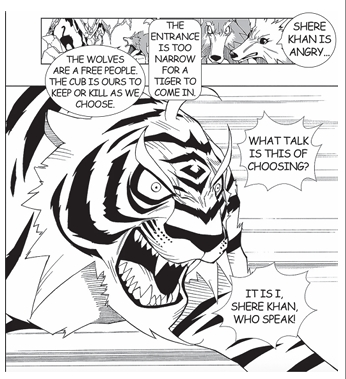
KIPLING, R.; CHAN, C. S. The Jungle Book.
Toronto: UDON Entertainment, s.d.
Provas
TEXT 1
“The Wolves are a free people,” said Father Wolf. “They take orders from the Head of the Pack, and not from any striped cattle-killer. The man’s cub is ours — to kill if we choose.”
“Ye choose and ye do not choose! What talk is this of choosing? By the bull that I killed, am I to stand nosing into your dog’s den for my fair dues? It is I, Shere Khan, who speak!”
KIPLING, R. The Jungle Book. S.l.: Project Gutenberg, 1894.
TEXT 2
KIPLING, R.; CHAN, C. S. The Jungle Book.
Toronto: UDON Entertainment, s.d.
Provas
TEXT 1
“The Wolves are a free people,” said Father Wolf. “They take orders from the Head of the Pack, and not from any striped cattle-killer. The man’s cub is ours — to kill if we choose.”
“Ye choose and ye do not choose! What talk is this of choosing? By the bull that I killed, am I to stand nosing into your dog’s den for my fair dues? It is I, Shere Khan, who speak!”
KIPLING, R. The Jungle Book. S.l.: Project Gutenberg, 1894.
TEXT 2
KIPLING, R.; CHAN, C. S. The Jungle Book.
Toronto: UDON Entertainment, s.d.
Provas
Provas
Provas
Provas
O Google lançou esta semana uma coleção com experimentos de inteligência artificial — desenvolvida com o modelo Gemini. Cada um dos experimentos da chamada Little Language Lessons, que ainda é uma exploração inicial, aborda uma maneira diferente pela qual a inteligência artificial pode apoiar a aprendizagem no mundo real.
O primeiro é o Tiny Lesson. Com ele, o usuário descreve uma situação, por exemplo “pedir informações” ou “encontrar um passaporte perdido”, e recebe vocabulário, frases e dicas gramaticais úteis, adaptados a esse contexto.
O segundo é o Slang Hang, que gera conversas autênticas para ajudar o usuário a aprender expressões e gírias. A pessoa pode acompanhar o desenrolar de um diálogo entre falantes nativos, revelando uma mensagem de cada vez e desvendando termos desconhecidos à medida que aparecem.
“Um dos aspectos mais interessantes deste experimento é o elemento da narrativa emergente. Cada cena é única e gerada na hora — pode ser um vendedor ambulante conversando com um cliente, dois colegas de trabalho se encontrando no metrô ou até mesmo um casal de amigos há muito perdidos se reencontrando inesperadamente em uma exposição de animais de estimação exóticos”, pontuou Wade, acrescentando que pode haver erros de precisão. “Ocasionalmente, ele usa incorretamente certas expressões e gírias, ou até mesmo as inventa. Os Large Language Models (LLM) ainda não são perfeitos e, por isso, é importante fazer referências cruzadas com fontes confiáveis”.
VEIGA, C. Google Launches AI Tools to Teach Languages. Disponível em: https://epocanegocios.globo.com.
Acesso em: 2 maio 2025 (adaptado).
Provas
O Google lançou esta semana uma coleção com experimentos de inteligência artificial — desenvolvida com o modelo Gemini. Cada um dos experimentos da chamada Little Language Lessons, que ainda é uma exploração inicial, aborda uma maneira diferente pela qual a inteligência artificial pode apoiar a aprendizagem no mundo real.
O primeiro é o Tiny Lesson. Com ele, o usuário descreve uma situação, por exemplo “pedir informações” ou “encontrar um passaporte perdido”, e recebe vocabulário, frases e dicas gramaticais úteis, adaptados a esse contexto.
O segundo é o Slang Hang, que gera conversas autênticas para ajudar o usuário a aprender expressões e gírias. A pessoa pode acompanhar o desenrolar de um diálogo entre falantes nativos, revelando uma mensagem de cada vez e desvendando termos desconhecidos à medida que aparecem.
“Um dos aspectos mais interessantes deste experimento é o elemento da narrativa emergente. Cada cena é única e gerada na hora — pode ser um vendedor ambulante conversando com um cliente, dois colegas de trabalho se encontrando no metrô ou até mesmo um casal de amigos há muito perdidos se reencontrando inesperadamente em uma exposição de animais de estimação exóticos”, pontuou Wade, acrescentando que pode haver erros de precisão. “Ocasionalmente, ele usa incorretamente certas expressões e gírias, ou até mesmo as inventa. Os Large Language Models (LLM) ainda não são perfeitos e, por isso, é importante fazer referências cruzadas com fontes confiáveis”.
VEIGA, C. Google Launches AI Tools to Teach Languages. Disponível em: https://epocanegocios.globo.com.
Acesso em: 2 maio 2025 (adaptado).
Provas
Caderno Container