Foram encontradas 50 questões.
Text 7A2-I
If we believe that our own information age is defined by the digital structures of electronic communication, we must take early modern culture as inextricably bound to the medium of print. Printed text and image arose within a few years of each other in the mid-fifteenth century, credited to the German goldsmith Johannes Gutenberg, who seemingly drew together a series of extant yet disparate technologies into a new machine that could print several thousand sheets a day. The ancient oil or wine press, the goldsmith’s craft in fine metal carving, the late-medieval development of plentiful rag paper, and the recent formulation of more stable oil-based inks enabled Gutenberg’s ‘revolution’.
Similarly, early photography developed from a coming together of two otherwise disparate technologies: on the one hand, the pinhole camera through which capture a refected view of the world as an image, and on the other the chemical means to fix the effects of light exposure on paper. In both cases, these technologies shared aesthetic resources with other media available at the time, while also producing forms of representation that were uniquely theirs, and which offered access to new ways of seeing, and enabled new forms of subjectivity. The greatly expanded flow of visual information facilitated by these technological breakthroughs worked to quicken the circulation of knowledge, and the foundations of thought itself.
Genevieve Warwick and Richard Taws. After Prometheus:
Art and Technology in Early Modern Europe. In:
Art History – Journal of the Association of Art Historians.
Special Edition: Art and Technology in Early Modern Europe. p. 201 (adapted)
In the first sentence of text 7A2-I,
Provas

Text 7A2-I
If we believe that our own information age is defined by the digital structures of electronic communication, we must take early modern culture as inextricably bound to the medium of print. Printed text and image arose within a few years of each other in the mid-fifteenth century, credited to the German goldsmith Johannes Gutenberg, who seemingly drew together a series of extant yet disparate technologies into a new machine that could print several thousand sheets a day. The ancient oil or wine press, the goldsmith’s craft in fine metal carving, the late-medieval development of plentiful rag paper, and the recent formulation of more stable oil-based inks enabled Gutenberg’s ‘revolution’.
Similarly, early photography developed from a coming together of two otherwise disparate technologies: on the one hand, the pinhole camera through which capture a refected view of the world as an image, and on the other the chemical means to fix the effects of light exposure on paper. In both cases, these technologies shared aesthetic resources with other media available at the time, while also producing forms of representation that were uniquely theirs, and which offered access to new ways of seeing, and enabled new forms of subjectivity. The greatly expanded flow of visual information facilitated by these technological breakthroughs worked to quicken the circulation of knowledge, and the foundations of thought itself.
Genevieve Warwick and Richard Taws. After Prometheus:
Art and Technology in Early Modern Europe. In:
Art History – Journal of the Association of Art Historians.
Special Edition: Art and Technology in Early Modern Europe. p. 201 (adapted)
Used in text 7A2-I, the words “Printed” (second sentence of the first paragraph) “carving” (third sentence of the first paragraph), and “producing” (second sentence of the second paragraph)
Provas
Text 7A2-I
If we believe that our own information age is defined by the digital structures of electronic communication, we must take early modern culture as inextricably bound to the medium of print. Printed text and image arose within a few years of each other in the mid-fifteenth century, credited to the German goldsmith Johannes Gutenberg, who seemingly drew together a series of extant yet disparate technologies into a new machine that could print several thousand sheets a day. The ancient oil or wine press, the goldsmith’s craft in fine metal carving, the late-medieval development of plentiful rag paper, and the recent formulation of more stable oil-based inks enabled Gutenberg’s ‘revolution’.
Similarly, early photography developed from a coming together of two otherwise disparate technologies: on the one hand, the pinhole camera through which capture a refected view of the world as an image, and on the other the chemical means to fix the effects of light exposure on paper. In both cases, these technologies shared aesthetic resources with other media available at the time, while also producing forms of representation that were uniquely theirs, and which offered access to new ways of seeing, and enabled new forms of subjectivity. The greatly expanded flow of visual information facilitated by these technological breakthroughs worked to quicken the circulation of knowledge, and the foundations of thought itself.
Genevieve Warwick and Richard Taws. After Prometheus:
Art and Technology in Early Modern Europe. In:
Art History – Journal of the Association of Art Historians.
Special Edition: Art and Technology in Early Modern Europe. p. 201 (adapted)
In the last two sentences of text 7A2-I, the word
Provas
Text 7A2-I
If we believe that our own information age is defined by the digital structures of electronic communication, we must take early modern culture as inextricably bound to the medium of print. Printed text and image arose within a few years of each other in the mid-fifteenth century, credited to the German goldsmith Johannes Gutenberg, who seemingly drew together a series of extant yet disparate technologies into a new machine that could print several thousand sheets a day. The ancient oil or wine press, the goldsmith’s craft in fine metal carving, the late-medieval development of plentiful rag paper, and the recent formulation of more stable oil-based inks enabled Gutenberg’s ‘revolution’.
Similarly, early photography developed from a coming together of two otherwise disparate technologies: on the one hand, the pinhole camera through which capture a refected view of the world as an image, and on the other the chemical means to fix the effects of light exposure on paper. In both cases, these technologies shared aesthetic resources with other media available at the time, while also producing forms of representation that were uniquely theirs, and which offered access to new ways of seeing, and enabled new forms of subjectivity. The greatly expanded flow of visual information facilitated by these technological breakthroughs worked to quicken the circulation of knowledge, and the foundations of thought itself.
Genevieve Warwick and Richard Taws. After Prometheus:
Art and Technology in Early Modern Europe. In:
Art History – Journal of the Association of Art Historians.
Special Edition: Art and Technology in Early Modern Europe. p. 201 (adapted)
The words “inextricably” (first sentence of text 7A2-I) and “goldsmith” (second sentence of text 7A2-I) are respectively formed by the word formation processes known as
Provas
Text 7A1-II
Two roads diverged in a yellow wood,
And sorry I could not travel both
And be one traveler, long I stood
And looked down one as far as I could
To where it bent in the undergrowth;
Then took the other, as just as fair,
And having perhaps the better claim,
Because it was grassy and wanted wear;
Though as for that the passing there
Had worn them really about the same,
And both that morning equally lay
In leaves no step had trodden black.
Oh, I kept the first for another day!
Yet knowing how way leads on to way,
I doubted if I should ever come back.
I shall be telling this with a sigh
Somewhere ages and ages hence:
Two roads diverged in a wood, and I—
I took the one less traveled by,
And that has made all the difference.
Robert Frost. The Road Not Taken. 1916 (adapted).
In text 7A1-II, the modal verb “should”, in “I doubted if I should ever come back.” (fifteenth verse), expresses
Provas
Text 7A1-II
Two roads diverged in a yellow wood,
And sorry I could not travel both
And be one traveler, long I stood
And looked down one as far as I could
To where it bent in the undergrowth;
Then took the other, as just as fair,
And having perhaps the better claim,
Because it was grassy and wanted wear;
Though as for that the passing there
Had worn them really about the same,
And both that morning equally lay
In leaves no step had trodden black.
Oh, I kept the first for another day!
Yet knowing how way leads on to way,
I doubted if I should ever come back.
I shall be telling this with a sigh
Somewhere ages and ages hence:
Two roads diverged in a wood, and I—
I took the one less traveled by,
And that has made all the difference.
Robert Frost. The Road Not Taken. 1916 (adapted).
In the 4th verse of text 7A1-II, the fragment “looked down” is classified as a
Provas
Text 7A1-II
Two roads diverged in a yellow wood,
And sorry I could not travel both
And be one traveler, long I stood
And looked down one as far as I could
To where it bent in the undergrowth;
Then took the other, as just as fair,
And having perhaps the better claim,
Because it was grassy and wanted wear;
Though as for that the passing there
Had worn them really about the same,
And both that morning equally lay
In leaves no step had trodden black.
Oh, I kept the first for another day!
Yet knowing how way leads on to way,
I doubted if I should ever come back.
I shall be telling this with a sigh
Somewhere ages and ages hence:
Two roads diverged in a wood, and I—
I took the one less traveled by,
And that has made all the difference.
Robert Frost. The Road Not Taken. 1916 (adapted).
In the last verse of text 7A1-II, the author uses the present perfect tense to
Provas
Text 7A1-II
Two roads diverged in a yellow wood,
And sorry I could not travel both
And be one traveler, long I stood
And looked down one as far as I could
To where it bent in the undergrowth;
Then took the other, as just as fair,
And having perhaps the better claim,
Because it was grassy and wanted wear;
Though as for that the passing there
Had worn them really about the same,
And both that morning equally lay
In leaves no step had trodden black.
Oh, I kept the first for another day!
Yet knowing how way leads on to way,
I doubted if I should ever come back.
I shall be telling this with a sigh
Somewhere ages and ages hence:
Two roads diverged in a wood, and I—
I took the one less traveled by,
And that has made all the difference.
Robert Frost. The Road Not Taken. 1916 (adapted).
In text 7A1-II, the verb “bent”, in “To where it bent in the undergrowth” (fifth verse), is correctly conjugated in the
Provas
Text 7A1-II
Two roads diverged in a yellow wood,
And sorry I could not travel both
And be one traveler, long I stood
And looked down one as far as I could
To where it bent in the undergrowth;
Then took the other, as just as fair,
And having perhaps the better claim,
Because it was grassy and wanted wear;
Though as for that the passing there
Had worn them really about the same,
And both that morning equally lay
In leaves no step had trodden black.
Oh, I kept the first for another day!
Yet knowing how way leads on to way,
I doubted if I should ever come back.
I shall be telling this with a sigh
Somewhere ages and ages hence:
Two roads diverged in a wood, and I—
I took the one less traveled by,
And that has made all the difference.
Robert Frost. The Road Not Taken. 1916 (adapted).
Considering text 7A1-II, choose the option that offers an appropriate synonym for “diverged” (first verse).
Provas
Text 7A1-I
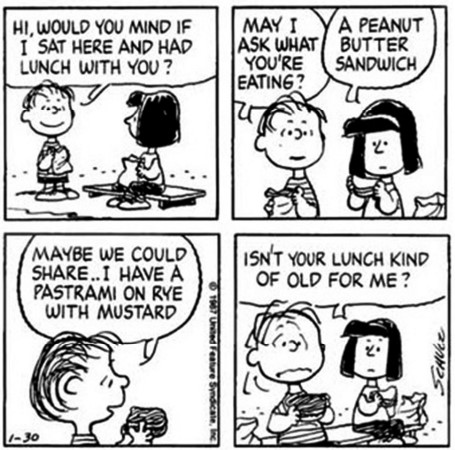
Charles Schulz. Peanuts. January 30, 1987. Internet: <www.gocomics.com> (adapted).
Certain words are cognates across English and Portuguese, while some are false cognates. Considering these two languages and text 7A1-I, it is correct to affirm that the words “lunch” (first panel), “sandwich” (second panel) and “mustard” (third panel) are, respectively,
Provas
Caderno Container