Foram encontradas 40 questões.
Disciplina: TI - Sistemas Operacionais
Banca: CESGRANRIO
Orgão: Transpetro
Provas

Disciplina: TI - Sistemas Operacionais
Banca: CESGRANRIO
Orgão: Transpetro
Uma das funções principais de um sistema operacional é controlar todos os dispositivos de E/S (entrada/saída) de um computador. Sobre as formas como a E/S pode ser feita do ponto de vista dos sistemas operacionais, considere as seguintes afirmativas.
I - Na E/S programada, a CPU principal lê ou escreve cada byte ou palavra e espera em um laço até que ela possa obter ou enviar o próximo dado.
II - Na E/S orientada a interrupção, a CPU inicia uma transferência de E/S para um caractere ou palavra e segue para outra atividade até que uma interrupção sinalize a conclusão daquela E/S.
III - Na E/S que usa DMA, um chip separado gerencia a transferência completa de um bloco de dados, ocorrendo uma interrupção somente quando o bloco for totalmente transferido.
Está(ão) correta(s) a(s) afirmativa(s):
Provas
Disciplina: TI - Sistemas Operacionais
Banca: CESGRANRIO
Orgão: Transpetro
- Fundamentos de Sistemas OperacionaisArquitetura de Sistemas Operacionais
- Fundamentos de Sistemas OperacionaisKernelEstrutura Monolítica
Provas
Disciplina: TI - Redes de Computadores
Banca: CESGRANRIO
Orgão: Transpetro
A tabela abaixo apresenta a configuração de quatro computadores (A, B, C e D) conectados fisicamente a uma rede, sendo que todos apresentam máscara de sub-rede 255.255.255.0.
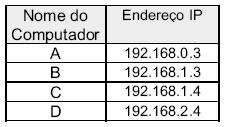
Considerando o tráfego de pacotes entre estes computadores pode-se afirmar que:
Provas
Disciplina: TI - Redes de Computadores
Banca: CESGRANRIO
Orgão: Transpetro
Provas
Disciplina: TI - Redes de Computadores
Banca: CESGRANRIO
Orgão: Transpetro
- Equipamentos de RedeHub
- Gerenciamento de RedesSNMP: Simple Network Management Protocol
- Protocolos e ServiçosTransferência de Arquivos
Quanto às redes de computadores, são feitas as afirmativas abaixo.
I - O protocolo SNMP utiliza o protocolo UDP e permite remotamente solucionar problemas e monitorar hubs e roteadores.
II - O NFS implementa o acesso transparente de arquivo utilizando o protocolo RPC, sendo este utilizado para a comunicação entre processos em diferentes computadores da rede.
III - Uma rede local de computadores ligados a um hub através de conexões 10Base-T apresenta topologia física de barra e lógica em anel.
Está(ão) correta(s) a(s) afirmativa(s):
Provas
Disciplina: TI - Desenvolvimento de Sistemas
Banca: CESGRANRIO
Orgão: Transpetro
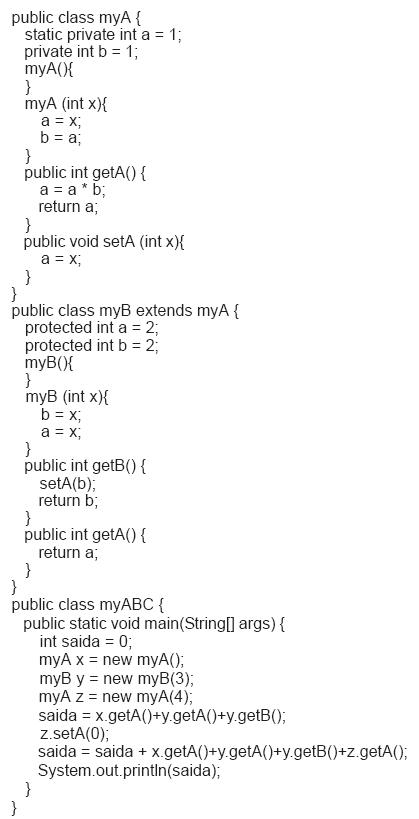
Supondo que a classe "myABC" possa ser executada com sucesso, o valor apresentado como saída pelo comando "System.out.println(saída);", quando a classe "myABC" é executada sem receber nenhum parâmetro, é:
Provas
Disciplina: TI - Desenvolvimento de Sistemas
Banca: CESGRANRIO
Orgão: Transpetro
Provas
applied an impressive array of innovative technologies to
improve productivity and efficiency, while yielding
environmental benefits. According to the U.S. Department
of Energy, "the petroleum business has transformed itself
into a high-technology industry."
State-of-the-art technology allows the industry to
produce more oil and natural gas from more remote
places - some previously unreachable - with significantly
less adverse effect on the environment. Among the
benefits: increased supply to meet the world's growing
energy demand, reduced energy consumption at oil and
natural gas facilities and refineries, reduced noise from
operations, decreased size of facilities, reduced
emissions of pollutants, better protection of water
resources, and preservation of habitats and wildlife.
With advanced exploration and production
technologies, the oil and gas industry can pinpoint
resources more accurately, extract them more efficiently
and with less surface disturbance, minimize associated
wastes, and, ultimately, restore sites to original or better
condition.
Exploration and production advances include
advanced directional drilling, slimhole drilling, and 3-D
seismic technology. Other segments of the industry have
benefited from technological advances as well. Refineries
are becoming highly automated with integrated process
and energy system controls; this results in improved
operational and environmental performance and enables
refineries to run harder and produce more products safer
than ever before. Also, new process equipment and
catalyst technology advances have been made very
recently to meet new fuel regulations requiring very low
levels of sulfur in gasoline and diesel.
Technology advances such as these are making it
possible for the oil and natural gas industry to grow in
tandem with the nation's energy needs while maintaining
a cleaner environment. The industry is committed to
investing in advanced technologies that will continue to
provide affordable and reliable energy to support our
current quality of life, and expand our economic horizons.
For example, we are researching fuel cells that may
power the vehicles of tomorrow with greater efficiency
and less environmental impact. We are investigating ways
to tap the huge natural gas resources locked in gas
hydrates. Gas hydrates are common in sediments in
the ocean's deep waters where cold temperatures and
high pressures cause natural gas and water to freeze
together, forming solid gas hydrates. Gas hydrates could
be an important future source of natural gas for our nation.
Some of our companies are also investigating
renewable energy resources such as solar, wind,
biomass and geothermal energy. By conducting research
into overcoming the many technological hurdles that limit
these energy resources, they hope to make them more
reliable, affordable and convenient for future use. Although
the potential for these energy resources is great,
scientists do not expect them to be a significant part of
the nation's energy mix for many decades. For this
reason, the industry must continue to invest in
conventional resources such as oil and natural gas. We
will need to rely on these important energy resources for
many decades to come.
Provas
applied an impressive array of innovative technologies to
improve productivity and efficiency, while yielding
environmental benefits. According to the U.S. Department
of Energy, "the petroleum business has transformed itself
into a high-technology industry."
State-of-the-art technology allows the industry to
produce more oil and natural gas from more remote
places - some previously unreachable - with significantly
less adverse effect on the environment. Among the
benefits: increased supply to meet the world's growing
energy demand, reduced energy consumption at oil and
natural gas facilities and refineries, reduced noise from
operations, decreased size of facilities, reduced
emissions of pollutants, better protection of water
resources, and preservation of habitats and wildlife.
With advanced exploration and production
technologies, the oil and gas industry can pinpoint
resources more accurately, extract them more efficiently
and with less surface disturbance, minimize associated
wastes, and, ultimately, restore sites to original or better
condition.
Exploration and production advances include
advanced directional drilling, slimhole drilling, and 3-D
seismic technology. Other segments of the industry have
benefited from technological advances as well. Refineries
are becoming highly automated with integrated process
and energy system controls; this results in improved
operational and environmental performance and enables
refineries to run harder and produce more products safer
than ever before. Also, new process equipment and
catalyst technology advances have been made very
recently to meet new fuel regulations requiring very low
levels of sulfur in gasoline and diesel.
Technology advances such as these are making it
possible for the oil and natural gas industry to grow in
tandem with the nation's energy needs while maintaining
a cleaner environment. The industry is committed to
investing in advanced technologies that will continue to
provide affordable and reliable energy to support our
current quality of life, and expand our economic horizons.
For example, we are researching fuel cells that may
power the vehicles of tomorrow with greater efficiency
and less environmental impact. We are investigating ways
to tap the huge natural gas resources locked in gas
hydrates. Gas hydrates are common in sediments in
the ocean's deep waters where cold temperatures and
high pressures cause natural gas and water to freeze
together, forming solid gas hydrates. Gas hydrates could
be an important future source of natural gas for our nation.
Some of our companies are also investigating
renewable energy resources such as solar, wind,
biomass and geothermal energy. By conducting research
into overcoming the many technological hurdles that limit
these energy resources, they hope to make them more
reliable, affordable and convenient for future use. Although
the potential for these energy resources is great,
scientists do not expect them to be a significant part of
the nation's energy mix for many decades. For this
reason, the industry must continue to invest in
conventional resources such as oil and natural gas. We
will need to rely on these important energy resources for
many decades to come.
Provas
Caderno Container