Magna Concursos

Foram encontradas 248 questões.

TEXT II


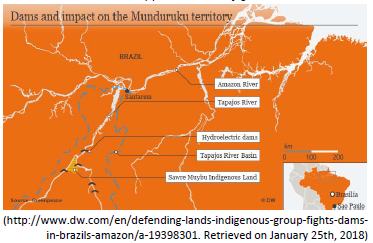
Brazil's mega hydro plan foreshadows China's growing impact on the Amazon

by Jonathan Watts

Thu 5 Oct ‘17 06.45 BST

Last modified on Mon 27 Nov ‘17 15.56 GMT

The government wants to open up the Tapajós basin – an area the size of France – for trade with China. But the indigenous Munduruku won’t let it happen without a fight
Enunciado 1087141-1

Crashing upstream through the São Luiz rapids, the churning river throws the speedboat around like a child’s toy. There is first a moment of fear, then relief and finally wonder at crossing a natural boundary that has held back the destruction of this corner of the Amazon for almost five centuries.

This is the gateway to a land that indigenous inhabitants call Mundurukania, after their tribe, the Munduruku, which has settled the middle and upper reaches of the Rio Tapajós since ancient times. The thickly vegetated shores, misty hills and untamed waters – breached at one point by a dolphin – mark it out as one of the few regions of the planet still to be explored and exploited by industrial commerce.

The tranquillity is breathtaking, but misleading. These rapids are now on the frontline of one of the world’s most important struggles for indigenous rights and environmental protection. Long ignored, they are suddenly seen as a strategically crucial step between the nations with the world’s biggest farms – Brazil – and the world’s most numerous dining tables – China. Longer term, the changes now being planned could bring this waterway closer to the industrialised, traffic-filled Yangtze in more ways than one.

Over the coming years, the Brazilian government – backed by Chinese and European finance and engineering – wants to turn this river into the world’s biggest grain canal by building 49 major dams on the Tapajós and its tributaries.

This would make the rapids navigable by barges carrying produce from the deforested cerrado savanna of Mato Grosso – which produces a third of the world’s soya – up to the giant container port being planned in the closest city of Santarém and then out to global markets, particularly in Asia.

The network of dams would also produce 29gW of electricity, increasing Brazil’s current supply by 25%. A consortium headed by Furnas – a subsidiary of the state-run energy utility Electrobras – plans to sell the power to distant cities and to local mining companies that want to unearth the mineral riches under the forest.

For the Brazilian government, this mega-scheme to open up the Tapajós basin – which is roughly the area of France – is a linchpin of national economic development and trade with China. For local politicians, it is an opportunity to industrialise, expand and enrich the business of nearby cities, which expect their populations to double in size over the next 10 years.

For opponents, however, the “hydrovia” – as the river transport scheme is known – and related projects are the biggest threat ever posed to the native inhabitants, traditional riverine communities, waters and wildlife. By one estimate, 950,000 hectares of forest would be cleared, releasing significant amounts of carbon dioxide.

(Source: https://www.theguardian.com/world/2017/oct/05/brazilamazon-tapajos-hydrovia-scheme. Retrieved on January 11th, 2018)

Text II discusses issues related to the opening up of the Tapajós basin for trade. Based on the text, analyse the following statements:

I. The Brazilian government is willing to build the dams without any international investment.

II. Local politicians believe the project may bring economic development to the region.

III. There might be considerable environmental impact if the plan is carried out.

Choose the correct answer:


Provas

Questão presente nas seguintes provas

TEXT I


In Europe, Weber still rules

Statecrafting

Jul 13, 2016

Steven Van de Walle

Enunciado 1087140-1

After 30 years of public administration reform in European countries inspired by New Public Management ideas, traditional Weberian administration still is the main organizing principle. This is the picture that emerges from a large-scale survey among the entire population of top civil servants in 18 European countries. The findings have now been published in our book — Public Administration Reforms in Europe: The View from the Top.

True, many tools and management practices associated with the NPM such as staff performance talks or management by objectives have become very common. Across all countries, the almost 7000 top civil servants we surveyed list achieving results and ensuring an efficient use of resources among the most important roles they have. They are also in agreement that, compared to five years ago, the public sector has made major progress in terms of efficiency and service quality — two main objectives of the NPM.

There are ‘NPM champions’ — countries that have gone further than others in reforming the Weberian state. Think the UK or the Netherlands, where public employment is increasingly normalised, and delivery contracted out. But even there, the structures of traditional public administration remain firmly in place.

Some elements of the NPM are still mainly absent from current management practice in European countries. Internal steering by contract is not very common, and performance related pay is very rare despite the popularity in reform talk. The weak presence of flexible employment also shows that the Weberian model still dominates. Despite attempts to normalize public employment in some countries, civil servants still enjoy a unique statute. We also observed this during the fiscal crisis, where outright firing permanent civil servants or cutting salaries has been relatively rare.

For civil servants, referring issues upwards in the hierarchy is still the dominant response in situations when responsibilities or interests conflict with that of other organisations. European top civil servants consider the impartial implementation of laws and rules as one of their dominant roles, and largely prefer state provision of services over market provision, with the exception of the British, Danish, and Dutch.

There are clear country differences, with management ‘champions’ such as the UK, Estonia, Norway and the Netherlands, and more legalistic and traditional public administrations such as in Austria, France, Germany, Hungary and Spain. The adoption of newer reform ideas suggest that the Weberian state may now be in decline. Yet some of the other findings of the survey, reported above, show that Weberianism’s main ideas are still deeply embedded in European countries.

(Source: https://statecrafting.net/in-europe-weber-still-rulesa851866dbf02. Retrieved on January 21st, 2018)

The word “True” in “True, many tools and management practices associated with the NPM” has the same function as
 

Provas

Questão presente nas seguintes provas

TEXT I


In Europe, Weber still rules

Statecrafting

Jul 13, 2016

Steven Van de Walle

Enunciado 1087139-1

After 30 years of public administration reform in European countries inspired by New Public Management ideas, traditional Weberian administration still is the main organizing principle. This is the picture that emerges from a large-scale survey among the entire population of top civil servants in 18 European countries. The findings have now been published in our book — Public Administration Reforms in Europe: The View from the Top.

True, many tools and management practices associated with the NPM such as staff performance talks or management by objectives have become very common. Across all countries, the almost 7000 top civil servants we surveyed list achieving results and ensuring an efficient use of resources among the most important roles they have. They are also in agreement that, compared to five years ago, the public sector has made major progress in terms of efficiency and service quality — two main objectives of the NPM.

There are ‘NPM champions’ — countries that have gone further than others in reforming the Weberian state. Think the UK or the Netherlands, where public employment is increasingly normalised, and delivery contracted out. But even there, the structures of traditional public administration remain firmly in place.

Some elements of the NPM are still mainly absent from current management practice in European countries. Internal steering by contract is not very common, and performance related pay is very rare despite the popularity in reform talk. The weak presence of flexible employment also shows that the Weberian model still dominates. Despite attempts to normalize public employment in some countries, civil servants still enjoy a unique statute. We also observed this during the fiscal crisis, where outright firing permanent civil servants or cutting salaries has been relatively rare.

For civil servants, referring issues upwards in the hierarchy is still the dominant response in situations when responsibilities or interests conflict with that of other organisations. European top civil servants consider the impartial implementation of laws and rules as one of their dominant roles, and largely prefer state provision of services over market provision, with the exception of the British, Danish, and Dutch.

There are clear country differences, with management ‘champions’ such as the UK, Estonia, Norway and the Netherlands, and more legalistic and traditional public administrations such as in Austria, France, Germany, Hungary and Spain. The adoption of newer reform ideas suggest that the Weberian state may now be in decline. Yet some of the other findings of the survey, reported above, show that Weberianism’s main ideas are still deeply embedded in European countries.

(Source: https://statecrafting.net/in-europe-weber-still-rulesa851866dbf02. Retrieved on January 21st, 2018)

The word “Despite” in the sentence “Despite attempts to normalize public employment in some countries” indicates
 

Provas

Questão presente nas seguintes provas

TEXT I


In Europe, Weber still rules

Statecrafting

Jul 13, 2016

Steven Van de Walle

Enunciado 1087138-1

After 30 years of public administration reform in European countries inspired by New Public Management ideas, traditional Weberian administration still is the main organizing principle. This is the picture that emerges from a large-scale survey among the entire population of top civil servants in 18 European countries. The findings have now been published in our book — Public Administration Reforms in Europe: The View from the Top.

True, many tools and management practices associated with the NPM such as staff performance talks or management by objectives have become very common. Across all countries, the almost 7000 top civil servants we surveyed list achieving results and ensuring an efficient use of resources among the most important roles they have. They are also in agreement that, compared to five years ago, the public sector has made major progress in terms of efficiency and service quality — two main objectives of the NPM.

There are ‘NPM champions’ — countries that have gone further than others in reforming the Weberian state. Think the UK or the Netherlands, where public employment is increasingly normalised, and delivery contracted out. But even there, the structures of traditional public administration remain firmly in place.

Some elements of the NPM are still mainly absent from current management practice in European countries. Internal steering by contract is not very common, and performance related pay is very rare despite the popularity in reform talk. The weak presence of flexible employment also shows that the Weberian model still dominates. Despite attempts to normalize public employment in some countries, civil servants still enjoy a unique statute. We also observed this during the fiscal crisis, where outright firing permanent civil servants or cutting salaries has been relatively rare.

For civil servants, referring issues upwards in the hierarchy is still the dominant response in situations when responsibilities or interests conflict with that of other organisations. European top civil servants consider the impartial implementation of laws and rules as one of their dominant roles, and largely prefer state provision of services over market provision, with the exception of the British, Danish, and Dutch.

There are clear country differences, with management ‘champions’ such as the UK, Estonia, Norway and the Netherlands, and more legalistic and traditional public administrations such as in Austria, France, Germany, Hungary and Spain. The adoption of newer reform ideas suggest that the Weberian state may now be in decline. Yet some of the other findings of the survey, reported above, show that Weberianism’s main ideas are still deeply embedded in European countries.

(Source: https://statecrafting.net/in-europe-weber-still-rulesa851866dbf02. Retrieved on January 21st, 2018)

Mark the statements below as true (T) or false (F) according to Text I.

( ) Internal steering by contract and performance related pay are two main ideas that come from Weber.

( ) Weberian ideals now belong to the past and are only used for historical interest.

( ) Employment flexibility is one of the tenets of the New Public Management.

The correct sequence is:


Provas

Questão presente nas seguintes provas

TEXT I


In Europe, Weber still rules

Statecrafting

Jul 13, 2016

Steven Van de Walle

Enunciado 1087137-1

After 30 years of public administration reform in European countries inspired by New Public Management ideas, traditional Weberian administration still is the main organizing principle. This is the picture that emerges from a large-scale survey among the entire population of top civil servants in 18 European countries. The findings have now been published in our book — Public Administration Reforms in Europe: The View from the Top.

True, many tools and management practices associated with the NPM such as staff performance talks or management by objectives have become very common. Across all countries, the almost 7000 top civil servants we surveyed list achieving results and ensuring an efficient use of resources among the most important roles they have. They are also in agreement that, compared to five years ago, the public sector has made major progress in terms of efficiency and service quality — two main objectives of the NPM.

There are ‘NPM champions’ — countries that have gone further than others in reforming the Weberian state. Think the UK or the Netherlands, where public employment is increasingly normalised, and delivery contracted out. But even there, the structures of traditional public administration remain firmly in place.

Some elements of the NPM are still mainly absent from current management practice in European countries. Internal steering by contract is not very common, and performance related pay is very rare despite the popularity in reform talk. The weak presence of flexible employment also shows that the Weberian model still dominates. Despite attempts to normalize public employment in some countries, civil servants still enjoy a unique statute. We also observed this during the fiscal crisis, where outright firing permanent civil servants or cutting salaries has been relatively rare.

For civil servants, referring issues upwards in the hierarchy is still the dominant response in situations when responsibilities or interests conflict with that of other organisations. European top civil servants consider the impartial implementation of laws and rules as one of their dominant roles, and largely prefer state provision of services over market provision, with the exception of the British, Danish, and Dutch.

There are clear country differences, with management ‘champions’ such as the UK, Estonia, Norway and the Netherlands, and more legalistic and traditional public administrations such as in Austria, France, Germany, Hungary and Spain. The adoption of newer reform ideas suggest that the Weberian state may now be in decline. Yet some of the other findings of the survey, reported above, show that Weberianism’s main ideas are still deeply embedded in European countries.

(Source: https://statecrafting.net/in-europe-weber-still-rulesa851866dbf02. Retrieved on January 21st, 2018)

Text I compares New Public Management and Weberian administration. In this respect, analyse the following statements.

I. The findings reported are not very telling as the sample israther small.

II. Some countries have made more progress than others in implementing NPM.

III. The British, Danish, and Dutch showed a preference towards market provision.

Choose the correct answer:


Provas

Questão presente nas seguintes provas

READ TEXT II AND ANSWER TO THE QUESTION.


TEXT II


Blockchain: An opportunity for accountants? Or a threat?


Enunciado 1087136-1

(Source: https://www.multirede.com.br/wpcontent/uploads/2017/09/blcokchain2.png. Retrieved on January 25th 2018)
By Ken Tysiac
November 17, 2017
The emergence of blockchain technology has led to a concern in the CPA profession that is perfectly understandable.
Technological advances can threaten people’s livelihoods in any number of professions. The development of the Internet had a devastating effect on newspaper journalists, and some experts say self-driving vehicles may cause huge job losses among truck drivers.
Blockchain, meanwhile, has implications for the accounting profession. Blockchain is a digital ledger on which transactions are recorded chronologically and can be viewed by all who have access. The technology is expected to affect auditing, cybersecurity, and financial planning and analysis.
Erik Asgeirsson, president and CEO of CPA.com, the technology arm of the AICPA, said that some CPAs have anxiety that blockchain might put audit professionals out of business. But while blockchain is likely to change the way CPAs work, he said, he is telling accounting firm leaders that the accounting profession can continue to thrive through the use of blockchain technology.
“It’s going to be a fantastic, secure database that will have uses,” he said during a panel presentation Tuesday at the Wall Street Blockchain Alliance’s Blockchain for Wall Street education day in New York City. “But it’s not going to put them out of work.”
Large and medium-size CPA firms already are seeing the implications of blockchain for their clients, Amy Pawlicki, CPA, vice president–Assurance & Advisory Innovation for the Association of International Certified Professional Accountants, said during the panel session. Companies are implementing blockchain into their enterprise resource planning (ERP) systems, particularly for tasks such as procurement and supplier management.
Blockchain’s ledger-based technology can simplify the procurement process because it enables secure recording of transactions in a way that can lead to unprecedented transparency and increased operational efficiency.
“Our auditors are already auditing transactions in the blockchain,” Pawlicki said.
Blockchain’s transparency gives visibility to all transactions for approved users, and this may decrease auditors’ work with sampling and validating transactions. But this allows auditors more time to focus on controls and investigating anomalies. Meanwhile, opportunities are emerging for CPAs to use blockchain technology as they expand their assurance services to areas such as cybersecurity and sustainability.
“We’ve got a lot of work to do … it’s a great opportunity in an area where CPAs can add a lot of value,” Pawlicki said.
An important next step for the profession in the use of blockchain is accommodations for the technology from standard setters and regulators. SEC Chief Accountant Wesley Bricker, CPA, J.D, said Tuesday that the commission’s Office of the Chief Accountant is investing time in understanding blockchain technologies, and suggested that accounting professionals do the same.
“It is important that those in the accounting profession invest the time to understand new trends and developments in technology and commerce to identify their potential effects on financial reporting to investors,” Bricker said during a speech at a Financial Executives International conference in New York City.
Past developments such as the emergence of computers, ERP systems, and cloud computing have merely changed CPAs’ work instead of making them irrelevant. The same can be true with blockchain, Asgeirsson said.
“Through every phase,” Asgeirsson said, “what’s really happened is that the accountant’s and the auditor’s role has just evolved.”
(Source:https://www.journalofaccountancy.com/news/2017/nov/blockch ain-opportunity-for-accountants-201717900.html. Retrieved on January 22nd, 2018)
Glossary:
CEO: Chief Executive Officer
CPA: Certified Public Accountant
ERP: Enterprise Resource Planning
AICPA: American Institute of Certified Public Accountants
During the panel presentation in New York, Erik Asgeirsson showed to be
 

Provas

Questão presente nas seguintes provas

READ TEXT II AND ANSWER TO THE QUESTION.


TEXT II


Blockchain: An opportunity for accountants? Or a threat?


Enunciado 1087135-1

(Source: https://www.multirede.com.br/wpcontent/uploads/2017/09/blcokchain2.png. Retrieved on January 25th 2018)
By Ken Tysiac
November 17, 2017
The emergence of blockchain technology has led to a concern in the CPA profession that is perfectly understandable.
Technological advances can threaten people’s livelihoods in any number of professions. The development of the Internet had a devastating effect on newspaper journalists, and some experts say self-driving vehicles may cause huge job losses among truck drivers.
Blockchain, meanwhile, has implications for the accounting profession. Blockchain is a digital ledger on which transactions are recorded chronologically and can be viewed by all who have access. The technology is expected to affect auditing, cybersecurity, and financial planning and analysis.
Erik Asgeirsson, president and CEO of CPA.com, the technology arm of the AICPA, said that some CPAs have anxiety that blockchain might put audit professionals out of business. But while blockchain is likely to change the way CPAs work, he said, he is telling accounting firm leaders that the accounting profession can continue to thrive through the use of blockchain technology.
“It’s going to be a fantastic, secure database that will have uses,” he said during a panel presentation Tuesday at the Wall Street Blockchain Alliance’s Blockchain for Wall Street education day in New York City. “But it’s not going to put them out of work.”
Large and medium-size CPA firms already are seeing the implications of blockchain for their clients, Amy Pawlicki, CPA, vice president–Assurance & Advisory Innovation for the Association of International Certified Professional Accountants, said during the panel session. Companies are implementing blockchain into their enterprise resource planning (ERP) systems, particularly for tasks such as procurement and supplier management.
Blockchain’s ledger-based technology can simplify the procurement process because it enables secure recording of transactions in a way that can lead to unprecedented transparency and increased operational efficiency.
“Our auditors are already auditing transactions in the blockchain,” Pawlicki said.
Blockchain’s transparency gives visibility to all transactions for approved users, and this may decrease auditors’ work with sampling and validating transactions. But this allows auditors more time to focus on controls and investigating anomalies. Meanwhile, opportunities are emerging for CPAs to use blockchain technology as they expand their assurance services to areas such as cybersecurity and sustainability.
“We’ve got a lot of work to do … it’s a great opportunity in an area where CPAs can add a lot of value,” Pawlicki said.
An important next step for the profession in the use of blockchain is accommodations for the technology from standard setters and regulators. SEC Chief Accountant Wesley Bricker, CPA, J.D, said Tuesday that the commission’s Office of the Chief Accountant is investing time in understanding blockchain technologies, and suggested that accounting professionals do the same.
“It is important that those in the accounting profession invest the time to understand new trends and developments in technology and commerce to identify their potential effects on financial reporting to investors,” Bricker said during a speech at a Financial Executives International conference in New York City.
Past developments such as the emergence of computers, ERP systems, and cloud computing have merely changed CPAs’ work instead of making them irrelevant. The same can be true with blockchain, Asgeirsson said.
“Through every phase,” Asgeirsson said, “what’s really happened is that the accountant’s and the auditor’s role has just evolved.”
(Source:https://www.journalofaccountancy.com/news/2017/nov/blockch ain-opportunity-for-accountants-201717900.html. Retrieved on January 22nd, 2018)
Glossary:
CEO: Chief Executive Officer
CPA: Certified Public Accountant
ERP: Enterprise Resource Planning
AICPA: American Institute of Certified Public Accountants
The sentence that warns about the harmful effects advances in technology may bring is:
 

Provas

Questão presente nas seguintes provas

READ TEXT II AND ANSWER TO THE QUESTION.


TEXT II


Blockchain: An opportunity for accountants? Or a threat?


Enunciado 1087134-1

(Source: https://www.multirede.com.br/wpcontent/uploads/2017/09/blcokchain2.png. Retrieved on January 25th 2018)
By Ken Tysiac
November 17, 2017
The emergence of blockchain technology has led to a concern in the CPA profession that is perfectly understandable.
Technological advances can threaten people’s livelihoods in any number of professions. The development of the Internet had a devastating effect on newspaper journalists, and some experts say self-driving vehicles may cause huge job losses among truck drivers.
Blockchain, meanwhile, has implications for the accounting profession. Blockchain is a digital ledger on which transactions are recorded chronologically and can be viewed by all who have access. The technology is expected to affect auditing, cybersecurity, and financial planning and analysis.
Erik Asgeirsson, president and CEO of CPA.com, the technology arm of the AICPA, said that some CPAs have anxiety that blockchain might put audit professionals out of business. But while blockchain is likely to change the way CPAs work, he said, he is telling accounting firm leaders that the accounting profession can continue to thrive through the use of blockchain technology.
“It’s going to be a fantastic, secure database that will have uses,” he said during a panel presentation Tuesday at the Wall Street Blockchain Alliance’s Blockchain for Wall Street education day in New York City. “But it’s not going to put them out of work.”
Large and medium-size CPA firms already are seeing the implications of blockchain for their clients, Amy Pawlicki, CPA, vice president–Assurance & Advisory Innovation for the Association of International Certified Professional Accountants, said during the panel session. Companies are implementing blockchain into their enterprise resource planning (ERP) systems, particularly for tasks such as procurement and supplier management.
Blockchain’s ledger-based technology can simplify the procurement process because it enables secure recording of transactions in a way that can lead to unprecedented transparency and increased operational efficiency.
“Our auditors are already auditing transactions in the blockchain,” Pawlicki said.
Blockchain’s transparency gives visibility to all transactions for approved users, and this may decrease auditors’ work with sampling and validating transactions. But this allows auditors more time to focus on controls and investigating anomalies. Meanwhile, opportunities are emerging for CPAs to use blockchain technology as they expand their assurance services to areas such as cybersecurity and sustainability.
“We’ve got a lot of work to do … it’s a great opportunity in an area where CPAs can add a lot of value,” Pawlicki said.
An important next step for the profession in the use of blockchain is accommodations for the technology from standard setters and regulators. SEC Chief Accountant Wesley Bricker, CPA, J.D, said Tuesday that the commission’s Office of the Chief Accountant is investing time in understanding blockchain technologies, and suggested that accounting professionals do the same.
“It is important that those in the accounting profession invest the time to understand new trends and developments in technology and commerce to identify their potential effects on financial reporting to investors,” Bricker said during a speech at a Financial Executives International conference in New York City.
Past developments such as the emergence of computers, ERP systems, and cloud computing have merely changed CPAs’ work instead of making them irrelevant. The same can be true with blockchain, Asgeirsson said.
“Through every phase,” Asgeirsson said, “what’s really happened is that the accountant’s and the auditor’s role has just evolved.”
(Source:https://www.journalofaccountancy.com/news/2017/nov/blockch ain-opportunity-for-accountants-201717900.html. Retrieved on January 22nd, 2018)
Glossary:
CEO: Chief Executive Officer
CPA: Certified Public Accountant
ERP: Enterprise Resource Planning
AICPA: American Institute of Certified Public Accountants
The title of Text II introduces a
 

Provas

Questão presente nas seguintes provas

READ TEXT II AND ANSWER TO THE QUESTION.


TEXT II


Blockchain: An opportunity for accountants? Or a threat?


Enunciado 1087133-1

(Source: https://www.multirede.com.br/wpcontent/uploads/2017/09/blcokchain2.png. Retrieved on January 25th 2018)
By Ken Tysiac
November 17, 2017
The emergence of blockchain technology has led to a concern in the CPA profession that is perfectly understandable.
Technological advances can threaten people’s livelihoods in any number of professions. The development of the Internet had a devastating effect on newspaper journalists, and some experts say self-driving vehicles may cause huge job losses among truck drivers.
Blockchain, meanwhile, has implications for the accounting profession. Blockchain is a digital ledger on which transactions are recorded chronologically and can be viewed by all who have access. The technology is expected to affect auditing, cybersecurity, and financial planning and analysis.
Erik Asgeirsson, president and CEO of CPA.com, the technology arm of the AICPA, said that some CPAs have anxiety that blockchain might put audit professionals out of business. But while blockchain is likely to change the way CPAs work, he said, he is telling accounting firm leaders that the accounting profession can continue to thrive through the use of blockchain technology.
“It’s going to be a fantastic, secure database that will have uses,” he said during a panel presentation Tuesday at the Wall Street Blockchain Alliance’s Blockchain for Wall Street education day in New York City. “But it’s not going to put them out of work.”
Large and medium-size CPA firms already are seeing the implications of blockchain for their clients, Amy Pawlicki, CPA, vice president–Assurance & Advisory Innovation for the Association of International Certified Professional Accountants, said during the panel session. Companies are implementing blockchain into their enterprise resource planning (ERP) systems, particularly for tasks such as procurement and supplier management.
Blockchain’s ledger-based technology can simplify the procurement process because it enables secure recording of transactions in a way that can lead to unprecedented transparency and increased operational efficiency.
“Our auditors are already auditing transactions in the blockchain,” Pawlicki said.
Blockchain’s transparency gives visibility to all transactions for approved users, and this may decrease auditors’ work with sampling and validating transactions. But this allows auditors more time to focus on controls and investigating anomalies. Meanwhile, opportunities are emerging for CPAs to use blockchain technology as they expand their assurance services to areas such as cybersecurity and sustainability.
“We’ve got a lot of work to do … it’s a great opportunity in an area where CPAs can add a lot of value,” Pawlicki said.
An important next step for the profession in the use of blockchain is accommodations for the technology from standard setters and regulators. SEC Chief Accountant Wesley Bricker, CPA, J.D, said Tuesday that the commission’s Office of the Chief Accountant is investing time in understanding blockchain technologies, and suggested that accounting professionals do the same.
“It is important that those in the accounting profession invest the time to understand new trends and developments in technology and commerce to identify their potential effects on financial reporting to investors,” Bricker said during a speech at a Financial Executives International conference in New York City.
Past developments such as the emergence of computers, ERP systems, and cloud computing have merely changed CPAs’ work instead of making them irrelevant. The same can be true with blockchain, Asgeirsson said.
“Through every phase,” Asgeirsson said, “what’s really happened is that the accountant’s and the auditor’s role has just evolved.”
(Source:https://www.journalofaccountancy.com/news/2017/nov/blockch ain-opportunity-for-accountants-201717900.html. Retrieved on January 22nd, 2018)
Glossary:
CEO: Chief Executive Officer
CPA: Certified Public Accountant
ERP: Enterprise Resource Planning
AICPA: American Institute of Certified Public Accountants
Text II discusses the implications of blockchain for the accounting profession. Based on the arguments presented, analyse the following statements:
I. New technologies have affected CPA’s work but not its relevance. II. Blockchain technology will allow CPAs to shift their attention to other areas. III. Accounting professionals should not waste time trying to understand new technologies.
Choose the correct answer:
 

Provas

Questão presente nas seguintes provas

READ TEXT I AND ANSWER TO THE QUESTION.


TEXT I


Enunciado 1087132-1

(Source: http://cpa-scribo.com/assess-control-risk/. Retrieved on January 27th, 2018)

The Challenges Facing Government Auditors
Posted on July 26, 2013

When it comes to the pressure of successfully identifying, anticipating and dealing with risks, few auditors shoulder as much burden as those who work with the government. As the Institute of Internal Auditors’ Richard Chambers wrote, these professionals deal with career-threatening political risks on a daily basis that many private sector auditors could never comprehend.
Internal auditors play a pivotal role in the relationship between the government and citizens. It’s up to auditors to set the appropriate controls to manage federal programs and also to provide insight into the effectiveness and the soundness of the government’s inner workings. Put simply, auditors are key to ensuring the public’s trust in their government is well-founded and not abused.
That being said, there are a number of challenges associated with governmental-level internal auditing. Citing a MicKinsey paper from 2011, Chambers points to a few key issues:
1. Turnover and Outsiders: Turnover in the political sector is high, with appointed executives seldom lasting for more than two years. On top of that, newly appointed officials often come from outside departments or agencies. This means officials frequently don’t have a firm grasp on all the risks and challenges associated with their position, which can lead to poor decision making.
2. Metrics for Success: In the private sector, business objectives are clear and are conducive to metrics: more sales, more customers, more revenue, return on investment, etc. This means it’s extremely easy to determine the efficiency of audit programs and controls. In the public sphere, metrics aren’t as obvious because financial and mission objectives are more complex. This complicates the job immensely.
3. ‘Mission Over Risk’ Mindset: Most companies undervalue the importance of risk culture. Departments want to achieve their objectives, and risk management takes a back seat to that. In the public sector, officials are often even more dedicated to and passionate about the mission at hand. Additionally, people tend to assume that government budgets are big enough to bail departments out of bad decisions, which can lead to risky behaviors. […]
Internal controls are pivotal to maintaining the public trust in government operations, so despite the challenges that lay in front of auditors, it’s crucial they work with managers to develop effective campaigns and programs.
(Adapted from: https://www.resolver.com/blog/the-challenges-facinggovernment-auditors/. Retrieved on January 25th, 2018)
The last paragraph states that, when developing campaigns and programs, auditors should not work
 

Provas

Questão presente nas seguintes provas