Foram encontradas 40 questões.
Language Learning Strategies
Strategies in language learning, or the steps that one takes to learn a language, are very important in ultimate language performance. It is defined as “specific actions, behaviors, steps, or techniques — such as seeking out conversation partners or giving oneself encouragement to tackle a difficult language task — used by students to enhance their own learning”. There are six strategies that learners use when learning a language. The strategies include:
1. Memory; 2. Cognitive; 3. Comprehension; 4. Metacognitive; 5. Affective; 6. Social.
Let’s examine some of them:
Memory strategy
People who adopt the memory strategy depend on their memorizing ability. They find ways to remember better to aid in entering information into long-term memory, by creating a word-meaning map in their brain (mental linkages), and then being able to retrieve that information. Adopting this strategy will allow the learning and retrieval via sounds (e.g., rhyming), images (e.g., a mental picture of the word itself or the meaning of the word), a combination of sounds and images (e.g., the keyword method), body movement (e.g., total physical response), mechanical means (e.g., flashcards), or location (e.g., on a page or blackboard).
Things they do: Do a lot of exercises on English grammar. Create a word bank from your reading materials or TV shows and memorize the meaning of the words and try to use them.
Cognitive strategy
People who adopt the cognitive strategy tend to analyse and reason. They form internal mental codes and revise them to receive and produce the message in the target language. Adopting this strategy will enable you to internalize the language in direct ways such as through reasoning, analysis, note-taking, summarizing, synthesizing, outlining, practicing in naturalistic settings, and practicing structures and sounds formally.
Comprehension strategy
People who adopt the comprehension strategy find themselves guessing unknown words when listening and reading. They also try to replace words they do not know with longer phrases or other words that they know when speaking and writing to overcome gaps in knowledge.
Things they do: Try to guess the meaning of words they don’t know. Try to understand the meaning through looking at the word in context. Guess the meaning of some words by reading the whole passage. Try to look for cues or nonverbal signs when in conversation.
Metacognitive strategy
People who adopt the metacognitive strategy plan, arrange, focus, evaluate on their own learning process. They identify and monitor their own learning style preferences and needs, such as gathering and organizing L2 materials, arranging a study space and a schedule for L2 revision and learning, monitoring mistakes made in L2, and evaluating task success, and evaluating the success of any type of learning strategy.
Things they do: Observe how the SL teacher speaks in the SL. Observe how they themselves speak in the SL. Practice speaking in SL in front of the mirror. Crosscheck with Google to find out if their pronunciation is correct, and correct it. Doing crossword puzzles and play word games like scrabble. Take note of how other people communicate in SL, especially natives.
Social/Affective strategy
People who adopt the social/affective strategy control their feelings, motivations and attitudes when in social situations such as asking questions, communicating with others, facilitate conversation and interaction.
Things they do: They encourage themselves to speak in SL even when they are afraid of making a mistake. They reward themselves for good performance. They remind themselves that it is okay to make mistakes. They tell themselves to be confident and not be afraid to make mistakes. They try to speak in SL to others. They ask for clarifications of a confusing point of the L2, or when communicating. They ask people to correct their speech when communicating.
Available at: https://blogs.ntu.edu.sg/hss-second-language-
acquisition/wiki/chapter-17/ Acess: 17 de may de 2022.
(Adapted).
Language Learning Strategies
Strategies in language learning, or the steps that one takes to learn a language, are very important in ultimate language performance. It is defined as “specific actions, behaviors, steps, or techniques — such as seeking out conversation partners or giving oneself encouragement to tackle a difficult language task — used by students to enhance their own learning”. There are six strategies that learners use when learning a language. The strategies include:
1. Memory; 2. Cognitive; 3. Comprehension; 4. Metacognitive; 5. Affective; 6. Social.
Let’s examine some of them:
Memory strategy
People who adopt the memory strategy depend on their memorizing ability. They find ways to remember better to aid in entering information into long-term memory, by creating a word-meaning map in their brain (mental linkages), and then being able to retrieve that information. Adopting this strategy will allow the learning and retrieval via sounds (e.g., rhyming), images (e.g., a mental picture of the word itself or the meaning of the word), a combination of sounds and images (e.g., the keyword method), body movement (e.g., total physical response), mechanical means (e.g., flashcards), or location (e.g., on a page or blackboard).
Things they do: Do a lot of exercises on English grammar. Create a word bank from your reading materials or TV shows and memorize the meaning of the words and try to use them.
Cognitive strategy
People who adopt the cognitive strategy tend to analyse and reason. They form internal mental codes and revise them to receive and produce the message in the target language. Adopting this strategy will enable you to internalize the language in direct ways such as through reasoning, analysis, note-taking, summarizing, synthesizing, outlining, practicing in naturalistic settings, and practicing structures and sounds formally.
Comprehension strategy
People who adopt the comprehension strategy find themselves guessing unknown words when listening and reading. They also try to replace words they do not know with longer phrases or other words that they know when speaking and writing to overcome gaps in knowledge.
Things they do: Try to guess the meaning of words they don’t know. Try to understand the meaning through looking at the word in context. Guess the meaning of some words by reading the whole passage. Try to look for cues or nonverbal signs when in conversation.
Metacognitive strategy
People who adopt the metacognitive strategy plan, arrange, focus, evaluate on their own learning process. They identify and monitor their own learning style preferences and needs, such as gathering and organizing L2 materials, arranging a study space and a schedule for L2 revision and learning, monitoring mistakes made in L2, and evaluating task success, and evaluating the success of any type of learning strategy.
Things they do: Observe how the SL teacher speaks in the SL. Observe how they themselves speak in the SL. Practice speaking in SL in front of the mirror. Crosscheck with Google to find out if their pronunciation is correct, and correct it. Doing crossword puzzles and play word games like scrabble. Take note of how other people communicate in SL, especially natives.
Social/Affective strategy
People who adopt the social/affective strategy control their feelings, motivations and attitudes when in social situations such as asking questions, communicating with others, facilitate conversation and interaction.
Things they do: They encourage themselves to speak in SL even when they are afraid of making a mistake. They reward themselves for good performance. They remind themselves that it is okay to make mistakes. They tell themselves to be confident and not be afraid to make mistakes. They try to speak in SL to others. They ask for clarifications of a confusing point of the L2, or when communicating. They ask people to correct their speech when communicating.
Available at: https://blogs.ntu.edu.sg/hss-second-language-
acquisition/wiki/chapter-17/ Acess: 17 de may de 2022.
(Adapted).
When using the metacognitive strategy, people
Provas

INSTRUCTIONS: Read the text carefully and then mark the alternatives that answer the questions or complete the sentences presented after questions 33, 34 and 35.
Language Learning Strategies
Strategies in language learning, or the steps that one takes to learn a language, are very important in ultimate language performance. It is defined as “specific actions, behaviors, steps, or techniques — such as seeking out conversation partners or giving oneself encouragement to tackle a difficult language task — used by students to enhance their own learning”. There are six strategies that learners use when learning a language. The strategies include:
1. Memory; 2. Cognitive; 3. Comprehension; 4. Metacognitive; 5. Affective; 6. Social.
Let’s examine some of them:
Memory strategy
People who adopt the memory strategy depend on their memorizing ability. They find ways to remember better to aid in entering information into long-term memory, by creating a word-meaning map in their brain (mental linkages), and then' being able to retrieve that information. Adopting this strategy will allow the learning and retrieval via sounds (e.g., rhyming), images (e.g., a mental picture of the word itself or the meaning of the word), a combination of sounds and images (e.g., the keyword method), body movement (e.g., total physical response), mechanical means (e.g., flashcards), or location (e.g., on a page or blackboard).
Things they do: Do a lot of exercises on English grammar. Create a word bank from your reading materials or TV shows and memorize the meaning of the words and try to use them.
Cognitive strategy
People who adopt the cognitive strategy tend to analyse and reason. They form internal mental codes and revise them to receive and produce the message in the target language. Adopting this strategy will enable you to internalize the language in direct ways such as through reasoning, analysis, note-taking, summarizing, synthesizing, outlining, practicing in naturalistic settings, and practicing structures and sounds formally.
Comprehension strategy
People who adopt the comprehension strategy find themselves guessing unknown words when listening and reading. They also try to replace words they do not know with longer phrases or other words that they know when speaking and writing to overcome gaps in knowledge.
Things they do: Try to guess the meaning of words they don’t know. Try to understand the meaning through looking at the word in context. Guess the meaning of some words by reading the whole passage. Try to look for cues or nonverbal signs when in conversation.
Metacognitive strategy
People who adopt the metacognitive strategy plan, arrange, focus, evaluate on their own learning process. They identify and monitor their own learning style preferences and needs, such as gathering and organizing L2 materials, arranging a study space and a schedule for L2 revision and learning, monitoring mistakes made in L2, and evaluating task success, and evaluating the success of any type of learning strategy.
Things they do: Observe how the SL teacher speaks in the SL. Observe how they themselves speak in the SL. Practice speaking in SL in front of the mirror. Crosscheck with Google to find out if their pronunciation is correct, and correct it. Doing crossword puzzles and play word games like scrabble. Take note of how other people communicate in SL, especially natives.
Social/Affective strategy
People who adopt the social/affective strategy control their feelings, motivations and attitudes when in social situations such as asking questions, communicating with others, facilitate conversation and interaction.
Things they do: They encourage themselves to speak in SL even when they are afraid of making a mistake. They reward themselves for good performance. They remind themselves that it is okay to make mistakes. They tell themselves to be confident and not be afraid to make mistakes. They try to speak in SL to others. They ask for clarifications of a confusing point of the L2, or when communicating. They ask people to correct their speech when communicating.
Available at: https://blogs.ntu.edu.sg/hss-second-languageacquisition/wiki/chapter-17/ Acess: 17 de may de 2022. (Adapted).
When using the metacognitive strategy, people
Provas
INSTRUCTIONS: Read the text carefully and then mark the alternatives that answer the questions or complete the sentences presented after questions 33, 34 and 35.
Language Learning Strategies
Strategies in language learning, or the steps that one takes to learn a language, are very important in ultimate language performance. It is defined as “specific actions, behaviors, steps, or techniques — such as seeking out conversation partners or giving oneself encouragement to tackle a difficult language task — used by students to enhance their own learning”. There are six strategies that learners use when learning a language. The strategies include:
1. Memory; 2. Cognitive; 3. Comprehension; 4. Metacognitive; 5. Affective; 6. Social.
Let’s examine some of them:
Memory strategy
People who adopt the memory strategy depend on their memorizing ability. They find ways to remember better to aid in entering information into long-term memory, by creating a word-meaning map in their brain (mental linkages), and then' being able to retrieve that information. Adopting this strategy will allow the learning and retrieval via sounds (e.g., rhyming), images (e.g., a mental picture of the word itself or the meaning of the word), a combination of sounds and images (e.g., the keyword method), body movement (e.g., total physical response), mechanical means (e.g., flashcards), or location (e.g., on a page or blackboard).
Things they do: Do a lot of exercises on English grammar. Create a word bank from your reading materials or TV shows and memorize the meaning of the words and try to use them.
Cognitive strategy
People who adopt the cognitive strategy tend to analyse and reason. They form internal mental codes and revise them to receive and produce the message in the target language. Adopting this strategy will enable you to internalize the language in direct ways such as through reasoning, analysis, note-taking, summarizing, synthesizing, outlining, practicing in naturalistic settings, and practicing structures and sounds formally.
Comprehension strategy
People who adopt the comprehension strategy find themselves guessing unknown words when listening and reading. They also try to replace words they do not know with longer phrases or other words that they know when speaking and writing to overcome gaps in knowledge.
Things they do: Try to guess the meaning of words they don’t know. Try to understand the meaning through looking at the word in context. Guess the meaning of some words by reading the whole passage. Try to look for cues or nonverbal signs when in conversation.
Metacognitive strategy
People who adopt the metacognitive strategy plan, arrange, focus, evaluate on their own learning process. They identify and monitor their own learning style preferences and needs, such as gathering and organizing L2 materials, arranging a study space and a schedule for L2 revision and learning, monitoring mistakes made in L2, and evaluating task success, and evaluating the success of any type of learning strategy.
Things they do: Observe how the SL teacher speaks in the SL. Observe how they themselves speak in the SL. Practice speaking in SL in front of the mirror. Crosscheck with Google to find out if their pronunciation is correct, and correct it. Doing crossword puzzles and play word games like scrabble. Take note of how other people communicate in SL, especially natives.
Social/Affective strategy
People who adopt the social/affective strategy control their feelings, motivations and attitudes when in social situations such as asking questions, communicating with others, facilitate conversation and interaction.
Things they do: They encourage themselves to speak in SL even when they are afraid of making a mistake. They reward themselves for good performance. They remind themselves that it is okay to make mistakes. They tell themselves to be confident and not be afraid to make mistakes. They try to speak in SL to others. They ask for clarifications of a confusing point of the L2, or when communicating. They ask people to correct their speech when communicating.
Available at: https://blogs.ntu.edu.sg/hss-second-languageacquisition/wiki/chapter-17/ Acess: 17 de may de 2022. (Adapted).
The device of trying to guess the meaning of a word by understanding it in the context of the sentence or paragraph can be considered as
Provas
INSTRUCTIONS: Read the following text and then answer the questions or complete the sentences presented in questions 31 and 32.
A Task-based approach
Task-based learning offers an alternative for language teachers. In a task-based lesson the teacher doesn’t predetermine what language will be studied, the lesson is based around the completion of a central task and the language studied is determined by what happens as the students complete it. The lesson follows certain stages.
Pre-task
The teacher introduces the topic and gives the students clear instructions on what they will have to do at the task stage and might help the students to recall some language that may be useful for the task. The pre-task stage can also often include playing a recording of people doing the task. This gives the students a clear model of what will be expected of them. The students can take notes and spend time preparing for the task.
Task
The students complete a task in pairs or groups using the language resources that they have as the teacher monitors and offers encouragement
Planning
Students prepare a short oral or written report to tell the class what happened during their task. They then practise what they are going to say in their groups. Meanwhile the teacher is available for the students to ask for advice to clear up any language questions they may have.
Report
Students then report back to the class orally or read the written report. The teacher chooses the order of when students will present their reports and may give the students some quick feedback on the content. At this stage the teacher may also play a recording of others doing the same task for the students to compare.
Analysis
The teacher then highlights relevant parts from the text of the recording for the students to analyse. They may ask students to notice interesting features within this text. The teacher can also highlight the language that the students used during the report phase for analysis.
Practice
Finally, the teacher selects language areas to practise based upon the needs of the students and what emerged from the task and report phases. The students then do practice activities to increase their confidence and make a note of useful language.
The advantages of TBL
Task-based learning has some clear advantages
• The students are free of language control. In all three stages they must use all their language resources rather than just practising one preselected item.
• A natural context is developed from the students’ experiences with the language that is personalised and relevant to them.
• The students will have a much more varied exposure to language with TBL. They will be exposed to a whole range of lexical phrases, collocations and patterns as well as language forms.
• The language explored arises from the students’ needs. This need dictates what will be covered in the lesson rather than a decision made by the teacher or the coursebook.
• It is a strong communicative approach where students spend a lot of time communicating. Just watch how much time the students spend communicating during a task-based lesson.
• It is enjoyable and motivating.
Richard Frost, British Council, Turkey
Available at: https://www.teachingenglish.org.uk. Accessed on August 10th, 2019. (Adapted).
Among the advantages of a task-based lesson, we cannot list:
Provas
INSTRUCTIONS: Read the following text and then answer the questions or complete the sentences presented in questions 31 and 32.
A Task-based approach
Task-based learning offers an alternative for language teachers. In a task-based lesson the teacher doesn’t predetermine what language will be studied, the lesson is based around the completion of a central task and the language studied is determined by what happens as the students complete it. The lesson follows certain stages.
Pre-task
The teacher introduces the topic and gives the students clear instructions on what they will have to do at the task stage and might help the students to recall some language that may be useful for the task. The pre-task stage can also often include playing a recording of people doing the task. This gives the students a clear model of what will be expected of them. The students can take notes and spend time preparing for the task.
Task
The students complete a task in pairs or groups using the language resources that they have as the teacher monitors and offers encouragement
Planning
Students prepare a short oral or written report to tell the class what happened during their task. They then practise what they are going to say in their groups. Meanwhile the teacher is available for the students to ask for advice to clear up any language questions they may have.
Report
Students then report back to the class orally or read the written report. The teacher chooses the order of when students will present their reports and may give the students some quick feedback on the content. At this stage the teacher may also play a recording of others doing the same task for the students to compare.
Analysis
The teacher then highlights relevant parts from the text of the recording for the students to analyse. They may ask students to notice interesting features within this text. The teacher can also highlight the language that the students used during the report phase for analysis.
Practice
Finally, the teacher selects language areas to practise based upon the needs of the students and what emerged from the task and report phases. The students then do practice activities to increase their confidence and make a note of useful language.
The advantages of TBL
Task-based learning has some clear advantages
• The students are free of language control. In all three stages they must use all their language resources rather than just practising one preselected item.
• A natural context is developed from the students’ experiences with the language that is personalised and relevant to them.
• The students will have a much more varied exposure to language with TBL. They will be exposed to a whole range of lexical phrases, collocations and patterns as well as language forms.
• The language explored arises from the students’ needs. This need dictates what will be covered in the lesson rather than a decision made by the teacher or the coursebook.
• It is a strong communicative approach where students spend a lot of time communicating. Just watch how much time the students spend communicating during a task-based lesson.
• It is enjoyable and motivating.
Richard Frost, British Council, Turkey
Available at: https://www.teachingenglish.org.uk. Accessed on August 10th, 2019. (Adapted).
In a task-based lesson,
Provas
Leia o texto a seguir para responder à questão.

A variação linguística na sentença “Tive tempo ainda não” é de característica
Provas
Leia o texto a seguir para responder à questão.
A sentença “Leu essa notícia, querida?!” deve ser reescrita, de modo a adequá-la à norma-padrão, porém sem modificação do sentido original da tirinha, da seguinte maneira:
Provas
Leia o texto a seguir para responder à questão.
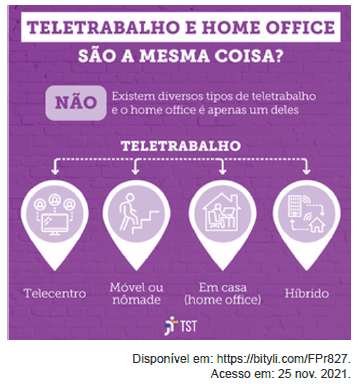
Analise as afirmativas a seguir.
I. Na sentença: “Existem diversos tipos de trabalho e o home office é apenas um deles”, há um erro de concordância verbal, pois o verbo “existir” está como sinônimo de “haver” e, portanto, sendo impessoal, não deveria sofrer flexão.
II. “Teletrabalho” e “telecentro” são lexias formadas a partir do processo de composição.
III. A sentença “Teletrabalho e home office são a mesma coisa?” é uma oração subordinada substantiva.
Estão incorretas as afirmativas
Provas
Leia o texto a seguir para responder à questão.
São características do gênero textual cartaz, exceto:
Provas
- OrtografiaEmprego do Hífen
- OrtografiaPontuaçãoDois-pontos
- OrtografiaPontuaçãoParênteses
- OrtografiaPontuaçãoVírgula
INSTRUÇÃO: Leia o texto a seguir para responder às questões de 1 a 6.
-
Pesquisa do Ipea mostra a evolução do mercado de trabalho durante a pandemia
Análise revela como os grupos de ocupados, afastados temporariamente, desocupados e desalentados se comportaram em meio à crise
-
O Instituto de Pesquisa Econômica Aplicada (Ipea) divulgou nesta sexta-feira (6), a Análise das Transições no Mercado de Trabalho Brasileiro no Período da Covid-19. O estudo avalia os impactos da pandemia sobre os fluxos de entrada e saída dos indivíduos nas várias possíveis situações no mercado de trabalho: estar trabalhando, afastamento temporário, desocupação e inatividade. A pesquisa tomou como base os microdados da Pnad Contínua e da Pnad Covid-19, divulgadas pelo Instituto Brasileiro de Geografia e Estatística (IBGE).
-
De acordo com os resultados apresentados, a probabilidade de um indivíduo que estava trabalhando no primeiro trimestre de 2020 continuar nessa condição no segundo foi de apenas 73,8%, contra 89% em 2018 e 2019. Os fluxos da condição de estar trabalhando para as condições de afastamento temporário ou inatividade, por sua vez, foram muito superiores aos valores observados no biênio anterior: 13,1% transitaram para o afastamento (contra cerca de 1,5% em 2018-19) e 9,3% para a inatividade (contra 6,3% em 2018 e 5,8% em 2019). Os fluxos na direção da desocupação também aumentaram em relação aos anos anteriores, mas de forma menos expressiva: 3,8% em 2020, contra 3,4% em 2018 e 2019.
-
O documento mostra que os níveis de ocupação e participação na força de trabalho caíram fortemente a partir de março e abril deste ano (apontado como o pior momento da crise). A partir de maio, houve uma rápida recuperação dos principais indicadores econômicos. Mas a pandemia levou muitas pessoas em idade ativa a deixarem de trabalhar e não procurarem emprego no segundo trimestre deste ano, tornando-se inativas. Diante do desalento e da concessão do auxílio emergencial, muitos indivíduos que teriam permanecido desocupados no segundo trimestre deste ano acabaram transitando para fora da força de trabalho.
-
Dos trabalhadores ocupados e não afastados no primeiro trimestre de 2020, a proporção que permaneceu nessa condição no segundo trimestre foi de cerca de 60% no setor privado informal, 68% no setor público informal e 67% entre os trabalhadores por conta própria. Em contrapartida, esse índice foi superior para os trabalhadores com carteira no setor privado (78%), para os empregados públicos CLT (79%) e para os militares e estatutários (77%).
-
O setor que registrou a menor proporção de permanência na condição de ocupado trabalhando entre o primeiro e o segundo trimestres de 2020 foi a construção civil (68,1%).
-
De acordo com dados da Pnad Covid, desde julho é crescente o número de trabalhadores que estão retornando para suas ocupações, em todos os segmentos pesquisados. Em termos agregados, o percentual de trabalhadores ocupados que foram afastados devido à pandemia caiu de 18,7% em maio deste ano para 3,7% em setembro de 2020.
-
Os pesquisadores acreditam que, com a continuidade dos processos de flexibilização das restrições às atividades socioeconômicas e de recuperação do nível de atividade, e tendo em vista a redução do auxílio emergencial, o nível de ocupação deve aumentar até o final do ano. No entanto, é esperado que a taxa de participação no mercado de trabalho também aumente, fazendo com que a taxa de desocupação continue a elevar-se no curto prazo e mantenha-se em patamar alto por algum tempo.
-
Disponível em: https://bityli.com/PgZe0o. Acesso em: 22 abr. 2022 (adaptado).
Releia este trecho.
-
“O Instituto de Pesquisa Econômica Aplicada (Ipea) divulgou nesta sexta-feira (6), a Análise das Transições no Mercado de Trabalho Brasileiro no Período da Covid-19. O estudo avalia os impactos da pandemia sobre os fluxos de entrada e saída dos indivíduos nas várias possíveis situações no mercado de trabalho: estar trabalhando, afastamento temporário, desocupação e inatividade. A pesquisa tomou como base os microdados da Pnad Contínua e da Pnad Covid-19, divulgadas pelo Instituto Brasileiro de Geografia e Estatística (IBGE).
-
As pontuações elencadas nas alternativas a seguir estão corretas de acordo com a norma-padrão, exceto:
Provas
Caderno Container