Foram encontradas 80 questões.
INPUT- BASED STRATEGIES
Input based strategies rest on the idea that learning occurs primarily through exposure to language input in the form of written or spoken texts and language descriptions. Input is seen as a sine qua non of learning. Two distinct subcategories of input-based strategies can be identified. The first is premised on the idea that input is sufficient for learning and the second on the idea that input needs to be followed by student output for learning to occur. In this strategy, students are primarily provided with language input inasmuch as exposure to it is understood to promote learning. Learning comes about as the students see evidence (sometimes also termed positive evidence) of how language works or how language is used in workplace, academic, or professional target environments. Students do not need to be pushed into immediate production in order to learn.
(BASTURKMEN, H. Ideas and options in English for specific purposes. Mahwah: Lawrence Erlbaum Associates, Inc., Publishers, 2006. pp.114-115)
“In this strategy, students are primarily provided with language input inasmuch as exposure to it is understood to promote learning” (line 5). In this excerpt, the highlighted expression is a textual element of cohesion. It can be explained by one of the alternatives below. Check it.
Provas

INPUT- BASED STRATEGIES
Input based strategies rest on the idea that learning occurs primarily through exposure to language input in the form of written or spoken texts and language descriptions. Input is seen as a sine qua non of learning. Two distinct subcategories of input-based strategies can be identified. The first is premised on the idea that input is sufficient for learning and the second on the idea that input needs to be followed by student output for learning to occur. In this strategy, students are primarily provided with language input inasmuch as exposure to it is understood to promote learning. Learning comes about as the students see evidence (sometimes also termed positive evidence) of how language works or how language is used in workplace, academic, or professional target environments. Students do not need to be pushed into immediate production in order to learn.
(BASTURKMEN, H. Ideas and options in English for specific purposes. Mahwah: Lawrence Erlbaum Associates, Inc., Publishers, 2006. pp.114-115)
Check the alternative that presents the discursive genre that best defines the text excerpt presented above:
Provas
INPUT- BASED STRATEGIES
Input based strategies rest on the idea that learning occurs primarily through exposure to language input in the form of written or spoken texts and language descriptions. Input is seen as a sine qua non of learning. Two distinct subcategories of input-based strategies can be identified. The first is premised on the idea that input is sufficient for learning and the second on the idea that input needs to be followed by student output for learning to occur. In this strategy, students are primarily provided with language input inasmuch as exposure to it is understood to promote learning. Learning comes about as the students see evidence (sometimes also termed positive evidence) of how language works or how language is used in workplace, academic, or professional target environments. Students do not need to be pushed into immediate production in order to learn.
(BASTURKMEN, H. Ideas and options in English for specific purposes. Mahwah: Lawrence Erlbaum Associates, Inc., Publishers, 2006. pp.114-115)
“In this strategy, students are primarily provided with language input inasmuch as exposure to it is understood to promote learning.” The best definition for the discourse marker “inasmuch as” and its communicative intention in the text that is expressed in:
Provas
INPUT- BASED STRATEGIES
Input based strategies rest on the idea that learning occurs primarily through exposure to language input in the form of written or spoken texts and language descriptions. Input is seen as a sine qua non of learning. Two distinct subcategories of input-based strategies can be identified. The first is premised on the idea that input is sufficient for learning and the second on the idea that input needs to be followed by student output for learning to occur. In this strategy, students are primarily provided with language input inasmuch as exposure to it is understood to promote learning. Learning comes about as the students see evidence (sometimes also termed positive evidence) of how language works or how language is used in workplace, academic, or professional target environments. Students do not need to be pushed into immediate production in order to learn.
(BASTURKMEN, H. Ideas and options in English for specific purposes. Mahwah: Lawrence Erlbaum Associates, Inc., Publishers, 2006. pp.114-115)
Check the alternative that represents the main idea of the text:
Provas
H. Douglas Brown, in his “Teaching by Principles” (2007), makes a quick history of the main language of teaching methods. Check below the definition given by the author to the “Direct Method”, considering its main features.
Provas
According to Prabhu (1987, p. 01), who stated that “the development of competence in a second language requires not systematization of language inputs or maximization of planned practice, but rather the creation of conditions in an effort to cope with communication”, only one of the following alternatives is correct. Check it.
Provas
Leia o seguinte trecho da letra da música “Trocando em miúdos” de Chico Buarque e Francis Hime, e assinale a alternativa que contém a figura de linguagem utilizada no texto.
“Devolva o Neruda que você me tomou
E nunca leu.
Fico com o disco do Pixinguinha, sim.
O resto é seu. ”
Chico Buarque e Francis. Chico Buarque: letra e música. São Paulo: Companhia das Letras, 1989, p. 173.
Provas
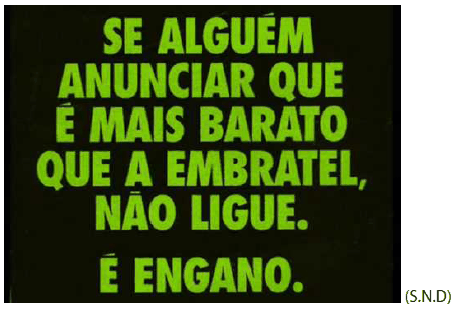
Analise o anúncio da empresa Embratel e assinale a alternativa correta:
Provas
O texto a seguir, de Luís Fernando Verissimo, focaliza de forma bem-humorada o modo como o marido se refere à mulher. Leia-o para responder à questão abaixo:
INIMIGOS
O apelido de Maria Teresa, para o Norberto, era “Quequinha”. Depois do casamento sempre que queria contar para os outros uma de sua mulher, o Norberto pegava sua mão carinhosamente, e começava:
- Pois a Quequinha...
E a Quequinha, dengosa, protestava.
- Ora, Beto!
Com o passar do tempo, o Norberto deixou de chamar a Maria Teresa de Quequinha. Se ela estivesse ao seu lado e ele quisesse se referir a ela, dizia:
- A mulher aqui...
Ou, às vezes:
- Esta mulherzinha...
Mas nunca mais Quequinha.
(O tempo, o tempo. O amor tem mil inimigos, mas o pior deles é o tempo. O tempo ataca em silêncio. O tempo usa armas químicas.)
Com o tempo, Norberto passou a tratar a mulher por “Ela”.
- Ela odeia o Charles Bronson.
- Ah, não gosto mesmo.
Deve-se dizer que o Norberto, a esta altura, embora a chamasse de Ela, ainda usava um vago gesto da mão para indicá-la. Pior foi quando passou a dizer “essa aí” e a apontar com o queixo.
- Essa aí...
E apontava com o queixo, até curvando a boca com um certo desdém.
(O tempo, o tempo. O tempo captura o amor e não o mata na hora. Vai tirando uma asa, depois a outra...)
Hoje, quando quer contar alguma coisa da mulher, o Norberto nem olha na sua direção. Faz um meneio de lado com a cabeça e diz:
- Aquilo...
(VERISSIMO, Luis Fernando. Novas comédias da vida privada. Porto Alegre: L&PM, 1996.)
Ainda com relação ao texto de Luís Fernando Verissimo, assinale a alternativa incorreta:
Provas
O texto a seguir, de Luís Fernando Verissimo, focaliza de forma bem-humorada o modo como o marido se refere à mulher. Leia-o para responder à questão abaixo:
INIMIGOS
O apelido de Maria Teresa, para o Norberto, era “Quequinha”. Depois do casamento sempre que queria contar para os outros uma de sua mulher, o Norberto pegava sua mão carinhosamente, e começava:
- Pois a Quequinha...
E a Quequinha, dengosa, protestava.
- Ora, Beto!
Com o passar do tempo, o Norberto deixou de chamar a Maria Teresa de Quequinha. Se ela estivesse ao seu lado e ele quisesse se referir a ela, dizia:
- A mulher aqui...
Ou, às vezes:
- Esta mulherzinha...
Mas nunca mais Quequinha.
(O tempo, o tempo. O amor tem mil inimigos, mas o pior deles é o tempo. O tempo ataca em silêncio. O tempo usa armas químicas.)
Com o tempo, Norberto passou a tratar a mulher por “Ela”.
- Ela odeia o Charles Bronson.
- Ah, não gosto mesmo.
Deve-se dizer que o Norberto, a esta altura, embora a chamasse de Ela, ainda usava um vago gesto da mão para indicá-la. Pior foi quando passou a dizer “essa aí” e a apontar com o queixo.
- Essa aí...
E apontava com o queixo, até curvando a boca com um certo desdém.
(O tempo, o tempo. O tempo captura o amor e não o mata na hora. Vai tirando uma asa, depois a outra...)
Hoje, quando quer contar alguma coisa da mulher, o Norberto nem olha na sua direção. Faz um meneio de lado com a cabeça e diz:
- Aquilo...
(VERISSIMO, Luis Fernando. Novas comédias da vida privada. Porto Alegre: L&PM, 1996.)
Diante da leitura do texto “Inimigos”, avalie as afirmativas abaixo:
I - os substantivos próprios Maria Teresa, Quequinha e mulher dão nome a um ser específico.
II - o substantivo comum mulher nomeia uma categoria de seres que têm em comum um conjunto de características (sexo, aparência, comportamento, hábitos etc.).
III - os pronomes ela, essa e aquilo são capazes de substituir os substantivos de modo a estabelecer, no contexto,
referência anafórica a Maria Teresa.
Assinale a alternativa correta:
Provas
Caderno Container