Foram encontradas 40 questões.
Use Text V to answer questions 26 to 32.
Text V
Literacy as a Multidimensional Concept
An emphasis on the development of literacy as a fluid concept (Knobel and Lankshear, 2014) is one of the most recent advances in twenty-first-century education. To conceptualize literacy, the ability of the learner to make use of language takes precedence in typical Western educational systems. However, as Kern highlights, “literacy is more than a set of academic skills” (2000, 23). It varies depending on the social context and is embedded in cultural practice (Paesani et al. 2016).
Therefore, in order to define it, we must take into consideration the set of resources, sociocultural practices and competences––beyond reading and writing––that enable student interaction, critical thinking, the drawing of conclusions and the application of knowledge to curricular areas and real-world situations (New London Group 1996; Kern 2000; American Association of School Librarians (AASL) 2011; Cooper et al. 2012; Kucer 2014; Paesani et al. 2016; Reyes-Torres 2018; Warner and Dupuy 2018). As such, the multimodal training approach that we propose for the FL class stems from Kern’s notion of literacy, first, “as a process of creating and transforming knowledge” (2000, 29), and second, “as a matter of engaging in the ever-developing process of using reading and writing as tools for thinking and learning, in order to expand one’s understanding of oneself and the world” (40). This involves paying careful attention to language, while also developing a critical awareness of the relationships between texts, images, discourse conventions and sociocultural and digital contexts.
In sum, and in consonance with Kern and other scholars such as the NLG (1996), Steve Kucer (2014), Maria Brisk (2015), Paesani et al. (2016) and Shari Tishman (2018), we define literacy as a dynamic and multidimensional concept whose main aim is to provide twenty-first-century learners with the language skills, visual thinking strategies and dialogic attitudes that are necessary to develop the knowledge that allows them to grasp and evaluate information, organize ideas, exchange perspectives, construct meaning and reflect critically on a variety of sociocultural contexts. In order to foster such a multidimensional approach to literacy in EFL and implement it as an organizing principle (Kress 2010; Serafini 2014), it is necessary that teachers become acquainted with the three dimensions that both Kern (2000) and Kucer (2014) acknowledge as the key components: a) cognitive; b) conceptual; and c) sociocultural.
These dimensions constitute a field of forces that complement one another and are equally important in the process of both teaching and learning, and they also illustrate the multiple facets and fluid nature of literacy.
Adapted from: FERNÁNDEZ, Teresa; REYES-TORRES, Agustín; FERNÁNDEZ, Pilar. A multimodal approach to foster the multiliteracies pedagogy in the English as a Foreign Language context. ATLANTIS: Journal of the Spanish Association of Anglo-American Studies, vol. 42, no. 1, pp. 94–119, 2020. Available at: https://www.atlantisjournal.org/index.php/atlantis/article/view/741. Accessed on: Mar. 21, 2025.
In “This involves paying careful attention to language, while also developing a critical awareness of the relationships between texts, images, discourse conventions and sociocultural and digital contexts”, select the correct alternative regarding the highlighted term “careful”.
Provas

Use Text V to answer questions 26 to 32.
Text V
Literacy as a Multidimensional Concept
An emphasis on the development of literacy as a fluid concept (Knobel and Lankshear, 2014) is one of the most recent advances in twenty-first-century education. To conceptualize literacy, the ability of the learner to make use of language takes precedence in typical Western educational systems. However, as Kern highlights, “literacy is more than a set of academic skills” (2000, 23). It varies depending on the social context and is embedded in cultural practice (Paesani et al. 2016).
Therefore, in order to define it, we must take into consideration the set of resources, sociocultural practices and competences––beyond reading and writing––that enable student interaction, critical thinking, the drawing of conclusions and the application of knowledge to curricular areas and real-world situations (New London Group 1996; Kern 2000; American Association of School Librarians (AASL) 2011; Cooper et al. 2012; Kucer 2014; Paesani et al. 2016; Reyes-Torres 2018; Warner and Dupuy 2018). As such, the multimodal training approach that we propose for the FL class stems from Kern’s notion of literacy, first, “as a process of creating and transforming knowledge” (2000, 29), and second, “as a matter of engaging in the ever-developing process of using reading and writing as tools for thinking and learning, in order to expand one’s understanding of oneself and the world” (40). This involves paying careful attention to language, while also developing a critical awareness of the relationships between texts, images, discourse conventions and sociocultural and digital contexts.
In sum, and in consonance with Kern and other scholars such as the NLG (1996), Steve Kucer (2014), Maria Brisk (2015), Paesani et al. (2016) and Shari Tishman (2018), we define literacy as a dynamic and multidimensional concept whose main aim is to provide twenty-first-century learners with the language skills, visual thinking strategies and dialogic attitudes that are necessary to develop the knowledge that allows them to grasp and evaluate information, organize ideas, exchange perspectives, construct meaning and reflect critically on a variety of sociocultural contexts. In order to foster such a multidimensional approach to literacy in EFL and implement it as an organizing principle (Kress 2010; Serafini 2014), it is necessary that teachers become acquainted with the three dimensions that both Kern (2000) and Kucer (2014) acknowledge as the key components: a) cognitive; b) conceptual; and c) sociocultural.
These dimensions constitute a field of forces that complement one another and are equally important in the process of both teaching and learning, and they also illustrate the multiple facets and fluid nature of literacy.
Adapted from: FERNÁNDEZ, Teresa; REYES-TORRES, Agustín; FERNÁNDEZ, Pilar. A multimodal approach to foster the multiliteracies pedagogy in the English as a Foreign Language context. ATLANTIS: Journal of the Spanish Association of Anglo-American Studies, vol. 42, no. 1, pp. 94–119, 2020. Available at: https://www.atlantisjournal.org/index.php/atlantis/article/view/741. Accessed on: Mar. 21, 2025.
Contextual clues such as definitions, examples, modifiers, relocation, parallel structures, connectors, and the repetition of keywords play a vital role in enhancing the flow and clarity of academic texts. In the Text V, the term 'however', present in the following excerpt, is used as one of these contextual clues. About it, select the correct alternative.
“An emphasis on the development of literacy as a fluid concept (Knobel and Lankshear (2014) is one of the most recent advances in twenty-first-century education. To conceptualize literacy, the ability of the learner to make use of language takes precedence in typical Western educational systems. However, as Kern highlights, “literacy is more than a set of academic skills” (2000, 23). It varies depending on the social context and is embedded in cultural practice (Paesani et al. 2016).”
Provas
Use Text V to answer questions 26 to 32.
Text V
Literacy as a Multidimensional Concept
An emphasis on the development of literacy as a fluid concept (Knobel and Lankshear, 2014) is one of the most recent advances in twenty-first-century education. To conceptualize literacy, the ability of the learner to make use of language takes precedence in typical Western educational systems. However, as Kern highlights, “literacy is more than a set of academic skills” (2000, 23). It varies depending on the social context and is embedded in cultural practice (Paesani et al. 2016).
Therefore, in order to define it, we must take into consideration the set of resources, sociocultural practices and competences––beyond reading and writing––that enable student interaction, critical thinking, the drawing of conclusions and the application of knowledge to curricular areas and real-world situations (New London Group 1996; Kern 2000; American Association of School Librarians (AASL) 2011; Cooper et al. 2012; Kucer 2014; Paesani et al. 2016; Reyes-Torres 2018; Warner and Dupuy 2018). As such, the multimodal training approach that we propose for the FL class stems from Kern’s notion of literacy, first, “as a process of creating and transforming knowledge” (2000, 29), and second, “as a matter of engaging in the ever-developing process of using reading and writing as tools for thinking and learning, in order to expand one’s understanding of oneself and the world” (40). This involves paying careful attention to language, while also developing a critical awareness of the relationships between texts, images, discourse conventions and sociocultural and digital contexts.
In sum, and in consonance with Kern and other scholars such as the NLG (1996), Steve Kucer (2014), Maria Brisk (2015), Paesani et al. (2016) and Shari Tishman (2018), we define literacy as a dynamic and multidimensional concept whose main aim is to provide twenty-first-century learners with the language skills, visual thinking strategies and dialogic attitudes that are necessary to develop the knowledge that allows them to grasp and evaluate information, organize ideas, exchange perspectives, construct meaning and reflect critically on a variety of sociocultural contexts. In order to foster such a multidimensional approach to literacy in EFL and implement it as an organizing principle (Kress 2010; Serafini 2014), it is necessary that teachers become acquainted with the three dimensions that both Kern (2000) and Kucer (2014) acknowledge as the key components: a) cognitive; b) conceptual; and c) sociocultural.
These dimensions constitute a field of forces that complement one another and are equally important in the process of both teaching and learning, and they also illustrate the multiple facets and fluid nature of literacy.
Adapted from: FERNÁNDEZ, Teresa; REYES-TORRES, Agustín; FERNÁNDEZ, Pilar. A multimodal approach to foster the multiliteracies pedagogy in the English as a Foreign Language context. ATLANTIS: Journal of the Spanish Association of Anglo-American Studies, vol. 42, no. 1, pp. 94–119, 2020. Available at: https://www.atlantisjournal.org/index.php/atlantis/article/view/741. Accessed on: Mar. 21, 2025.
The Text V discusses the essential dimensions identified by Kern (2000) and Kucer (2014) as foundational for a multidimensional approach to literacy in English as a Foreign Language (EFL). What is the role of these dimensions in the teaching and learning process?
Provas
Use Text V to answer questions 26 to 32.
Text V
Literacy as a Multidimensional Concept
An emphasis on the development of literacy as a fluid concept (Knobel and Lankshear, 2014) is one of the most recent advances in twenty-first-century education. To conceptualize literacy, the ability of the learner to make use of language takes precedence in typical Western educational systems. However, as Kern highlights, “literacy is more than a set of academic skills” (2000, 23). It varies depending on the social context and is embedded in cultural practice (Paesani et al. 2016).
Therefore, in order to define it, we must take into consideration the set of resources, sociocultural practices and competences––beyond reading and writing––that enable student interaction, critical thinking, the drawing of conclusions and the application of knowledge to curricular areas and real-world situations (New London Group 1996; Kern 2000; American Association of School Librarians (AASL) 2011; Cooper et al. 2012; Kucer 2014; Paesani et al. 2016; Reyes-Torres 2018; Warner and Dupuy 2018). As such, the multimodal training approach that we propose for the FL class stems from Kern’s notion of literacy, first, “as a process of creating and transforming knowledge” (2000, 29), and second, “as a matter of engaging in the ever-developing process of using reading and writing as tools for thinking and learning, in order to expand one’s understanding of oneself and the world” (40). This involves paying careful attention to language, while also developing a critical awareness of the relationships between texts, images, discourse conventions and sociocultural and digital contexts.
In sum, and in consonance with Kern and other scholars such as the NLG (1996), Steve Kucer (2014), Maria Brisk (2015), Paesani et al. (2016) and Shari Tishman (2018), we define literacy as a dynamic and multidimensional concept whose main aim is to provide twenty-first-century learners with the language skills, visual thinking strategies and dialogic attitudes that are necessary to develop the knowledge that allows them to grasp and evaluate information, organize ideas, exchange perspectives, construct meaning and reflect critically on a variety of sociocultural contexts. In order to foster such a multidimensional approach to literacy in EFL and implement it as an organizing principle (Kress 2010; Serafini 2014), it is necessary that teachers become acquainted with the three dimensions that both Kern (2000) and Kucer (2014) acknowledge as the key components: a) cognitive; b) conceptual; and c) sociocultural.
These dimensions constitute a field of forces that complement one another and are equally important in the process of both teaching and learning, and they also illustrate the multiple facets and fluid nature of literacy.
Adapted from: FERNÁNDEZ, Teresa; REYES-TORRES, Agustín; FERNÁNDEZ, Pilar. A multimodal approach to foster the multiliteracies pedagogy in the English as a Foreign Language context. ATLANTIS: Journal of the Spanish Association of Anglo-American Studies, vol. 42, no. 1, pp. 94–119, 2020. Available at: https://www.atlantisjournal.org/index.php/atlantis/article/view/741. Accessed on: Mar. 21, 2025.
According to the Text V, what is the proposed approach for the foreign language (FL) class?
Provas
Use Text V to answer questions 26 to 32.
Text V
Literacy as a Multidimensional Concept
An emphasis on the development of literacy as a fluid concept (Knobel and Lankshear, 2014) is one of the most recent advances in twenty-first-century education. To conceptualize literacy, the ability of the learner to make use of language takes precedence in typical Western educational systems. However, as Kern highlights, “literacy is more than a set of academic skills” (2000, 23). It varies depending on the social context and is embedded in cultural practice (Paesani et al. 2016).
Therefore, in order to define it, we must take into consideration the set of resources, sociocultural practices and competences––beyond reading and writing––that enable student interaction, critical thinking, the drawing of conclusions and the application of knowledge to curricular areas and real-world situations (New London Group 1996; Kern 2000; American Association of School Librarians (AASL) 2011; Cooper et al. 2012; Kucer 2014; Paesani et al. 2016; Reyes-Torres 2018; Warner and Dupuy 2018). As such, the multimodal training approach that we propose for the FL class stems from Kern’s notion of literacy, first, “as a process of creating and transforming knowledge” (2000, 29), and second, “as a matter of engaging in the ever-developing process of using reading and writing as tools for thinking and learning, in order to expand one’s understanding of oneself and the world” (40). This involves paying careful attention to language, while also developing a critical awareness of the relationships between texts, images, discourse conventions and sociocultural and digital contexts.
In sum, and in consonance with Kern and other scholars such as the NLG (1996), Steve Kucer (2014), Maria Brisk (2015), Paesani et al. (2016) and Shari Tishman (2018), we define literacy as a dynamic and multidimensional concept whose main aim is to provide twenty-first-century learners with the language skills, visual thinking strategies and dialogic attitudes that are necessary to develop the knowledge that allows them to grasp and evaluate information, organize ideas, exchange perspectives, construct meaning and reflect critically on a variety of sociocultural contexts. In order to foster such a multidimensional approach to literacy in EFL and implement it as an organizing principle (Kress 2010; Serafini 2014), it is necessary that teachers become acquainted with the three dimensions that both Kern (2000) and Kucer (2014) acknowledge as the key components: a) cognitive; b) conceptual; and c) sociocultural.
These dimensions constitute a field of forces that complement one another and are equally important in the process of both teaching and learning, and they also illustrate the multiple facets and fluid nature of literacy.
Adapted from: FERNÁNDEZ, Teresa; REYES-TORRES, Agustín; FERNÁNDEZ, Pilar. A multimodal approach to foster the multiliteracies pedagogy in the English as a Foreign Language context. ATLANTIS: Journal of the Spanish Association of Anglo-American Studies, vol. 42, no. 1, pp. 94–119, 2020. Available at: https://www.atlantisjournal.org/index.php/atlantis/article/view/741. Accessed on: Mar. 21, 2025.
In the Text V, the author refers to several scholars and organizations, such as Knobel and Lankshear (2014), Kern (2000), the New London Group (1996), and others. What is the author's main purpose in including these references throughout the text?
Provas
Texto I
Variação linguística
O termo variação se aplica a uma característica das línguas humanas que faz parte de sua própria natureza: a heterogeneidade. A palavra língua nos dá uma ilusão de uniformidade, de homogeneidade, que não corresponde aos fatos. Quando nos referimos ao português, ao francês, ao chinês, ao árabe etc., usamos um rótulo único para designar uma multiplicidade de modos de falar decorrente da multiplicidade das sociedades e das culturas em que as línguas são faladas. Cada um desses modos de falar recebe o nome de variedade linguística. Por isso, muitos autores definem língua como “um conjunto de variedades” e substituem a noção da língua como um sistema pela noção da língua como um polissistema, formado por essas múltiplas variedades.
A variação linguística se manifesta desde o nível mais elevado e coletivo – quando comparamos, por exemplo, o português falado em dois países diferentes (Brasil e Angola) – até o nível mais baixo e individual, quando observamos o modo de falar de uma única pessoa, a tal ponto que é possível dizer que o número de “línguas” num país é o mesmo de habitantes de seu território. Entre esses dois níveis extremos, a variação é observada em diversos outros níveis: grandes regiões, estados, regiões dentro dos estados, classes sociais, faixas etárias, níveis de renda, graus de escolarização, profissões, acesso às tecnologias de informação, usos escritos e usos falados.
A consciência de que a língua é variável remonta à Antiguidade, quando os primeiros estudiosos da língua grega tentaram sistematizá-la para o ensino e para a crítica literária. Eles, no entanto, fizeram uma avaliação negativa da variação, que viram como um obstáculo para a unificação territorial e para a difusão da língua. Foi nessa época (século III a.C.) que surgiu a disciplina chamada gramática, dedicada explicitamente a criar um modelo de língua que se elevasse acima da variação e servisse de instrumento de controle social por meio de um instrumento linguístico. A consequência cultural desse processo histórico é que o termo língua passou a ser usado, no senso comum, para rotular exclusivamente esse modelo idealizado, literário, enquanto todos os usos reais, principalmente falados, foram lançados à categoria do erro.
Com os avanços das ciências da linguagem, essa visão foi abandonada: o exame minucioso de cada variedade linguística revela que ela tem sua própria lógica gramatical, é tão regrada quanto a língua literária idealizada, e serve perfeitamente bem como recurso de interação e integração social para seus falantes. Diante disso, um novo projeto de educação linguística vem se formando: é preciso ampliar o repertório e a competência linguística dos aprendizes, levá-los a se apoderar da escrita e dos muitos gêneros discursivos associados a ela, sem contudo desprezar suas variedades linguísticas de origem, valorizando-as, ao contrário, como elementos formadores de sua identidade individual e social e como patrimônio cultural do país.
BAGNO, Marcos. Variação linguística. Glossário Ceale – Centro de Alfabetização, Leitura e Escrita. Universidade Federal de Minas Gerais, 2013. Disponível em: https://www.ceale.fae.ufmg.br/glossarioceale/verbetes/preconceitolinguistico. Acesso em: 21 mar. 2025.
Leia o Texto II, a seguir, para responder às questões 16 e 17.
Texto II
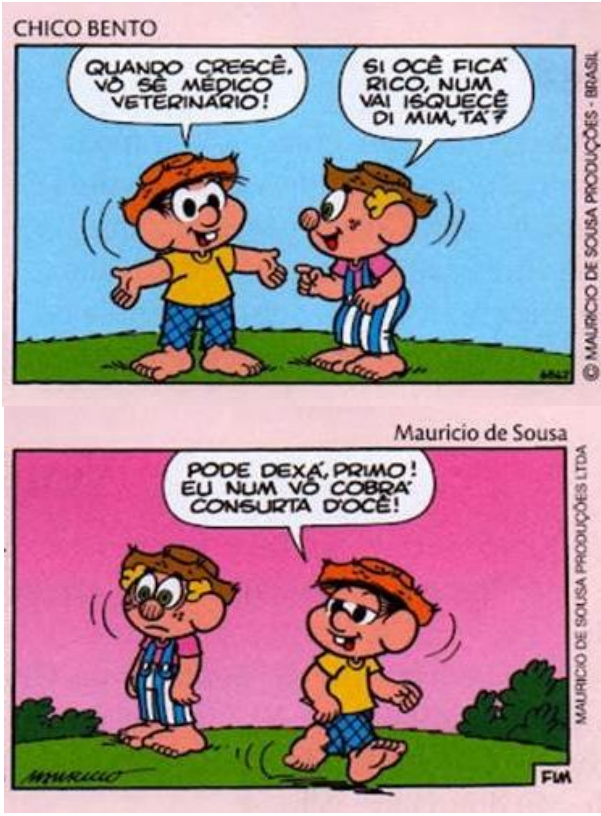
CHICO BENTO. Revista Chico Bento, n. 268, p. 5-6, 1997.
Considerando a relação entre os Textos I e II, assinale a alternativa correta.
Provas
Leia o Texto III, a seguir, para responder às questões de 19 a 22.
Texto III
Sabiá
(Chico Buarque e Tom Jobim)
Vou voltar
Sei que ainda vou voltar
Para o meu lugar
Foi lá e é ainda lá
Que eu hei de ouvir cantar
Uma sabiá
Vou voltar
Sei que ainda vou voltar
Vou deitar à sombra
De uma palmeira que já não há
Colher a flor que já não dá
E algum amor talvez
Possa espantar as noites
Que eu não queria
E anunciar o dia
Vou voltar
Sei que ainda vou voltar
Não vai ser em vão
Que fiz tantos planos
De me enganar
Como fiz enganos
De me encontrar
Como fiz estradas
De me perder
Fiz de tudo e nada
De te esquecer
Vou voltar
Sei que ainda vou voltar
E é pra ficar
Sei que o amor existe
Eu não sou mais triste
E que a nova vida
Já vai chegar
E que a solidão
Vai se acabar
Buarque, C. (s.d.). Sabiá. Disponível em: https://www.letras.mus.br/blog/sabia. Acesso em: 21 mar. 2025.
A intertextualidade é um dos fatores de textualidade e desempenha papel fundamental na construção de sentidos. Acerca desse assunto, analise as assertivas e assinale a alternativa que aponta as corretas.
I. A intertextualidade ocorre quando, em um texto, está inserido outro texto (intertexto) anteriormente produzido, que faz parte da memória social de uma coletividade ou da memória discursiva.
II. A intertextualidade explícita ocorre, por exemplo, por meio de citações, referências, menções, resumos, resenhas e traduções.
III. O plágio é um tipo particular de intertextualidade explícita, com valor de captação, no qual o produtor do texto espera (ou deseja) que o interlocutor não tenha na memória o intertexto e sua fonte.
IV. Nos casos de intertextualidade implícita, o produtor do texto espera que o leitor/ouvinte seja capaz de reconhecer a presença do intertexto, pela ativação do texto-fonte em sua memória discursiva, visto que, se tal não ocorrer, estará prejudicada a construção do sentido, particularmente no caso da subversão.
V. A canção Sabiá, de Chico Buarque e Tom Jobim, estabelece uma intertextualidade explícita com o poema Canção do Exílio, de Gonçalves Dias, ao evocar, em novo contexto histórico e poético, o desejo de retorno e pertencimento à terra natal.
Provas
Leia o Texto III, a seguir, para responder às questões de 19 a 22.
Texto III
Sabiá
(Chico Buarque e Tom Jobim)
Vou voltar
Sei que ainda vou voltar
Para o meu lugar
Foi lá e é ainda lá
Que eu hei de ouvir cantar
Uma sabiá
Vou voltar
Sei que ainda vou voltar
Vou deitar à sombra
De uma palmeira que já não há
Colher a flor que já não dá
E algum amor talvez
Possa espantar as noites
Que eu não queria
E anunciar o dia
Vou voltar
Sei que ainda vou voltar
Não vai ser em vão
Que fiz tantos planos
De me enganar
Como fiz enganos
De me encontrar
Como fiz estradas
De me perder
Fiz de tudo e nada
De te esquecer
Vou voltar
Sei que ainda vou voltar
E é pra ficar
Sei que o amor existe
Eu não sou mais triste
E que a nova vida
Já vai chegar
E que a solidão
Vai se acabar
Buarque, C. (s.d.). Sabiá. Disponível em: https://www.letras.mus.br/blog/sabia. Acesso em: 21 mar. 2025.
A linguagem utilizada na canção “Sabiá” constrói sentidos simbólicos, recorrendo a diversos recursos expressivos. O verso “fiz estradas de me perder”, por exemplo, é especialmente significativo nesse contexto. Sobre a figura de linguagem presente nesse verso, assinale a alternativa correta.
Provas
Leia o Texto III, a seguir, para responder às questões de 19 a 22.
Texto III
Sabiá
(Chico Buarque e Tom Jobim)
Vou voltar
Sei que ainda vou voltar
Para o meu lugar
Foi lá e é ainda lá
Que eu hei de ouvir cantar
Uma sabiá
Vou voltar
Sei que ainda vou voltar
Vou deitar à sombra
De uma palmeira que já não há
Colher a flor que já não dá
E algum amor talvez
Possa espantar as noites
Que eu não queria
E anunciar o dia
Vou voltar
Sei que ainda vou voltar
Não vai ser em vão
Que fiz tantos planos
De me enganar
Como fiz enganos
De me encontrar
Como fiz estradas
De me perder
Fiz de tudo e nada
De te esquecer
Vou voltar
Sei que ainda vou voltar
E é pra ficar
Sei que o amor existe
Eu não sou mais triste
E que a nova vida
Já vai chegar
E que a solidão
Vai se acabar
Buarque, C. (s.d.). Sabiá. Disponível em: https://www.letras.mus.br/blog/sabia. Acesso em: 21 mar. 2025.
No que tange aos seguintes versos retirados do Texto III, assinale a alternativa correta.
“Sei que o amor existe
Eu não sou mais triste
E que a nova vida
Já vai chegar”
Provas
Leia o Texto III, a seguir, para responder às questões de 19 a 22.
Texto III
Sabiá
(Chico Buarque e Tom Jobim)
Vou voltar
Sei que ainda vou voltar
Para o meu lugar
Foi lá e é ainda lá
Que eu hei de ouvir cantar
Uma sabiá
Vou voltar
Sei que ainda vou voltar
Vou deitar à sombra
De uma palmeira que já não há
Colher a flor que já não dá
E algum amor talvez
Possa espantar as noites
Que eu não queria
E anunciar o dia
Vou voltar
Sei que ainda vou voltar
Não vai ser em vão
Que fiz tantos planos
De me enganar
Como fiz enganos
De me encontrar
Como fiz estradas
De me perder
Fiz de tudo e nada
De te esquecer
Vou voltar
Sei que ainda vou voltar
E é pra ficar
Sei que o amor existe
Eu não sou mais triste
E que a nova vida
Já vai chegar
E que a solidão
Vai se acabar
Buarque, C. (s.d.). Sabiá. Disponível em: https://www.letras.mus.br/blog/sabia. Acesso em: 21 mar. 2025.
A canção “Sabiá” dialoga com o poema “Canção do Exílio”, de Gonçalves Dias. Esse diálogo intertextual se manifesta como
Provas
Caderno Container