Foram encontradas 50 questões.
962794
Ano: 2012
Disciplina: TI - Desenvolvimento de Sistemas
Banca: UPENET/IAUPE
Orgão: EMPREL
Disciplina: TI - Desenvolvimento de Sistemas
Banca: UPENET/IAUPE
Orgão: EMPREL
Provas:
Sobre o diagrama de casos de uso, analise as assertivas abaixo:
I. Se a definição de um caso de uso tiver um fragmento de comportamento bem-definido que provavelmente será útil em outras situações, o ideal seria utilizá-lo na especificação de um novo caso de uso e usar a relação de include com o caso de uso original.
II. Se você pode definir um caso de uso significativo com recursos opcionais, então modele o comportamento básico como um caso de uso e acrescente os recursos com a relação extend. Isso permite que o sistema seja testado e depurado sem as extensões, que podem ser incluídas mais tarde.
III. A relação include implica que o comportamento incluído é parte necessária de um sistema, enquanto a relação extend implica que um sistema sem o comportamento incluído seria significativo.
IV. Se um caso de uso possui diversas variações, modele o comportamento comum com um caso de uso abstrato e, depois, especialize cada uma das variações. Não use generalização simplesmente para compartilhar um fragmento de comportamento; use a relação de include para esse fim.
Assinale a alternativa que aponta a quantidade de assertiva(s) FALSA(S).
Provas
Questão presente nas seguintes provas

962758
Ano: 2012
Disciplina: TI - Desenvolvimento de Sistemas
Banca: UPENET/IAUPE
Orgão: EMPREL
Disciplina: TI - Desenvolvimento de Sistemas
Banca: UPENET/IAUPE
Orgão: EMPREL
Provas:
Sobre o modelo conceitual de informação, analise as assertivas abaixo:
I. Um modelo conceitual de informação consiste na representação dos objetos, suas características e seus relacionamentos no contexto de um determinado ambiente.
II. Uma entidade do negócio, quando modelada em um modelo conceitual de informação, representa uma categoria atribuída ao conjunto de objetos existentes neste ambiente que estão agrupados em função de suas semelhanças.
III. O diagrama de classe, quando usado para representar o modelo conceitual de informação, deve mostrar os métodos de todas as classes.
IV. No contexto da modelagem orientada a objetos, os relacionamentos mais comuns entre as entidades de negócio do modelo conceitual de informação são as associações, as agregações, as heranças e as dependências.
Assinale a alternativa que aponta a quantidade de assertiva(s) CORRETA(S).
Provas
Questão presente nas seguintes provas
- Read the text below and answer the questions.
The Five Generations of Computers
Each generation of computer is characterized by a major technological development that fundamentally changed the way computers operate, resulting in increasingly smaller, cheaper, more powerful and more efficient and reliable devices.
The history of computer development is often referred to in reference to the different generations of computing devices. Each generation of computer is characterized by a major technological development that fundamentally changed the way computers operate, resulting in increasingly smaller, cheaper, more powerful and more efficient and reliable devices. Read about each generation and the developments that led to the current devices that we use today.
First Generation (1940-1956) Vacuum Tubes
The first computers used vacuum tubes for circuitry and magnetic drums for memory, and were often enormous, taking up entire rooms. They were very expensive to operate and in addition to using a great deal of electricity, generated a lot of heat, which was often the cause of malfunctions.
First generation computers relied on machine language, the lowest-level programming language understood by computers, to perform operations, and they could only solve one problem at a time. Input was based on punched cards and paper tape, and output was displayed on printouts.
The UNIVAC and ENIAC computers are examples of first-generation computing devices. The UNIVAC was the first commercial computer delivered to a business client, the U.S. Census Bureau in 1951.
Second Generation (1956-1963) Transistors
Transistors replaced vacuum tubes and ushered in the second generation of computers. The transistor was invented in 1947 but did not see widespread use in computers until the late 1950s. The transistor was far superior to the vacuum tube, allowing computers to become smaller, faster, cheaper, more energy-efficient and more reliable than their firstgeneration predecessors. Though the transistor still generated a great deal of heat that subjected the computer to damage, it was a vast improvement over the vacuum tube. Second-generation computers still relied on punched cards for input and printouts for output.
Second-generation computers moved from cryptic binary machine language to symbolic, or assembly, languages, which allowed programmers to specify instructions in words. High-level programming languages were also being developed at this time, such as early versions of COBOL and FORTRAN. These were also the first computers that stored their instructions in their memory, which moved from a magnetic drum to magnetic core technology.The first computers of this generation were developed for the atomic energy industry.
Third Generation (1964-1971) Integrated Circuits
The development of the integrated circuit was the hallmark of the third generation of computers. Transistors were miniaturized and placed on silicon chips, called semiconductors, which drastically increased the speed and efficiency of computers.
Instead of punched cards and printouts, users interacted with third generation computers through keyboards and monitors and interfaced with an operating system, which allowed the device to run many different applications at one time with a central program that monitored the memory. Computers for the first time became accessible to a mass audience because they were smaller and cheaper than their predecessors.
Fourth Generation (1971-Present) Microprocessors
The microprocessor brought the fourth generation of computers, as thousands of integrated circuits were built onto a single silicon chip. What in the first generation filled an entire room could now fit in the palm of the hand. The Intel 4004 chip, developed in 1971, located all the components of the computer—from the central processing unit and memory to input/output controls—on a single chip.
In 1981 IBM introduced its first computer for the home user, and in 1984 Apple introduced the Macintosh. Microprocessors also moved out of the realm of desktop computers and into many areas of life as more and more everyday products began to use microprocessors.
As these small computers became more powerful, they could be linked together to form networks, which eventually led to the development of the Internet. Fourth generation computers also saw the development of GUIs, the mouse and handheld devices.
Fifth Generation (Present and Beyond) Artificial Intelligence
Fifth generation computing devices, based on artificial intelligence, are still in development, though there are some applications, such as voice recognition, that are being used today. The use of parallel processing and superconductors is helping to make artificial intelligence a reality. Quantum computation and molecular and nanotechnology will radically change the face of computers in years to come. The goal of fifth-generation computing is to develop devices that respond to natural language input and are capable of learning and self-organization.
http://www.webopedia.com/DidYouKnow/Hardware_Software/2002/FiveGenerations.asp (consultado em 11/04/12)
The very first computers
Provas
Questão presente nas seguintes provas
949800
Ano: 2012
Disciplina: TI - Desenvolvimento de Sistemas
Banca: UPENET/IAUPE
Orgão: EMPREL
Disciplina: TI - Desenvolvimento de Sistemas
Banca: UPENET/IAUPE
Orgão: EMPREL
Provas:
Os padrões de projeto do catálogo GoF (Gang of Four) podem ter finalidade de criação, estrutural ou comportamental. Os padrões de criação se preocupam com o processo de criação de objetos. Os padrões estruturais lidam com a composição de classes ou de objetos. Os padrões comportamentais caracterizam as maneiras pelas quais classes ou objetos interagem e distribuem responsabilidades. Assinale a alternativa que apresenta, apenas, padrões de projeto comportamentais.
Provas
Questão presente nas seguintes provas
- Read the text below and answer the questions.
The Five Generations of Computers
Each generation of computer is characterized by a major technological development that fundamentally changed the way computers operate, resulting in increasingly smaller, cheaper, more powerful and more efficient and reliable devices.
The history of computer development is often referred to in reference to the different generations of computing devices. Each generation of computer is characterized by a major technological development that fundamentally changed the way computers operate, resulting in increasingly smaller, cheaper, more powerful and more efficient and reliable devices. Read about each generation and the developments that led to the current devices that we use today.
First Generation (1940-1956) Vacuum Tubes
The first computers used vacuum tubes for circuitry and magnetic drums for memory, and were often enormous, taking up entire rooms. They were very expensive to operate and in addition to using a great deal of electricity, generated a lot of heat, which was often the cause of malfunctions.
First generation computers relied on machine language, the lowest-level programming language understood by computers, to perform operations, and they could only solve one problem at a time. Input was based on punched cards and paper tape, and output was displayed on printouts.
The UNIVAC and ENIAC computers are examples of first-generation computing devices. The UNIVAC was the first commercial computer delivered to a business client, the U.S. Census Bureau in 1951.
Second Generation (1956-1963) Transistors
Transistors replaced vacuum tubes and ushered in the second generation of computers. The transistor was invented in 1947 but did not see widespread use in computers until the late 1950s. The transistor was far superior to the vacuum tube, allowing computers to become smaller, faster, cheaper, more energy-efficient and more reliable than their firstgeneration predecessors. Though the transistor still generated a great deal of heat that subjected the computer to damage, it was a vast improvement over the vacuum tube. Second-generation computers still relied on punched cards for input and printouts for output.
Second-generation computers moved from cryptic binary machine language to symbolic, or assembly, languages, which allowed programmers to specify instructions in words. High-level programming languages were also being developed at this time, such as early versions of COBOL and FORTRAN. These were also the first computers that stored their instructions in their memory, which moved from a magnetic drum to magnetic core technology.The first computers of this generation were developed for the atomic energy industry.
Third Generation (1964-1971) Integrated Circuits
The development of the integrated circuit was the hallmark of the third generation of computers. Transistors were miniaturized and placed on silicon chips, called semiconductors, which drastically increased the speed and efficiency of computers.
Instead of punched cards and printouts, users interacted with third generation computers through keyboards and monitors and interfaced with an operating system, which allowed the device to run many different applications at one time with a central program that monitored the memory. Computers for the first time became accessible to a mass audience because they were smaller and cheaper than their predecessors.
Fourth Generation (1971-Present) Microprocessors
The microprocessor brought the fourth generation of computers, as thousands of integrated circuits were built onto a single silicon chip. What in the first generation filled an entire room could now fit in the palm of the hand. The Intel 4004 chip, developed in 1971, located all the components of the computer—from the central processing unit and memory to input/output controls—on a single chip.
In 1981 IBM introduced its first computer for the home user, and in 1984 Apple introduced the Macintosh. Microprocessors also moved out of the realm of desktop computers and into many areas of life as more and more everyday products began to use microprocessors.
As these small computers became more powerful, they could be linked together to form networks, which eventually led to the development of the Internet. Fourth generation computers also saw the development of GUIs, the mouse and handheld devices.
Fifth Generation (Present and Beyond) Artificial Intelligence
Fifth generation computing devices, based on artificial intelligence, are still in development, though there are some applications, such as voice recognition, that are being used today. The use of parallel processing and superconductors is helping to make artificial intelligence a reality. Quantum computation and molecular and nanotechnology will radically change the face of computers in years to come. The goal of fifth-generation computing is to develop devices that respond to natural language input and are capable of learning and self-organization.
http://www.webopedia.com/DidYouKnow/Hardware_Software/2002/FiveGenerations.asp (consultado em 11/04/12)
According to the context the best translation for “hallmark” to Portuguese is
Provas
Questão presente nas seguintes provas

Disponível em: www.recantodasluzes.com.br. Acesso em: 14.04.2012.
Sobre o texto acima, é CORRETO afirmar que o autor
Provas
Questão presente nas seguintes provas
- Read the text below and answer the questions.
The Five Generations of Computers
Each generation of computer is characterized by a major technological development that fundamentally changed the way computers operate, resulting in increasingly smaller, cheaper, more powerful and more efficient and reliable devices.
The history of computer development is often referred to in reference to the different generations of computing devices. Each generation of computer is characterized by a major technological development that fundamentally changed the way computers operate, resulting in increasingly smaller, cheaper, more powerful and more efficient and reliable devices. Read about each generation and the developments that led to the current devices that we use today.
First Generation (1940-1956) Vacuum Tubes
The first computers used vacuum tubes for circuitry and magnetic drums for memory, and were often enormous, taking up entire rooms. They were very expensive to operate and in addition to using a great deal of electricity, generated a lot of heat, which was often the cause of malfunctions.
First generation computers relied on machine language, the lowest-level programming language understood by computers, to perform operations, and they could only solve one problem at a time. Input was based on punched cards and paper tape, and output was displayed on printouts.
The UNIVAC and ENIAC computers are examples of first-generation computing devices. The UNIVAC was the first commercial computer delivered to a business client, the U.S. Census Bureau in 1951.
Second Generation (1956-1963) Transistors
Transistors replaced vacuum tubes and ushered in the second generation of computers. The transistor was invented in 1947 but did not see widespread use in computers until the late 1950s. The transistor was far superior to the vacuum tube, allowing computers to become smaller, faster, cheaper, more energy-efficient and more reliable than their firstgeneration predecessors. Though the transistor still generated a great deal of heat that subjected the computer to damage, it was a vast improvement over the vacuum tube. Second-generation computers still relied on punched cards for input and printouts for output.
Second-generation computers moved from cryptic binary machine language to symbolic, or assembly, languages, which allowed programmers to specify instructions in words. High-level programming languages were also being developed at this time, such as early versions of COBOL and FORTRAN. These were also the first computers that stored their instructions in their memory, which moved from a magnetic drum to magnetic core technology.The first computers of this generation were developed for the atomic energy industry.
Third Generation (1964-1971) Integrated Circuits
The development of the integrated circuit was the hallmark of the third generation of computers. Transistors were miniaturized and placed on silicon chips, called semiconductors, which drastically increased the speed and efficiency of computers.
Instead of punched cards and printouts, users interacted with third generation computers through keyboards and monitors and interfaced with an operating system, which allowed the device to run many different applications at one time with a central program that monitored the memory. Computers for the first time became accessible to a mass audience because they were smaller and cheaper than their predecessors.
Fourth Generation (1971-Present) Microprocessors
The microprocessor brought the fourth generation of computers, as thousands of integrated circuits were built onto a single silicon chip. What in the first generation filled an entire room could now fit in the palm of the hand. The Intel 4004 chip, developed in 1971, located all the components of the computer—from the central processing unit and memory to input/output controls—on a single chip.
In 1981 IBM introduced its first computer for the home user, and in 1984 Apple introduced the Macintosh. Microprocessors also moved out of the realm of desktop computers and into many areas of life as more and more everyday products began to use microprocessors.
As these small computers became more powerful, they could be linked together to form networks, which eventually led to the development of the Internet. Fourth generation computers also saw the development of GUIs, the mouse and handheld devices.
Fifth Generation (Present and Beyond) Artificial Intelligence
Fifth generation computing devices, based on artificial intelligence, are still in development, though there are some applications, such as voice recognition, that are being used today. The use of parallel processing and superconductors is helping to make artificial intelligence a reality. Quantum computation and molecular and nanotechnology will radically change the face of computers in years to come. The goal of fifth-generation computing is to develop devices that respond to natural language input and are capable of learning and self-organization.
http://www.webopedia.com/DidYouKnow/Hardware_Software/2002/FiveGenerations.asp (consultado em 11/04/12)
According to the context, “devices” are
Provas
Questão presente nas seguintes provas
Enter password: ********
Welcome to the MySQL monitor. Commands end with ; or g.
Your MySQL connection id is 4
Server version: 5.5.17 MySQL Community Server (GPL)
Copyright c) 2000, 2011, Oracle and/or its affiliates. All rights reserved.
Oracle is a registered trademark of Oracle Corporation and/or its
affiliates. Other names may be trademarks of their respective owners.
Type 'help;' or 'h' for help. Type 'c' to clear the current input statement.
mysql> CREATE DATABASE EMPREL;
Query OK, 1 row affected (0.01 sec)
mysql> USE EMPREL;
Database changed
mysql> CREATE TABLE Empregado (
-> Matricula char(5) PRIMARY KEY,
-> Nome varchar(30),
-> numDepto int
-> );
Query OK, 0 rows affected (0.06 sec)
Welcome to the MySQL monitor. Commands end with ; or g.
Your MySQL connection id is 4
Server version: 5.5.17 MySQL Community Server (GPL)
Copyright c) 2000, 2011, Oracle and/or its affiliates. All rights reserved.
Oracle is a registered trademark of Oracle Corporation and/or its
affiliates. Other names may be trademarks of their respective owners.
Type 'help;' or 'h' for help. Type 'c' to clear the current input statement.
mysql> CREATE DATABASE EMPREL;
Query OK, 1 row affected (0.01 sec)
mysql> USE EMPREL;
Database changed
mysql> CREATE TABLE Empregado (
-> Matricula char(5) PRIMARY KEY,
-> Nome varchar(30),
-> numDepto int
-> );
Query OK, 0 rows affected (0.06 sec)
mysql> CREATE TABLE Departamento (
-> numDepto int UNIQUE,
-> nomeDepto varchar(30)
-> );
Query OK, 0 rows affected (0.06 sec)
mysql> ALTER TABLE Empregado ADD CONSTRAINT fk_empregado_depto
-> FOREIGN KEY (numDepto) REFERENCES Departamento(numDepto);
Query OK, 0 rows affected (0.13 sec)
Records: 0 Duplicates: 0 Warnings: 0
mysql> INSERT INTO Departamento VALUES (1, 'Vendas');
Query OK, 1 row affected (0.02 sec)
mysql> INSERT INTO Departamento VALUES (2, 'Marketing');
Query OK, 1 row affected (0.02 sec)
mysql> INSERT INTO Departamento VALUES (3, 'Contabilidade');
Query OK, 1 row affected (0.03 sec)
mysql> INSERT INTO Departamento VALUES (4, 'RH');
Query OK, 1 row affected (0.01 sec)
mysql> INSERT INTO Empregado VALUES ('11111', 'Ana', 1);
Query OK, 1 row affected (0.01 sec)
mysql> INSERT INTO Empregado VALUES ('22222', 'Beth', 3);
Query OK, 1 row affected (0.02 sec)
mysql> INSERT INTO Empregado VALUES ('33333', 'Carla', 3);
Query OK, 1 row affected (0.01 sec)
mysql> INSERT INTO Empregado VALUES ('44444', 'Danny', 4);
Query OK, 1 row affected (0.00 sec)
mysql> INSERT INTO Empregado VALUES ('55555', 'Eliane', 4);
Query OK, 1 row affected (0.03 sec)
mysql> INSERT INTO Empregado VALUES ('66666', 'Fatima', NULL);
Query OK, 1 row affected (0.01 sec)
mysql> ALTER TABLE Departamento ADD TotalEmpregados int;
Query OK, 4 rows affected (0.14 sec)
Records: 4 Duplicates: 0 Warnings: 0
mysql> /* IMPORTANTE! Nesse ponto, entra um comando SQL que será cobrado na questão 26. */
mysql> Delimiter //
mysql> CREATE TRIGGER alteraDepto1
-> AFTER INSERT ON Empregado
-> FOR EACH ROW
-> BEGIN
-> IF (NEW.numDepto IS NOT NULL) THEN
-> UPDATE departamento
-> SET TotalEmpregados = TotalEmpregados + 1
-> WHERE departamento.numDepto = NEW.numDepto;
-> END IF;
-> END//
Query OK, 0 rows affected (0.00 sec)
mysql> Delimiter ;
mysql> INSERT INTO Empregado values ('77777', 'Gabriela', 3);
Query OK, 1 row affected (0.03 sec)
mysql> Delimiter //
mysql> CREATE TRIGGER alteraDepto2
-> AFTER DELETE ON Empregado
-> FOR EACH ROW
-> BEGIN
-> IF (OLD.numDepto IS NOT NULL) THEN
-> UPDATE Departamento
-> SET totalEmpregados = totalEmpregados - 1
-> WHERE Departamento.numDepto = OLD.numDepto;
-> END IF;
-> END//
Query OK, 0 rows affected (0.03 sec)
mysql> Delimiter ;
mysql> DELETE FROM Empregado WHERE Matricula = '77777';
Query OK, 1 row affected (0.03 sec)
-> numDepto int UNIQUE,
-> nomeDepto varchar(30)
-> );
Query OK, 0 rows affected (0.06 sec)
mysql> ALTER TABLE Empregado ADD CONSTRAINT fk_empregado_depto
-> FOREIGN KEY (numDepto) REFERENCES Departamento(numDepto);
Query OK, 0 rows affected (0.13 sec)
Records: 0 Duplicates: 0 Warnings: 0
mysql> INSERT INTO Departamento VALUES (1, 'Vendas');
Query OK, 1 row affected (0.02 sec)
mysql> INSERT INTO Departamento VALUES (2, 'Marketing');
Query OK, 1 row affected (0.02 sec)
mysql> INSERT INTO Departamento VALUES (3, 'Contabilidade');
Query OK, 1 row affected (0.03 sec)
mysql> INSERT INTO Departamento VALUES (4, 'RH');
Query OK, 1 row affected (0.01 sec)
mysql> INSERT INTO Empregado VALUES ('11111', 'Ana', 1);
Query OK, 1 row affected (0.01 sec)
mysql> INSERT INTO Empregado VALUES ('22222', 'Beth', 3);
Query OK, 1 row affected (0.02 sec)
mysql> INSERT INTO Empregado VALUES ('33333', 'Carla', 3);
Query OK, 1 row affected (0.01 sec)
mysql> INSERT INTO Empregado VALUES ('44444', 'Danny', 4);
Query OK, 1 row affected (0.00 sec)
mysql> INSERT INTO Empregado VALUES ('55555', 'Eliane', 4);
Query OK, 1 row affected (0.03 sec)
mysql> INSERT INTO Empregado VALUES ('66666', 'Fatima', NULL);
Query OK, 1 row affected (0.01 sec)
mysql> ALTER TABLE Departamento ADD TotalEmpregados int;
Query OK, 4 rows affected (0.14 sec)
Records: 4 Duplicates: 0 Warnings: 0
mysql> /* IMPORTANTE! Nesse ponto, entra um comando SQL que será cobrado na questão 26. */
mysql> Delimiter //
mysql> CREATE TRIGGER alteraDepto1
-> AFTER INSERT ON Empregado
-> FOR EACH ROW
-> BEGIN
-> IF (NEW.numDepto IS NOT NULL) THEN
-> UPDATE departamento
-> SET TotalEmpregados = TotalEmpregados + 1
-> WHERE departamento.numDepto = NEW.numDepto;
-> END IF;
-> END//
Query OK, 0 rows affected (0.00 sec)
mysql> Delimiter ;
mysql> INSERT INTO Empregado values ('77777', 'Gabriela', 3);
Query OK, 1 row affected (0.03 sec)
mysql> Delimiter //
mysql> CREATE TRIGGER alteraDepto2
-> AFTER DELETE ON Empregado
-> FOR EACH ROW
-> BEGIN
-> IF (OLD.numDepto IS NOT NULL) THEN
-> UPDATE Departamento
-> SET totalEmpregados = totalEmpregados - 1
-> WHERE Departamento.numDepto = OLD.numDepto;
-> END IF;
-> END//
Query OK, 0 rows affected (0.03 sec)
mysql> Delimiter ;
mysql> DELETE FROM Empregado WHERE Matricula = '77777';
Query OK, 1 row affected (0.03 sec)
Conforme pode ser observado nas instruções em SQL que foram apresentadas, ocorreu uma mudança na estrutura da tabela Departamento com a inclusão de uma nova coluna (TotalEmpregados). Porém, após essa inclusão, o estado atual da tabela Departamento se apresenta da seguinte forma:
mysql> SELECT * FROM Departamento;
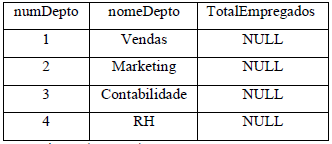
4 rows in set (0.00 sec)
mysql>
mysql>
Assinale a alternativa que apresenta a instrução SQL que vai preencher todas as linhas da nova coluna (TotalEmpregados) com o total de empregados que trabalham nos respectivos departamentos.
Provas
Questão presente nas seguintes provas
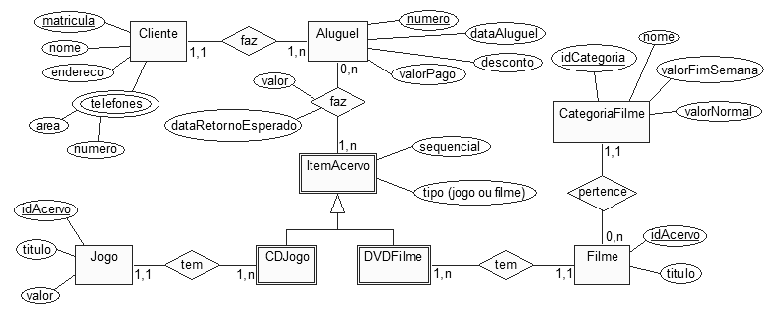
Sobre o diagrama apresentado, analise as assertivas abaixo:
i. “Telefones” é um exemplo de atributo complexo, no qual atributos compostos e multivalorados podem ser aninhados.
ii. Entre os relacionamentos do modelo apresentado, apenas o que envolve as entidades “Aluguel” e “ItemAcervo” – o “faz” – será transformado em uma tabela após a normalização.
iii. O modelo, depois de normalizado, dará origem a oito tabelas.
iv. No modelo, depois de normalizado, a entidade “Cliente” ficará com quatro atributos.
Assinale a alternativa que aponta a quantidade de assertiva(s) CORRETA(S).
Provas
Questão presente nas seguintes provas
881986
Ano: 2012
Disciplina: TI - Desenvolvimento de Sistemas
Banca: UPENET/IAUPE
Orgão: EMPREL
Disciplina: TI - Desenvolvimento de Sistemas
Banca: UPENET/IAUPE
Orgão: EMPREL
Provas:
Sobre a implementação com Java, analise as afirmações abaixo:
i. Java trata seus tipos de dados primários por valor, e seus tipos não primários (objetos e arrays), por referência (ponteiros controlados pelo interpretador Java, e não pelo usuário). O valor padrão de qualquer dado não primário é null (palavra reservada que significa ausência de valor).
ii. Um objeto vai existir desde o momento da sua construção e até que todas as suas referências sejam removidas (ou até que o programa termine). A remoção de uma referência a um objeto pode se dar explícita (nomeDoObjeto = null) ou implicitamente (fim do escopo de existência do objeto).
iii. A Sobrecarga (Overloading) de métodos é a possibilidade de declarar métodos com o mesmo nome, só que com passagem de parâmetros diferentes. A maior utilidade de sobrecarga de métodos é para a construção de métodos que fazem a mesma coisa com dados diferentes.
iv. O modificador static indica que o método ou atributo é de classe (as instâncias criadas terão esse método ou atributo), o que implica na utilização da palavra reservada this (referência ao próprio objeto) no interior desse tipo de método, pois este nunca vai fazer parte de nenhum objeto.
Assinale a alternativa que aponta a quantidade de assertiva(s) FALSA(S).
Provas
Questão presente nas seguintes provas
Cadernos
Caderno Container