Foram encontradas 60 questões.
- Paradigmas de ProgramaçãoOrientação a ObjetosOrientação a Objetos: Herança
- Paradigmas de ProgramaçãoOrientação a ObjetosOrientação à Objetos: Modificadores de Acesso
Em uma aplicação orientada a objetos, um método protegido (protected) em uma classe poderá ser acessado:
Provas
Questão presente nas seguintes provas

Analise os requisitos a seguir, de um sistema para uma clínica médica.
1. O usuário deve ser capaz de pesquisar as listas de agendamento de pacientes.
2. O sistema deve implementar as disposições de privacidade dos pacientes, tal como estabelecido pela legislação e padrões internacionais.
3. O sistema deve ser capaz de gerar a cada dia uma lista de pacientes para consulta naquele dia.
4. A equipe médica deve ser capaz de usar todas as funções do sistema após quatro horas de treinamento.
5. Cada membro da equipe que usa o sistema deve ser identificado apenas por seu número de identificação de dez dígitos.
6. O sistema deve estar disponível durante o horário comercial, sendo permitido um tempo de indisponibilidade que não exceda cinco segundos.
São requisitos funcionais SOMENTE o que consta em:
1. O usuário deve ser capaz de pesquisar as listas de agendamento de pacientes.
2. O sistema deve implementar as disposições de privacidade dos pacientes, tal como estabelecido pela legislação e padrões internacionais.
3. O sistema deve ser capaz de gerar a cada dia uma lista de pacientes para consulta naquele dia.
4. A equipe médica deve ser capaz de usar todas as funções do sistema após quatro horas de treinamento.
5. Cada membro da equipe que usa o sistema deve ser identificado apenas por seu número de identificação de dez dígitos.
6. O sistema deve estar disponível durante o horário comercial, sendo permitido um tempo de indisponibilidade que não exceda cinco segundos.
São requisitos funcionais SOMENTE o que consta em:
Provas
Questão presente nas seguintes provas
- Engenharia de SoftwareModelos de DesenvolvimentoUP: Unified ProcessRUP: Rational Unified Process
- Engenharia de SoftwareUML: Unified Modeling LanguageDiagrama de Casos de Uso
Associe as atividades aos papéis, no RUP.
Atividades:
1. Planejamento de uma Interação.
2. Desenvolver um plano de Gerência de Requisitos.
3. Detalhar uma Entidade de Negócios.
4. Encontrar atores e Casos de Uso.
Papéis:
A. Gerente de Projeto.
B. Analista de Sistemas.
C. Designer de Negócios.
D. Analista do Processo de Negócios.
A associação correta é:
Atividades:
1. Planejamento de uma Interação.
2. Desenvolver um plano de Gerência de Requisitos.
3. Detalhar uma Entidade de Negócios.
4. Encontrar atores e Casos de Uso.
Papéis:
A. Gerente de Projeto.
B. Analista de Sistemas.
C. Designer de Negócios.
D. Analista do Processo de Negócios.
A associação correta é:
Provas
Questão presente nas seguintes provas
No modelo ágil Scrum:
Provas
Questão presente nas seguintes provas
ATENÇÃO: a imagem a seguir representa uma visão do processo de medição funcional da International Function Point Users Group (AFPUG), que é um organismo internacional responsável pela manutenção e evolução do padrão de medição de pontos de função. Ela deve ser utilizada para responder às questão.
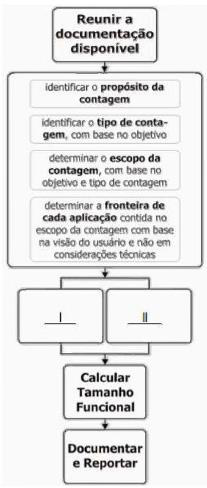
Na identificação do Tipo da Contagem os responsáveis pela medição estabelecem o tipo da contagem que será utilizado para medir o software. Considere:
I. contagem de um projeto de desenvolvimento: mede a funcionalidade fornecida aos usuários finais do software quando da sua primeira instalação.
II. contagem de um projeto de melhoria: mede as funções adicionadas, modificadas ou excluídas do sistema pelo projeto.
III. contagem de uma aplicação: mede a funcionalidade fornecida aos usuários por uma aplicação instalada.
A contagem de pontos de função pode estar associada tipos de contagem apresentados em:
Na identificação do Tipo da Contagem os responsáveis pela medição estabelecem o tipo da contagem que será utilizado para medir o software. Considere:
I. contagem de um projeto de desenvolvimento: mede a funcionalidade fornecida aos usuários finais do software quando da sua primeira instalação.
II. contagem de um projeto de melhoria: mede as funções adicionadas, modificadas ou excluídas do sistema pelo projeto.
III. contagem de uma aplicação: mede a funcionalidade fornecida aos usuários por uma aplicação instalada.
A contagem de pontos de função pode estar associada tipos de contagem apresentados em:
Provas
Questão presente nas seguintes provas
- Engenharia de SoftwareEngenharia de Requisitos
- Engenharia de SoftwareGerenciamento de Projetos de Software
- Qualidade de SoftwareMétricas de SoftwareAPF: Análise de Pontos de Função
- Qualidade de SoftwareMétricas de SoftwareUCP: Use Case Points
Leia as afirmativas a seguir.
I. A Análise Por Pontos de Função pode ser aplicada a qualquer tipo de software, independentemente de como este será desenvolvido.
II. Pontos por Casos de Uso só podem ser aplicados de forma eficiente a projetos de software que especifiquem requisitos por meio de casos de uso.
III. O processo de medição usando Pontos por Caso de Uso deve ser empregado antes de concluída a análise de requisitos do projeto.
IV. Utilizando Pontos por Casos de Uso conseguem-se medidas padronizadas, consistentes e isentas de subjetividade.
Está correto o que se afirma somente em
I. A Análise Por Pontos de Função pode ser aplicada a qualquer tipo de software, independentemente de como este será desenvolvido.
II. Pontos por Casos de Uso só podem ser aplicados de forma eficiente a projetos de software que especifiquem requisitos por meio de casos de uso.
III. O processo de medição usando Pontos por Caso de Uso deve ser empregado antes de concluída a análise de requisitos do projeto.
IV. Utilizando Pontos por Casos de Uso conseguem-se medidas padronizadas, consistentes e isentas de subjetividade.
Está correto o que se afirma somente em
Provas
Questão presente nas seguintes provas
O modelo ágil Extreme Programming (XP) segue uma série de práticas que dizem respeito ao relacionamento com o cliente, a gerência do projeto, a programação e aos testes. NAO é uma dessas práticas:
Provas
Questão presente nas seguintes provas
0 processo Coletar Requisitos do grupo de Processos de Planejamento utiliza ferramentas e técnicas que podem ser usadas para definir e documentar as funções e funcionalidades do projeto e do produto. Dentre as técnicas classificadas pelo PMBoK quarta edição como Técnicas de Criatividade em Grupo, estão:
Provas
Questão presente nas seguintes provas
No grupo de Processos de Planejamento do PMBoK quarta edição, o processo Coletar Requisitos permite definir e documentar as necessidades das partes interessadas para alcançar os objetivos do projeto. Constitui uma saída desse processo:
Provas
Questão presente nas seguintes provas
The following text refers to questions .
Informatics education:
Europe cannot afford to miss the boat
Principies for an effective informatics curriculum
The committee performed a comprehensive review of the considerabie existing material on building informatics curricula, including among many others the (UK) Royal Society report, the CSPrinciples site, the Computing at Schools Initiative, and the work of the CSTA. Two major conclusions follow from that review.
The first is the sheer number of existing experiences demonstrating that it is indeed possible to teach informatics successfully in primary and secondary education. The second conclusion is in the form of two core principies for such curricula. Existing experiences use a wide variety of approaches; there is no standard curriculum yet, and it was not part of the Committee's mission to define such a standard informatics curriculum for the whole of Europe. The committee has found, however, that while views diverge on the details, a remarkable consensus exists among experts on the basics of what a school informatics curriculum should (and should not) include. On the basis of that existing work, the Committee has identified two principies: leverage students' creativity, emphasize quality.
Leverage student creativity
A powerful aid for informatics teaching is the topic's potential for stimulating students; creativity. The barriers to innovation are often lower than in other disciplines; the technical equipment (computers) is ubiquitous and considerably less expensive. Opportunities exist even for a beginner: with proper guidance, a Creative student can quickly start writing a program or a Web Service, see the results right away, and make them available to numerous other people. Informatics education should draw on this phenomenon and channel the creativity into useful directions, while warning students away from nefarious directions such as destructive "hacking". The example of HFOSS (Humanitarian Free and Open Software Systems)
shows the way towards constructive societal contributions based on informatics.
Informatics education must not just dwell on imparting information to students. It must draw attention to aspects of informatics that immediately appeal to young students, to encourage interaction, to bring abstract concepts to life through visualization and animation; a typical application of this idea is the careful use of (non- violent) games.
Foster quality
Curious students are always going to learn some IT and in particular some programming outside of informatics education through games scripting, Web site development, or adding software components to social networks. Informatics education must emphasize quality, in particular software quality, including the need for correctness (proper functioning of software), for good user interfaces, for taking the needs of users into consideration including psychological and social concerns. The role of informatics education here is:
• To convey the distinction between mere "coding" and software development as a constructive activity based on scientific and engineering principies.
• To dispel the wrong image of programming as an activity for "nerds" and emphasize its human, user-centered aspects, a focus that helps attract students of both genders.
Breaking the teacher availability deadlock
An obstacle to generalizing informatics education is the lack of teachers. It follows from a chicken-and-egg problem: as long as informatics is not in the curriculum, there is Iittle incentive to educate teachers in the subject; as long as there are no teachers, there is Iittle incentive to introduce the subject.
To bring informatics education to the levei that their schools deserve, European countries will have to take both long-term and short-term initiatives:
• Universities, in particular through their informatics departments, must put in place comprehensive programs to train informatics teachers, able to teach digital literacy and informatics under the same intellectual standards as in mathematics, physics and other Sciences.
• The current chicken-and-egg situation is not an excuse for deferring the start of urgently needed efforts. Existing experiences conclusively show that it is possible to break the deadlock. For example, a recent New York Times article explains how IT companies such as Microsoft and Google, conscious of the need to improve the state of education, allow some of their most committed engineers and researchers in the US to pair up with high school teachers to teach computational thinking. In Russia, it is common for academics who graduated from the best high schools to go back to these schools, also on a volunteer basis, and help teachers introduce the concepts of modern informatics. Ali these efforts respect the principie that outsiders must always be paired with current high-school teachers.
(Excerpt of ' Report ofthe joint Informatics Europe & ACM Europe Working Group on Informatics Education April 2013')
The text tells about the experiences in Microsoft and Google that is:Informatics education:
Europe cannot afford to miss the boat
Principies for an effective informatics curriculum
The committee performed a comprehensive review of the considerabie existing material on building informatics curricula, including among many others the (UK) Royal Society report, the CSPrinciples site, the Computing at Schools Initiative, and the work of the CSTA. Two major conclusions follow from that review.
The first is the sheer number of existing experiences demonstrating that it is indeed possible to teach informatics successfully in primary and secondary education. The second conclusion is in the form of two core principies for such curricula. Existing experiences use a wide variety of approaches; there is no standard curriculum yet, and it was not part of the Committee's mission to define such a standard informatics curriculum for the whole of Europe. The committee has found, however, that while views diverge on the details, a remarkable consensus exists among experts on the basics of what a school informatics curriculum should (and should not) include. On the basis of that existing work, the Committee has identified two principies: leverage students' creativity, emphasize quality.
Leverage student creativity
A powerful aid for informatics teaching is the topic's potential for stimulating students; creativity. The barriers to innovation are often lower than in other disciplines; the technical equipment (computers) is ubiquitous and considerably less expensive. Opportunities exist even for a beginner: with proper guidance, a Creative student can quickly start writing a program or a Web Service, see the results right away, and make them available to numerous other people. Informatics education should draw on this phenomenon and channel the creativity into useful directions, while warning students away from nefarious directions such as destructive "hacking". The example of HFOSS (Humanitarian Free and Open Software Systems)
shows the way towards constructive societal contributions based on informatics.
Informatics education must not just dwell on imparting information to students. It must draw attention to aspects of informatics that immediately appeal to young students, to encourage interaction, to bring abstract concepts to life through visualization and animation; a typical application of this idea is the careful use of (non- violent) games.
Foster quality
Curious students are always going to learn some IT and in particular some programming outside of informatics education through games scripting, Web site development, or adding software components to social networks. Informatics education must emphasize quality, in particular software quality, including the need for correctness (proper functioning of software), for good user interfaces, for taking the needs of users into consideration including psychological and social concerns. The role of informatics education here is:
• To convey the distinction between mere "coding" and software development as a constructive activity based on scientific and engineering principies.
• To dispel the wrong image of programming as an activity for "nerds" and emphasize its human, user-centered aspects, a focus that helps attract students of both genders.
Breaking the teacher availability deadlock
An obstacle to generalizing informatics education is the lack of teachers. It follows from a chicken-and-egg problem: as long as informatics is not in the curriculum, there is Iittle incentive to educate teachers in the subject; as long as there are no teachers, there is Iittle incentive to introduce the subject.
To bring informatics education to the levei that their schools deserve, European countries will have to take both long-term and short-term initiatives:
• Universities, in particular through their informatics departments, must put in place comprehensive programs to train informatics teachers, able to teach digital literacy and informatics under the same intellectual standards as in mathematics, physics and other Sciences.
• The current chicken-and-egg situation is not an excuse for deferring the start of urgently needed efforts. Existing experiences conclusively show that it is possible to break the deadlock. For example, a recent New York Times article explains how IT companies such as Microsoft and Google, conscious of the need to improve the state of education, allow some of their most committed engineers and researchers in the US to pair up with high school teachers to teach computational thinking. In Russia, it is common for academics who graduated from the best high schools to go back to these schools, also on a volunteer basis, and help teachers introduce the concepts of modern informatics. Ali these efforts respect the principie that outsiders must always be paired with current high-school teachers.
(Excerpt of ' Report ofthe joint Informatics Europe & ACM Europe Working Group on Informatics Education April 2013')
Provas
Questão presente nas seguintes provas
Cadernos
Caderno Container