Foram encontradas 40 questões.
A partir das afirmativas abaixo relativas às características da linguagem Java, pode-se afirmar que:
I. É possível utilizar vários blocos catch para capturar exceções vindas de um único bloco try.
II. Uma classe pode implementar mais de uma interface.
III. Todas as classes em Java herdam implicitamente a classe Object.
IV. É possível sobrecarregar um operador da linguagem como, por exemplo, o operador '+', assim como pode ser feito na linguagem C++.
Está(ão) correta(s) apenas a(s) afirmativa(s):
I. É possível utilizar vários blocos catch para capturar exceções vindas de um único bloco try.
II. Uma classe pode implementar mais de uma interface.
III. Todas as classes em Java herdam implicitamente a classe Object.
IV. É possível sobrecarregar um operador da linguagem como, por exemplo, o operador '+', assim como pode ser feito na linguagem C++.
Está(ão) correta(s) apenas a(s) afirmativa(s):
Provas
Questão presente nas seguintes provas

- Paradigmas de ProgramaçãoOrientação a ObjetosAnálise e Projeto Orientado a Objetos
- Paradigmas de ProgramaçãoOrientação a ObjetosOrientação a Objetos: Encapsulamento
- Paradigmas de ProgramaçãoOrientação a ObjetosOrientação a Objetos: Herança
- Paradigmas de ProgramaçãoOrientação a ObjetosOrientação a Objetos: Polimorfismo
Dentro de um contexto de análise orientada a objetos, assinale o INCORRETO:
Provas
Questão presente nas seguintes provas
Segundo Pressman (1995), Engenharia de Software é o estabelecimento e uso de sólidos princípios de engenharia para que se possa obter economicamente um software que seja confiável e que funcione eficientemente em máquinas reais, abrangendo um conjunto de três elementos fundamentais (métodos, ferramentas e procedimentos). Assinale a alternativa INCORRETA:
Provas
Questão presente nas seguintes provas
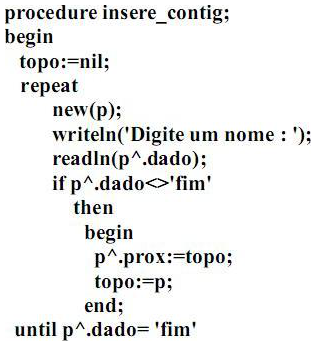
O procedimento abaixo é uma inserção em uma:
Provas
Questão presente nas seguintes provas
A respeito dos padrões de Qualidade ISO9000, identifique a única alternativa válida:
I. Um sistema de garantia da qualidade pode ser definido como a estrutura organizacional, responsabilidades, procedimentos, processos e recursos para implementar a gestão da qualidade.
II. Sistemas de garantia da qualidade são criados para ajudar organizações a garantir que seus produtos e serviços satisfaçam as expectativas do cliente, estando de acordo com suas especificações. Porém, não abrangem todo o ciclo de vida de um produto.
III. Para se registrar num dos modelos de sistema de garantia da qualidade contidos na ISO9000, o sistema e operações de qualidade da empresa são escrutinados por auditores externos para verificação do atendimento das normas e da efetividade da operação.
Está(ão) correta(s) apenas a(s) afirmativa(s):
I. Um sistema de garantia da qualidade pode ser definido como a estrutura organizacional, responsabilidades, procedimentos, processos e recursos para implementar a gestão da qualidade.
II. Sistemas de garantia da qualidade são criados para ajudar organizações a garantir que seus produtos e serviços satisfaçam as expectativas do cliente, estando de acordo com suas especificações. Porém, não abrangem todo o ciclo de vida de um produto.
III. Para se registrar num dos modelos de sistema de garantia da qualidade contidos na ISO9000, o sistema e operações de qualidade da empresa são escrutinados por auditores externos para verificação do atendimento das normas e da efetividade da operação.
Está(ão) correta(s) apenas a(s) afirmativa(s):
Provas
Questão presente nas seguintes provas
Paulo César Nóbrega is one of 40 milion people living with HIV/AIDS. This is story:
Like most young people of my generation, I started using drugs as an adolescent. By the time I was 16, I was taking cannabis, hallucinogens and injecting drugs. Soon, my addiction led me to drug trafficking. Between 1985 and 1993, I was imprisoned in the city of São Paulo, Brazil, where I was diagnosed HIV-positive.
Initially, I was shocked. But I didn't really know what HIV or AIDS were, which is why I continued using drugs and sharing needles with other inmates. We received no guidance or preventive care.
In prison, AIDS first manifested itself through tuberculosis, an illness I suffered from three times. Although I was eventually given anti-retroviral medicines, I continued taking drugs and only restarted the treatment in earnest after abandoning drugs for good in 1999.
At that time, I was a member of a support group in my hometown, the coastal city of São Vicente, and was close to other HIV-positive people. We soon decided to establish the Hipupiara NGO to promote a sense of unity among people living with HIV and to improve their quality of life.
Unfortunately, I suffered a lot of prejudice for being HIV-positive, including from members of my family. I was also denied jobs. Then, in 2001, I started working as a fisherman, a job I retired from in 2005, at 50, due to poor health.
Today, I am free of drugs and am sticking to the treatment. I work as a volunteer for Hipupiara, contacting drug users in the city and referring them to treatment and assistance services.
Thanks to all the information I have accumulated about HIV/AIDS, I can now face and beat prejudice. People infected with HIV and drug users should not close up or avoid talking about their problems; we should help each other so that we can all lead a better life.
The text is about the story: Like most young people of my generation, I started using drugs as an adolescent. By the time I was 16, I was taking cannabis, hallucinogens and injecting drugs. Soon, my addiction led me to drug trafficking. Between 1985 and 1993, I was imprisoned in the city of São Paulo, Brazil, where I was diagnosed HIV-positive.
Initially, I was shocked. But I didn't really know what HIV or AIDS were, which is why I continued using drugs and sharing needles with other inmates. We received no guidance or preventive care.
In prison, AIDS first manifested itself through tuberculosis, an illness I suffered from three times. Although I was eventually given anti-retroviral medicines, I continued taking drugs and only restarted the treatment in earnest after abandoning drugs for good in 1999.
At that time, I was a member of a support group in my hometown, the coastal city of São Vicente, and was close to other HIV-positive people. We soon decided to establish the Hipupiara NGO to promote a sense of unity among people living with HIV and to improve their quality of life.
Unfortunately, I suffered a lot of prejudice for being HIV-positive, including from members of my family. I was also denied jobs. Then, in 2001, I started working as a fisherman, a job I retired from in 2005, at 50, due to poor health.
Today, I am free of drugs and am sticking to the treatment. I work as a volunteer for Hipupiara, contacting drug users in the city and referring them to treatment and assistance services.
Thanks to all the information I have accumulated about HIV/AIDS, I can now face and beat prejudice. People infected with HIV and drug users should not close up or avoid talking about their problems; we should help each other so that we can all lead a better life.
(Available in: <
http://www.unodc.org/newsletter/200601/page005.htm...>; Acess in: Mar. 6, 2006.)
Provas
Questão presente nas seguintes provas
Paulo César Nóbrega is one of 40 milion people living with HIV/AIDS. This is story:
Like most young people of my generation, I started using drugs as an adolescent. By the time I was 16, I was taking cannabis, hallucinogens and injecting drugs. Soon, my addiction led me to drug trafficking. Between 1985 and 1993, I was imprisoned in the city of São Paulo, Brazil, where I was diagnosed HIV-positive.
Initially, I was shocked. But I didn't really know what HIV or AIDS were, which is why I continued using drugs and sharing needles with other inmates. We received no guidance or preventive care.
In prison, AIDS first manifested itself through tuberculosis, an illness I suffered from three times. Although I was eventually given anti-retroviral medicines, I continued taking drugs and only restarted the treatment in earnest after abandoning drugs for good in 1999.
At that time, I was a member of a support group in my hometown, the coastal city of São Vicente, and was close to other HIV-positive people. We soon decided to establish the Hipupiara NGO to promote a sense of unity among people living with HIV and to improve their quality of life.
Unfortunately, I suffered a lot of prejudice for being HIV-positive, including from members of my family. I was also denied jobs. Then, in 2001, I started working as a fisherman, a job I retired from in 2005, at 50, due to poor health.
Today, I am free of drugs and am sticking to the treatment. I work as a volunteer for Hipupiara, contacting drug users in the city and referring them to treatment and assistance services.
Thanks to all the information I have accumulated about HIV/AIDS, I can now face and beat prejudice. People infected with HIV and drug users should not close up or avoid talking about their problems; we should help each other so that we can all lead a better life.
Mr. Nóbrega started dealing drugs:Like most young people of my generation, I started using drugs as an adolescent. By the time I was 16, I was taking cannabis, hallucinogens and injecting drugs. Soon, my addiction led me to drug trafficking. Between 1985 and 1993, I was imprisoned in the city of São Paulo, Brazil, where I was diagnosed HIV-positive.
Initially, I was shocked. But I didn't really know what HIV or AIDS were, which is why I continued using drugs and sharing needles with other inmates. We received no guidance or preventive care.
In prison, AIDS first manifested itself through tuberculosis, an illness I suffered from three times. Although I was eventually given anti-retroviral medicines, I continued taking drugs and only restarted the treatment in earnest after abandoning drugs for good in 1999.
At that time, I was a member of a support group in my hometown, the coastal city of São Vicente, and was close to other HIV-positive people. We soon decided to establish the Hipupiara NGO to promote a sense of unity among people living with HIV and to improve their quality of life.
Unfortunately, I suffered a lot of prejudice for being HIV-positive, including from members of my family. I was also denied jobs. Then, in 2001, I started working as a fisherman, a job I retired from in 2005, at 50, due to poor health.
Today, I am free of drugs and am sticking to the treatment. I work as a volunteer for Hipupiara, contacting drug users in the city and referring them to treatment and assistance services.
Thanks to all the information I have accumulated about HIV/AIDS, I can now face and beat prejudice. People infected with HIV and drug users should not close up or avoid talking about their problems; we should help each other so that we can all lead a better life.
(Available in: <
http://www.unodc.org/newsletter/200601/page005.htm...>; Acess in: Mar. 6, 2006.)
Provas
Questão presente nas seguintes provas
Paulo César Nóbrega is one of 40 milion people living with HIV/AIDS. This is story:
Like most young people of my generation, I started using drugs as an adolescent. By the time I was 16, I was taking cannabis, hallucinogens and injecting drugs. Soon, my addiction led me to drug trafficking. Between 1985 and 1993, I was imprisoned in the city of São Paulo, Brazil, where I was diagnosed HIV-positive.
Initially, I was shocked. But I didn't really know what HIV or AIDS were, which is why I continued using drugs and sharing needles with other inmates. We received no guidance or preventive care.
In prison, AIDS first manifested itself through tuberculosis, an illness I suffered from three times. Although I was eventually given anti-retroviral medicines, I continued taking drugs and only restarted the treatment in earnest after abandoning drugs for good in 1999.
At that time, I was a member of a support group in my hometown, the coastal city of São Vicente, and was close to other HIV-positive people. We soon decided to establish the Hipupiara NGO to promote a sense of unity among people living with HIV and to improve their quality of life.
Unfortunately, I suffered a lot of prejudice for being HIV-positive, including from members of my family. I was also denied jobs. Then, in 2001, I started working as a fisherman, a job I retired from in 2005, at 50, due to poor health.
Today, I am free of drugs and am sticking to the treatment. I work as a volunteer for Hipupiara, contacting drug users in the city and referring them to treatment and assistance services.
Thanks to all the information I have accumulated about HIV/AIDS, I can now face and beat prejudice. People infected with HIV and drug users should not close up or avoid talking about their problems; we should help each other so that we can all lead a better life.
During the time Mr. Nóbrega spent in prison he: Like most young people of my generation, I started using drugs as an adolescent. By the time I was 16, I was taking cannabis, hallucinogens and injecting drugs. Soon, my addiction led me to drug trafficking. Between 1985 and 1993, I was imprisoned in the city of São Paulo, Brazil, where I was diagnosed HIV-positive.
Initially, I was shocked. But I didn't really know what HIV or AIDS were, which is why I continued using drugs and sharing needles with other inmates. We received no guidance or preventive care.
In prison, AIDS first manifested itself through tuberculosis, an illness I suffered from three times. Although I was eventually given anti-retroviral medicines, I continued taking drugs and only restarted the treatment in earnest after abandoning drugs for good in 1999.
At that time, I was a member of a support group in my hometown, the coastal city of São Vicente, and was close to other HIV-positive people. We soon decided to establish the Hipupiara NGO to promote a sense of unity among people living with HIV and to improve their quality of life.
Unfortunately, I suffered a lot of prejudice for being HIV-positive, including from members of my family. I was also denied jobs. Then, in 2001, I started working as a fisherman, a job I retired from in 2005, at 50, due to poor health.
Today, I am free of drugs and am sticking to the treatment. I work as a volunteer for Hipupiara, contacting drug users in the city and referring them to treatment and assistance services.
Thanks to all the information I have accumulated about HIV/AIDS, I can now face and beat prejudice. People infected with HIV and drug users should not close up or avoid talking about their problems; we should help each other so that we can all lead a better life.
(Available in: <
http://www.unodc.org/newsletter/200601/page005.htm...>; Acess in: Mar. 6, 2006.)
Provas
Questão presente nas seguintes provas
Paulo César Nóbrega is one of 40 milion people living with HIV/AIDS. This is story:
Like most young people of my generation, I started using drugs as an adolescent. By the time I was 16, I was taking cannabis, hallucinogens and injecting drugs. Soon, my addiction led me to drug trafficking. Between 1985 and 1993, I was imprisoned in the city of São Paulo, Brazil, where I was diagnosed HIV-positive.
Initially, I was shocked. But I didn't really know what HIV or AIDS were, which is why I continued using drugs and sharing needles with other inmates. We received no guidance or preventive care.
In prison, AIDS first manifested itself through tuberculosis, an illness I suffered from three times. Although I was eventually given anti-retroviral medicines, I continued taking drugs and only restarted the treatment in earnest after abandoning drugs for good in 1999.
At that time, I was a member of a support group in my hometown, the coastal city of São Vicente, and was close to other HIV-positive people. We soon decided to establish the Hipupiara NGO to promote a sense of unity among people living with HIV and to improve their quality of life.
Unfortunately, I suffered a lot of prejudice for being HIV-positive, including from members of my family. I was also denied jobs. Then, in 2001, I started working as a fisherman, a job I retired from in 2005, at 50, due to poor health.
Today, I am free of drugs and am sticking to the treatment. I work as a volunteer for Hipupiara, contacting drug users in the city and referring them to treatment and assistance services.
Thanks to all the information I have accumulated about HIV/AIDS, I can now face and beat prejudice. People infected with HIV and drug users should not close up or avoid talking about their problems; we should help each other so that we can all lead a better life.
Mr. Nóbrega “was denied jobs” because: Like most young people of my generation, I started using drugs as an adolescent. By the time I was 16, I was taking cannabis, hallucinogens and injecting drugs. Soon, my addiction led me to drug trafficking. Between 1985 and 1993, I was imprisoned in the city of São Paulo, Brazil, where I was diagnosed HIV-positive.
Initially, I was shocked. But I didn't really know what HIV or AIDS were, which is why I continued using drugs and sharing needles with other inmates. We received no guidance or preventive care.
In prison, AIDS first manifested itself through tuberculosis, an illness I suffered from three times. Although I was eventually given anti-retroviral medicines, I continued taking drugs and only restarted the treatment in earnest after abandoning drugs for good in 1999.
At that time, I was a member of a support group in my hometown, the coastal city of São Vicente, and was close to other HIV-positive people. We soon decided to establish the Hipupiara NGO to promote a sense of unity among people living with HIV and to improve their quality of life.
Unfortunately, I suffered a lot of prejudice for being HIV-positive, including from members of my family. I was also denied jobs. Then, in 2001, I started working as a fisherman, a job I retired from in 2005, at 50, due to poor health.
Today, I am free of drugs and am sticking to the treatment. I work as a volunteer for Hipupiara, contacting drug users in the city and referring them to treatment and assistance services.
Thanks to all the information I have accumulated about HIV/AIDS, I can now face and beat prejudice. People infected with HIV and drug users should not close up or avoid talking about their problems; we should help each other so that we can all lead a better life.
(Available in: <
http://www.unodc.org/newsletter/200601/page005.htm...>; Acess in: Mar. 6, 2006.)
Provas
Questão presente nas seguintes provas
- Gramática - Língua InglesaAdjetivos | AdjectivesComparativo e superlativo de adjetivos | Comparative and superlative
- Gramática - Língua InglesaPronomes | PronounsPronome reflexivo | Reflexive Pronoun
- Gramática - Língua InglesaSubstantivos e compostos | Nouns and compounds
- Gramática - Língua InglesaPreposições | Prepositions
Paulo César Nóbrega is one of 40 milion people living with HIV/AIDS. This is story:
Like most young people of my generation, I started using drugs as an adolescent. By the time I was 16, I was taking cannabis, hallucinogens and injecting drugs. Soon, my addiction led me to drug trafficking. Between 1985 and 1993, I was imprisoned in the city of São Paulo, Brazil, where I was diagnosed HIV-positive.
Initially, I was shocked. But I didn't really know what HIV or AIDS were, which is why I continued using drugs and sharing needles with other inmates. We received no guidance or preventive care.
In prison, AIDS first manifested itself through tuberculosis, an illness I suffered from three times. Although I was eventually given anti-retroviral medicines, I continued taking drugs and only restarted the treatment in earnest after abandoning drugs for good in 1999.
At that time, I was a member of a support group in my hometown, the coastal city of São Vicente, and was close to other HIV-positive people. We soon decided to establish the Hipupiara NGO to promote a sense of unity among people living with HIV and to improve their quality of life.
Unfortunately, I suffered a lot of prejudice for being HIV-positive, including from members of my family. I was also denied jobs. Then, in 2001, I started working as a fisherman, a job I retired from in 2005, at 50, due to poor health.
Today, I am free of drugs and am sticking to the treatment. I work as a volunteer for Hipupiara, contacting drug users in the city and referring them to treatment and assistance services.
Thanks to all the information I have accumulated about HIV/AIDS, I can now face and beat prejudice. People infected with HIV and drug users should not close up or avoid talking about their problems; we should help each other so that we can all lead a better life.
“Addiction/ better/itself/among”. The following words can be classified as: Like most young people of my generation, I started using drugs as an adolescent. By the time I was 16, I was taking cannabis, hallucinogens and injecting drugs. Soon, my addiction led me to drug trafficking. Between 1985 and 1993, I was imprisoned in the city of São Paulo, Brazil, where I was diagnosed HIV-positive.
Initially, I was shocked. But I didn't really know what HIV or AIDS were, which is why I continued using drugs and sharing needles with other inmates. We received no guidance or preventive care.
In prison, AIDS first manifested itself through tuberculosis, an illness I suffered from three times. Although I was eventually given anti-retroviral medicines, I continued taking drugs and only restarted the treatment in earnest after abandoning drugs for good in 1999.
At that time, I was a member of a support group in my hometown, the coastal city of São Vicente, and was close to other HIV-positive people. We soon decided to establish the Hipupiara NGO to promote a sense of unity among people living with HIV and to improve their quality of life.
Unfortunately, I suffered a lot of prejudice for being HIV-positive, including from members of my family. I was also denied jobs. Then, in 2001, I started working as a fisherman, a job I retired from in 2005, at 50, due to poor health.
Today, I am free of drugs and am sticking to the treatment. I work as a volunteer for Hipupiara, contacting drug users in the city and referring them to treatment and assistance services.
Thanks to all the information I have accumulated about HIV/AIDS, I can now face and beat prejudice. People infected with HIV and drug users should not close up or avoid talking about their problems; we should help each other so that we can all lead a better life.
(Available in: <
http://www.unodc.org/newsletter/200601/page005.htm...>; Acess in: Mar. 6, 2006.)
Provas
Questão presente nas seguintes provas
Cadernos
Caderno Container