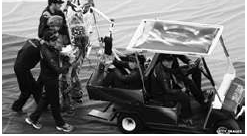
Juliano Pinto, a 29-year-old with complete paralysis of the lower trunk, performed the symbolic kick-off at the Corinthians Arena in Sao Paulo, during the 2014 FIFA World Cup. Using his robotic suit, Mr Pinto kicked the official ball a short distance along a mat laid down by the touchline.
His robotic exoskeleton was created by a team of more than 150 researchers led by Brazilian neuroscientist Dr Miguel Nicolelis. The neuroscientist, who is based at Duke University in the US, is a leading figure in the field of brain-machine interfaces. In breakthrough work published in 2003, he showed that monkeys could control the movement of virtual arms on an avatar using just their brain activity.
Dr Nicolelis had been training eight patients at his lab in Sao Paulo, all of whom were over 20 years of age, with the oldest about 35. "It's the first time an exoskeleton has been controlled by brain activity and offered feedback to the patients," Dr Nicolelis said. "Doing a demonstration in a stadium is something very much outside our routine in robotics. It's never been done before."
The exoskeleton uses a cap placed on the patient's head to pick up brain signals and relay them to a computer in the exoskeleton's backpack. This then decodes the signals and sends them to the legs. The robotic suit is powered by hydraulics, and a battery in the backpack allows for approximately two hours of use. "The basic idea is that we are recording from the brain and then that signal is being translated into commands for the robot to start moving," Dr Gordon Cheng, a member of the team, told the BBC.
Dr Cheng led the development of a form of artificial skin for the exoskeleton. This skin consists of flexible printed circuit boards, each containing pressure, temperature and speed sensors.
It is applied on the soles of the feet and allows the patient to receive tactile stimulation when walking with the exoskeleton. When the robotic suit starts to move and touches the ground, signals are transmitted to an electronic vibration device on the patient's arm, which stimulates their skin.
After lots of practice, the brain starts associating the movements of the legs with the vibration in the arm. In theory, the patient should start to develop the sensation that they have legs and that they are walking.
The suit has been named Bra-Santos Dumont, which combines the three-letter designation for Brazil and Alberto Santos Dumont, the aviation pioneer who was born in the country's southern state of Minas Gerais.
MARTINS, Alejandra; RINCON, Paul. Paraplegic in robotic suit kicks off World Cup.
Disponível em: <www.bbc.com/news/science-environment-27812218>. Acesso em: 20
ago. 2015. Adaptado.
Fill in the parentheses with T (True) or F (False).
About Juliano Pinto, it’s correct to say:
( ) He is paralyzed from the waist down.
( ) In order to kick the ball, he wore a robotic suit controlled by his mind.
( ) He needed no special training to perform the experience with the robotic suit.
( ) He managed to kick the ball from one side to the other of the football field.
The correct sequence, from top to bottom, is
