Foram encontradas 50 questões.
Initiating and sustaining motivation
Increasing and directing student motivation is one of a teacher’s responsibilities, though we cannot be responsible for all of our students’ motivation. In the end it is up to them (Allwright 1977). However, there are three areas where our behaviour can directly influence our students’ continuing participation: goals and goal setting; learning environment; interesting classes. Here we will deal with the first of the three.
Motivation is closely bound up with a person’s desire to achieve a goal; and a distinction needs to be made between long- and short-term goals.
Long-term goals may include the mastery of English, the passing of an exam (at the end of the year), the possibility for the use of the language in the future, etc. Short-term goals, on the other hand, might be the learning of a small amount of new language, the successful writing of an essay, the ability to partake in a discussion or the passing of the progress test at the end of the week.
Teachers need to recognise that long-term goals are vitally important but that they can often seem too far away. When English seems to be more difficult than the student had anticipated, the long-term goals can begin to behave like mirages in the desert, appearing and disappearing at random.
Short-term goals, on the other hand, are by their nature much closer to the student’s day-to-day reality. It is much easier to focus on the end of the week than the end of the year. If the teacher can help students in the achievement of short-term goals, this will have a significant effect on their motivation. After all, ‘nothing succeeds like success’!
(Jeremy Harmer. The practice of English language teaching. 4th ed. Longman, 2007. Adapted)
In the fragment from the first paragraph “However, there are three areas where our behaviour can directly influence our students’ continuing participation”, the underlined word may be replaced, with no change in meaning, by
Provas

Fala e escrita, como formas de manifestação da linguagem, ocorrem em ambientes sociais distintos, com exigências específicas quanto à sintaxe e às estruturas textuais. (...) Uma vez que as formas de manifestação da linguagem são diversificadas, a preocupação com sua delimitação e nomeação traduz-se na noção de gêneros discursivos de Bakhtin (1992).
Bakktin concebe os gêneros do discurso como tipos de enunciados criados dentro dos vários campos da atividade humana. Consoante tal perspectiva, a linguagem é aprendida por meio de enunciados concretos, ouvidos e reproduzidos na comunicação verbal. Cada um dos vários gêneros apresenta suas próprias exigências em termos de conteúdo, de estrutura e de sequências linguísticas que os compõem. Todos esses aspectos devem ser aprendidos mediante práticas sociais que desenvolvam as capacidades de linguagem dos indivíduos e as estratégias de aprendizagem.
(Abuêndia Padilha Pinto. Gêneros discursivos e ensino de Língua Inglesa. In: Dionisio, A. P.; Machado, A. R e Bezerra, M. A (orgs). Gêneros textuais e ensino. Rio de Janeiro: Lucerna. 2005, p.48. Adapted)
Examples of genres to be dealt with in English classes are:
Provas
Fala e escrita, como formas de manifestação da linguagem, ocorrem em ambientes sociais distintos, com exigências específicas quanto à sintaxe e às estruturas textuais. (...) Uma vez que as formas de manifestação da linguagem são diversificadas, a preocupação com sua delimitação e nomeação traduz-se na noção de gêneros discursivos de Bakhtin (1992).
Bakktin concebe os gêneros do discurso como tipos de enunciados criados dentro dos vários campos da atividade humana. Consoante tal perspectiva, a linguagem é aprendida por meio de enunciados concretos, ouvidos e reproduzidos na comunicação verbal. Cada um dos vários gêneros apresenta suas próprias exigências em termos de conteúdo, de estrutura e de sequências linguísticas que os compõem. Todos esses aspectos devem ser aprendidos mediante práticas sociais que desenvolvam as capacidades de linguagem dos indivíduos e as estratégias de aprendizagem.
(Abuêndia Padilha Pinto. Gêneros discursivos e ensino de Língua Inglesa. In: Dionisio, A. P.; Machado, A. R e Bezerra, M. A (orgs). Gêneros textuais e ensino. Rio de Janeiro: Lucerna. 2005, p.48. Adapted)
The reading of the excerpt allows for the following considerations on language teaching and learning:
Provas
Read the comic strip to answer the question.
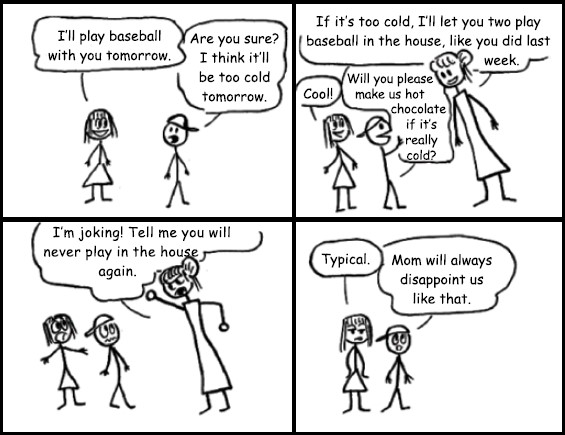
(www.magoosh.com. Adapted)
The modal verb “will” expresses a promise in sentence
Provas
Structures
The word “structures” is most often used to talk about language syllabuses. Until not so many decades ago, language teaching was based on the assumption that students first needed to master particular language frames – the structures. The assumption was that once they had mastered these, they could subsequently learn to “fill the gaps” in structurally correct stretches of language.
To many teachers, a structural syllabus is synonymous with mastering the tense system of the English verb. This is surprising, for to most linguists the English verb has only two tenses – Present Simple and Past Simple. Chalker (1984), for example, in the introduction of her Current English Grammar, writes as follows:
“Once one accepts that the English verb system is binary, and that will and shall are just two of the modals, the whole verbal system and its meaning appears much neater and more understandable”.
(Michael Lewis. The lexical approach. HeinleCengage. 2002. Adapted)
Structural syllabuses to language teaching
Provas
Structures
The word “structures” is most often used to talk about language syllabuses. Until not so many decades ago, language teaching was based on the assumption that students first needed to master particular language frames – the structures. The assumption was that once they had mastered these, they could subsequently learn to “fill the gaps” in structurally correct stretches of language.
To many teachers, a structural syllabus is synonymous with mastering the tense system of the English verb. This is surprising, for to most linguists the English verb has only two tenses – Present Simple and Past Simple. Chalker (1984), for example, in the introduction of her Current English Grammar, writes as follows:
“Once one accepts that the English verb system is binary, and that will and shall are just two of the modals, the whole verbal system and its meaning appears much neater and more understandable”.
(Michael Lewis. The lexical approach. HeinleCengage. 2002. Adapted)
Though easily encountered in texts discussing language teaching and learning, words such as “methods”, “approaches”, “syllabuses” and “techniques” are often confused and misunderstood. The term “syllabus” refers, particularly, to the
Provas
You decide to use the article with an older, more advanced reading group. Questions about the meaning of expressions such as “universal credit” (paragraph 1) and “food banks” (paragraph 4) arise. You understand – as proposed by official documents guiding the teaching of English in Brazilian schools – that the learning of the language may represent a privileged opportunity for the students’ expanded participation in a globalized and plural world. You then implicitly introduce the concept of interculturality by asking your students to
Provas
The graph which closes the article could be used at a conference about government measures against child vulnerability in England to support the argument that
Provas
The contrastive discourse marker “but”, which introduces the third paragraph, helps underscore the idea that, in England,
Provas
The fragment from the second paragraph “the rate at which prices rise” plays in the sentence the role of
Provas
Caderno Container