Foram encontradas 48 questões.
Disciplina: Inglês (Língua Inglesa)
Banca: DIRENS Aeronáutica
Orgão: EPCAR
Direction: Consider text III to answer questions 10 to 12.
TEXT III
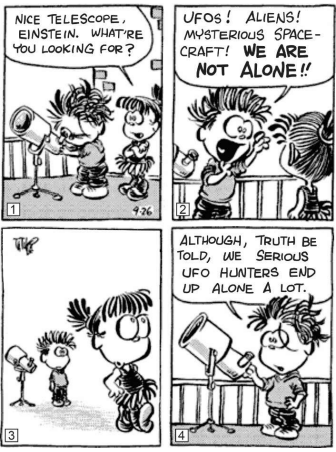
MARK, Tatulli. Heart of the City. Available on: https://www.gocomics.com/blog /326/the-truth-is-out-there-happy-world-ufo-day. Accessed on: February 25th, 2025
By calling the boy “Einstein”, it can be inferred that the girl is being
Provas

Disciplina: Inglês (Língua Inglesa)
Banca: DIRENS Aeronáutica
Orgão: EPCAR
Direction: Consider text III to answer questions 10 to 12.
TEXT III
MARK, Tatulli. Heart of the City. Available on: https://www.gocomics.com/blog /326/the-truth-is-out-there-happy-world-ufo-day. Accessed on: February 25th, 2025
About the word “alone” in the second and fourth boxes, it’s possible to infer that
Provas
Disciplina: Inglês (Língua Inglesa)
Banca: DIRENS Aeronáutica
Orgão: EPCAR
Direction: Consider text III to answer questions 10 to 12.
TEXT III
MARK, Tatulli. Heart of the City. Available on: https://www.gocomics.com/blog /326/the-truth-is-out-there-happy-world-ufo-day. Accessed on: February 25th, 2025
About the expression “truth be told” check (T) True or (F) False:
( ) make a point.
( ) admit something.
( ) restate a point of view.
( ) give an honest opinion.
Choose the correct sequence.
Provas
Disciplina: Inglês (Língua Inglesa)
Banca: DIRENS Aeronáutica
Orgão: EPCAR
Direction: Consider text II to answer questions 05 to 09.
TEXT II
Is There Life On Other Planets?
The ultimate goal of NASA's exoplanet program is to find
unmistakable signs of current life on a planet beyond Earth.
How soon that can happen depends on two unknowns: the
prevalence of life in the galaxy and how lucky we get as we
5 take those first, tentative, exploratory steps.
Our early planet finding missions, such as NASA’s Kepler
and its extended incarnation, K2, or the James Webb Space
Telescope, could yield bare bones evidence of the
potentially habitable worlds. James Webb, designed in part
10 to investigate gas giants and super-Earths, might find an
outsized version of our planet. NASA's Nancy Grace Roman
Space Telescope or the Wide-Field Infrared Survey
Telescope, could zero in on a distant planet’s reflected light
to detect the signatures of oxygen, water vapor, or some
15 other powerful indication of possible life.
But unless we get lucky, the search for signs of life could
take decades. Discovering another blue-white marble hidden
in the star field, like a sand grain on the beach, will probably
require an even larger imaging telescope. Designs are
20 already underway for that next-generation planet finder, to
be sent aloft in the 2030s or 2040s.
MIT physics professor Sara Seager looks for possible
chemical combinations that could signal the presence of
alien life. She and her biochemistry colleagues first focused
25 on the six main elements associated with life on Earth:
carbon, nitrogen, oxygen, phosphorous, sulfur and
hydrogen.
“We’re going to have so few planets, we have to get lucky,”
Seager said. “I don’t want to miss anything. I don’t want to
30 miss it because we weren’t smart enough to think of some
molecule.”
Adapted from: NASA. Is There Life On Other Planets? Available on: https://science.nasa.gov/exoplanets/is-there-life-on-other-planets. Accessed on: February 25th, 2025.
Glossary:
1. exoplanet: a planet of a star that is outside the solar system.
2. prevalence: the fact that something is very common or happens often.
3. NASA’s Kepler: space telescope designed to survey a portion of the Milky Way galaxy.
4. loft: in the air or in a higher position.
5. MIT: Massachusetts Institute of Technology.
When the text says “Discovering another blue-white marble hidden in the star field” (l. 17-18), they
Provas
Disciplina: Inglês (Língua Inglesa)
Banca: DIRENS Aeronáutica
Orgão: EPCAR
Direction: Consider text II to answer questions 05 to 09.
TEXT II
Is There Life On Other Planets?
The ultimate goal of NASA's exoplanet program is to find
unmistakable signs of current life on a planet beyond Earth.
How soon that can happen depends on two unknowns: the
prevalence of life in the galaxy and how lucky we get as we
5 take those first, tentative, exploratory steps.
Our early planet finding missions, such as NASA’s Kepler
and its extended incarnation, K2, or the James Webb Space
Telescope, could yield bare bones evidence of the
potentially habitable worlds. James Webb, designed in part
10 to investigate gas giants and super-Earths, might find an
outsized version of our planet. NASA's Nancy Grace Roman
Space Telescope or the Wide-Field Infrared Survey
Telescope, could zero in on a distant planet’s reflected light
to detect the signatures of oxygen, water vapor, or some
15 other powerful indication of possible life.
But unless we get lucky, the search for signs of life could
take decades. Discovering another blue-white marble hidden
in the star field, like a sand grain on the beach, will probably
require an even larger imaging telescope. Designs are
20 already underway for that next-generation planet finder, to
be sent aloft in the 2030s or 2040s.
MIT physics professor Sara Seager looks for possible
chemical combinations that could signal the presence of
alien life. She and her biochemistry colleagues first focused
25 on the six main elements associated with life on Earth:
carbon, nitrogen, oxygen, phosphorous, sulfur and
hydrogen.
“We’re going to have so few planets, we have to get lucky,”
Seager said. “I don’t want to miss anything. I don’t want to
30 miss it because we weren’t smart enough to think of some
molecule.”
Adapted from: NASA. Is There Life On Other Planets? Available on: https://science.nasa.gov/exoplanets/is-there-life-on-other-planets. Accessed on: February 25th, 2025.
Glossary:
1. exoplanet: a planet of a star that is outside the solar system.
2. prevalence: the fact that something is very common or happens often.
3. NASA’s Kepler: space telescope designed to survey a portion of the Milky Way galaxy.
4. loft: in the air or in a higher position.
5. MIT: Massachusetts Institute of Technology.
“Extended incarnation” (\( l \). 7) conveys the idea that
Provas
Disciplina: Inglês (Língua Inglesa)
Banca: DIRENS Aeronáutica
Orgão: EPCAR
Direction: Consider text II to answer questions 05 to 09.
TEXT II
Is There Life On Other Planets?
The ultimate goal of NASA's exoplanet program is to find
unmistakable signs of current life on a planet beyond Earth.
How soon that can happen depends on two unknowns: the
prevalence of life in the galaxy and how lucky we get as we
5 take those first, tentative, exploratory steps.
Our early planet finding missions, such as NASA’s Kepler
and its extended incarnation, K2, or the James Webb Space
Telescope, could yield bare bones evidence of the
potentially habitable worlds. James Webb, designed in part
10 to investigate gas giants and super-Earths, might find an
outsized version of our planet. NASA's Nancy Grace Roman
Space Telescope or the Wide-Field Infrared Survey
Telescope, could zero in on a distant planet’s reflected light
to detect the signatures of oxygen, water vapor, or some
15 other powerful indication of possible life.
But unless we get lucky, the search for signs of life could
take decades. Discovering another blue-white marble hidden
in the star field, like a sand grain on the beach, will probably
require an even larger imaging telescope. Designs are
20 already underway for that next-generation planet finder, to
be sent aloft in the 2030s or 2040s.
MIT physics professor Sara Seager looks for possible
chemical combinations that could signal the presence of
alien life. She and her biochemistry colleagues first focused
25 on the six main elements associated with life on Earth:
carbon, nitrogen, oxygen, phosphorous, sulfur and
hydrogen.
“We’re going to have so few planets, we have to get lucky,”
Seager said. “I don’t want to miss anything. I don’t want to
30 miss it because we weren’t smart enough to think of some
molecule.”
Adapted from: NASA. Is There Life On Other Planets? Available on: https://science.nasa.gov/exoplanets/is-there-life-on-other-planets. Accessed on: February 25th, 2025.
Glossary:
1. exoplanet: a planet of a star that is outside the solar system.
2. prevalence: the fact that something is very common or happens often.
3. NASA’s Kepler: space telescope designed to survey a portion of the Milky Way galaxy.
4. loft: in the air or in a higher position.
5. MIT: Massachusetts Institute of Technology.
The sentence "the James Webb Space Telescope, could yield bare bones evidence of the potentially habitable worlds" implies that the telescope
Provas
Disciplina: Inglês (Língua Inglesa)
Banca: DIRENS Aeronáutica
Orgão: EPCAR
Direction: Consider text II to answer questions 05 to 09.
TEXT II
Is There Life On Other Planets?
The ultimate goal of NASA's exoplanet program is to find
unmistakable signs of current life on a planet beyond Earth.
How soon that can happen depends on two unknowns: the
prevalence of life in the galaxy and how lucky we get as we
5 take those first, tentative, exploratory steps.
Our early planet finding missions, such as NASA’s Kepler
and its extended incarnation, K2, or the James Webb Space
Telescope, could yield bare bones evidence of the
potentially habitable worlds. James Webb, designed in part
10 to investigate gas giants and super-Earths, might find an
outsized version of our planet. NASA's Nancy Grace Roman
Space Telescope or the Wide-Field Infrared Survey
Telescope, could zero in on a distant planet’s reflected light
to detect the signatures of oxygen, water vapor, or some
15 other powerful indication of possible life.
But unless we get lucky, the search for signs of life could
take decades. Discovering another blue-white marble hidden
in the star field, like a sand grain on the beach, will probably
require an even larger imaging telescope. Designs are
20 already underway for that next-generation planet finder, to
be sent aloft in the 2030s or 2040s.
MIT physics professor Sara Seager looks for possible
chemical combinations that could signal the presence of
alien life. She and her biochemistry colleagues first focused
25 on the six main elements associated with life on Earth:
carbon, nitrogen, oxygen, phosphorous, sulfur and
hydrogen.
“We’re going to have so few planets, we have to get lucky,”
Seager said. “I don’t want to miss anything. I don’t want to
30 miss it because we weren’t smart enough to think of some
molecule.”
Adapted from: NASA. Is There Life On Other Planets? Available on: https://science.nasa.gov/exoplanets/is-there-life-on-other-planets. Accessed on: February 25th, 2025.
Glossary:
1. exoplanet: a planet of a star that is outside the solar system.
2. prevalence: the fact that something is very common or happens often.
3. NASA’s Kepler: space telescope designed to survey a portion of the Milky Way galaxy.
4. loft: in the air or in a higher position.
5. MIT: Massachusetts Institute of Technology.
The sentence "NASA's Nancy Grace Roman Space Telescope or the Wide-Field Infrared Survey Telescope, could zero in on a distant planet’s reflected light" means that the telescope will
Provas
Disciplina: Inglês (Língua Inglesa)
Banca: DIRENS Aeronáutica
Orgão: EPCAR
Direction: Consider text II to answer questions 05 to 09.
TEXT II
Is There Life On Other Planets?
The ultimate goal of NASA's exoplanet program is to find
unmistakable signs of current life on a planet beyond Earth.
How soon that can happen depends on two unknowns: the
prevalence of life in the galaxy and how lucky we get as we
5 take those first, tentative, exploratory steps.
Our early planet finding missions, such as NASA’s Kepler
and its extended incarnation, K2, or the James Webb Space
Telescope, could yield bare bones evidence of the
potentially habitable worlds. James Webb, designed in part
10 to investigate gas giants and super-Earths, might find an
outsized version of our planet. NASA's Nancy Grace Roman
Space Telescope or the Wide-Field Infrared Survey
Telescope, could zero in on a distant planet’s reflected light
to detect the signatures of oxygen, water vapor, or some
15 other powerful indication of possible life.
But unless we get lucky, the search for signs of life could
take decades. Discovering another blue-white marble hidden
in the star field, like a sand grain on the beach, will probably
require an even larger imaging telescope. Designs are
20 already underway for that next-generation planet finder, to
be sent aloft in the 2030s or 2040s.
MIT physics professor Sara Seager looks for possible
chemical combinations that could signal the presence of
alien life. She and her biochemistry colleagues first focused
25 on the six main elements associated with life on Earth:
carbon, nitrogen, oxygen, phosphorous, sulfur and
hydrogen.
“We’re going to have so few planets, we have to get lucky,”
Seager said. “I don’t want to miss anything. I don’t want to
30 miss it because we weren’t smart enough to think of some
molecule.”
Adapted from: NASA. Is There Life On Other Planets? Available on: https://science.nasa.gov/exoplanets/is-there-life-on-other-planets. Accessed on: February 25th, 2025.
Glossary:
1. exoplanet: a planet of a star that is outside the solar system.
2. prevalence: the fact that something is very common or happens often.
3. NASA’s Kepler: space telescope designed to survey a portion of the Milky Way galaxy.
4. loft: in the air or in a higher position.
5. MIT: Massachusetts Institute of Technology.
What is one of the main reasons NASA's exoplanet program could take decades to find definitive signs of life?
Provas
Disciplina: Inglês (Língua Inglesa)
Banca: DIRENS Aeronáutica
Orgão: EPCAR
Direction: Consider text I to answer questions 01 to 04.
TEXT I
Aliens
I pointed my flashlight’s beam into the doorway to reveal the
interior of the spaceship. I called inside. “Hello. Is anybody
there?” No response. A big round silver table was in the
middle of the room with a smaller black spot on top of it. Test
5 tubes lined the far wall, some small and others large enough
to fit a cow. Most of them were occupied with creatures I had
never seen before in any book I had ever read. Then I heard
a noise. I turned around to see the door close. Everything was
really dark and all I could hear was my own breathing. Then I
10 smelled something that made me feel calmer. I felt so relaxed
like I could fall asleep. Like I could just fall asleep. I fell
asleep.
I opened my eyes to a bright light shining in my face. I stood
up to see where I was and what happened. I was still on the
15 ship but it was different. I was laying on a long silver chair with
a light over me like I was in a hospital. The walls were radiating
a violet purple, the floor was glowing white and the top bar that
was connecting the middle table to the ceiling was glowing
blue. I turned to my left to see what was behind me and what
20 I saw was space. Stars and meteors were floating outside the
window. Venus was so close I could see the rocks floating in
its ring. I got up to observe the table when a metal door
opened up to reveal something. Or someone. It had a
humanoid body and a handsome face but with extraordinary
25 features. It had grey skin that looked like sandpaper with
glitter. It was wearing a white lab coat and black pants while
holding what looked like an iPad but longer.
Adapted from: SCHWIEBERT, Jesse. Short Story: Aliens. The Mustangmoom,2020. Available on: https://themustangmoom.com/13473/creative-corner/short-story-aliens. Accessed on: February 25th, 2025.
In the sentence “Or someone” (ℓ. 23), the use of “Or” expresses the emphasis on
Provas
Disciplina: Inglês (Língua Inglesa)
Banca: DIRENS Aeronáutica
Orgão: EPCAR
Direction: Consider text I to answer questions 01 to 04.
TEXT I
Aliens
I pointed my flashlight’s beam into the doorway to reveal the
interior of the spaceship. I called inside. “Hello. Is anybody
there?” No response. A big round silver table was in the
middle of the room with a smaller black spot on top of it. Test
5 tubes lined the far wall, some small and others large enough
to fit a cow. Most of them were occupied with creatures I had
never seen before in any book I had ever read. Then I heard
a noise. I turned around to see the door close. Everything was
really dark and all I could hear was my own breathing. Then I
10 smelled something that made me feel calmer. I felt so relaxed
like I could fall asleep. Like I could just fall asleep. I fell
asleep.
I opened my eyes to a bright light shining in my face. I stood
up to see where I was and what happened. I was still on the
15 ship but it was different. I was laying on a long silver chair with
a light over me like I was in a hospital. The walls were radiating
a violet purple, the floor was glowing white and the top bar that
was connecting the middle table to the ceiling was glowing
blue. I turned to my left to see what was behind me and what
20 I saw was space. Stars and meteors were floating outside the
window. Venus was so close I could see the rocks floating in
its ring. I got up to observe the table when a metal door
opened up to reveal something. Or someone. It had a
humanoid body and a handsome face but with extraordinary
25 features. It had grey skin that looked like sandpaper with
glitter. It was wearing a white lab coat and black pants while
holding what looked like an iPad but longer.
Adapted from: SCHWIEBERT, Jesse. Short Story: Aliens. The Mustangmoom,2020. Available on: https://themustangmoom.com/13473/creative-corner/short-story-aliens. Accessed on: February 25th, 2025.
What did the alien’s skin look like?
Provas
Caderno Container